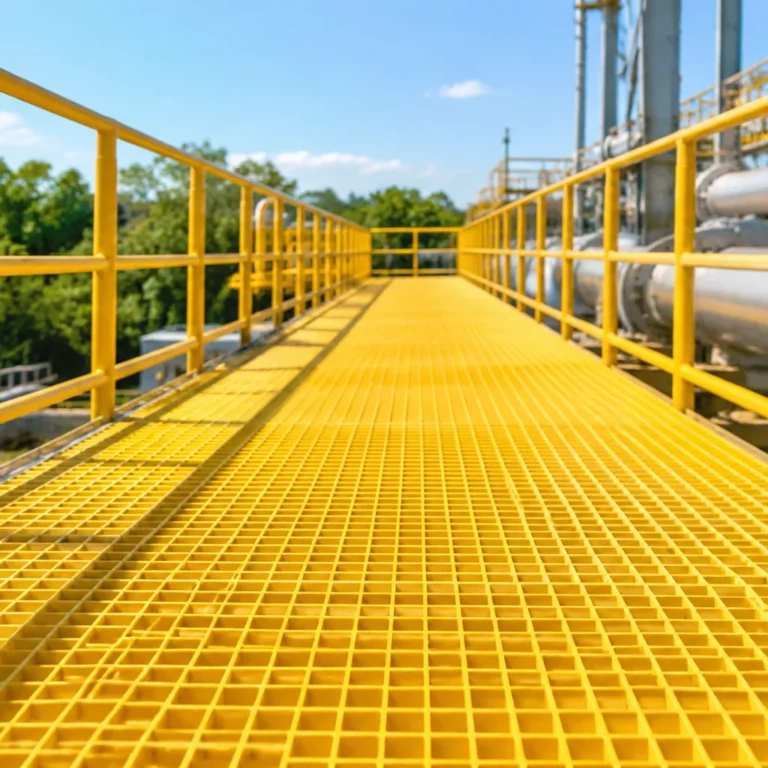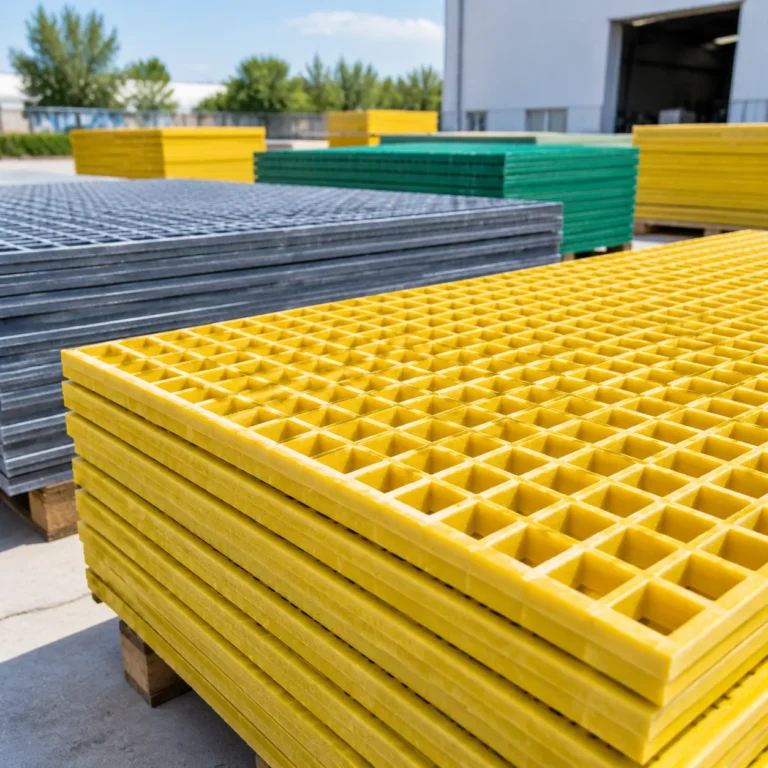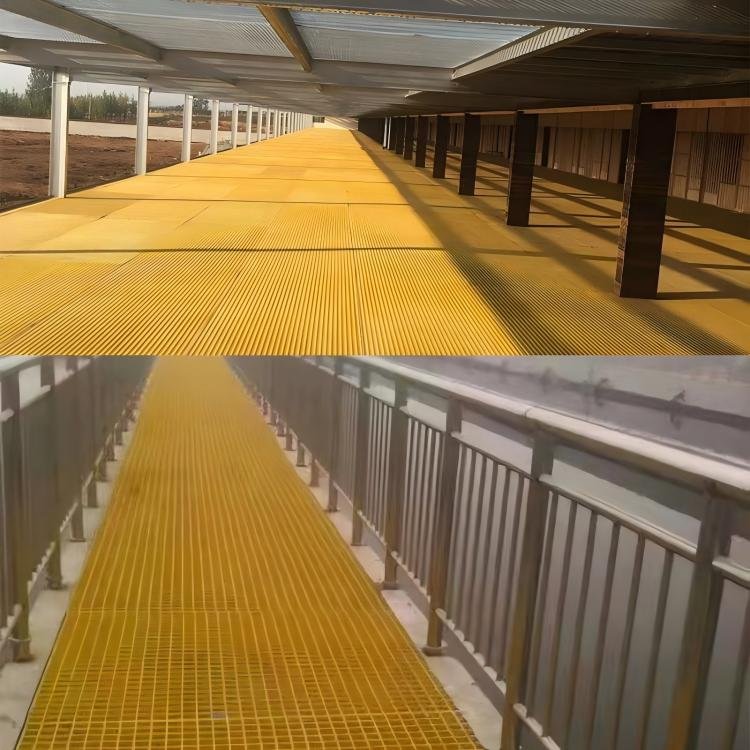
FRP Grating Stair Treads Types Sizes and Load Ratings
Are slick, corroding metal stairs creating a serious safety hazard at your facility?
Upgrading to fiberglass is a smart move—but picking the wrong specification can compromise your entire structure.
In this comprehensive guide, we break down everything you need to know about FRP Grating Stair Treads: Types, Sizes, Nosing Options and Load Notes. From molded vs. pultruded designs and standard spans to high-visibility nosing profiles and critical OSHA load capacities, you’ll get the exact engineering insights needed to build safer, longer-lasting stairs.
Let’s dive right in.
Overview of FRP Grating Stair Treads
What Are FRP Stair Treads?
FRP grating stair treads are high-performance industrial steps manufactured from fiberglass reinforced plastic. Engineered by combining high-strength continuous fiberglass rovings with premium thermosetting resins, these treads serve as a superior alternative to traditional carbon steel, galvanized iron, and aluminum steps.
Designed specifically for demanding industrial stair towers, access platforms, and vertical escape routes, our factory-direct FRP stair treads deliver exceptional structural load support while maintaining structural integrity in hostile environments.
Key Benefits and Material Advantages
Switching from conventional metal steps to fiberglass stair treads provides substantial operational and economic advantages across the entire facility life cycle:
- High Strength-to-Weight Ratio: One-third the weight of steel, significantly reducing overall dead load on stair towers while preserving high load-bearing capacity.
- Zero Maintenance Costs: Eliminates the need for ongoing sandblasting, galvanizing, or repainting, even in high-moisture settings.
- Electrical and Thermal Non-Conductivity: Outstanding dielectric properties provide essential passive safety around high-voltage equipment and electrical sub-stations.
- Impact Resilience: Absorbs point impacts without permanent deformation or structural failure, maintaining dimensional stability.
- Fast and Low-Cost Installation: Lightweight profiles can be transported, cut, and fastened with standard handheld tools without hot-work permits or welding.
| Performance Metric | FRP Stair Treads | Carbon / Galvanized Steel |
|---|---|---|
| Corrosion Resistance | Permanent (acids, alkalis, salts) | Requires frequent coating/galvanizing |
| Weight per Tread | Approx. 1/3 of steel | Heavy; requires structural lifting |
| Slip Hazard | Low (integral grit surface) | High when wet, oily, or iced |
| Electrical Hazard | Non-conductive | Highly conductive |
| Lifecycle Service Cost | Low / maintenance-free | High maintenance and recoating costs |
Corrosion and Slip Resistance Features
Industrial slip and fall accidents remain a leading workplace risk, especially in wet, oily, or marine environments. FRP grating stair treads eliminate these hazards through specialized material formulation:
- Targeted Resin Systems: Formulated using orthophthalic, isophthalic, or vinyl ester resin systems to provide comprehensive protection against aggressive acids, alkalis, organic solvents, and constant saltwater spray.
- Embedded Anti-Slip Grit Surface: Quartz or silicon carbide grit is bonded directly to the top walking matrix during manufacturing, creating a durable, slip-resistant surface that does not peel or wear thin under foot traffic.
- Open-Mesh Self-Draining Design: Standard open mesh geometry allows liquids, oils, chemicals, and industrial debris to drain through immediately, preventing liquid pooling and ice buildup on the step surface.
Common Types of FRP Grating Stair Treads
Selecting the right stair step comes down to your span distance, chemical environment, and impact requirements. At Leihong Fiberglass, we manufacture our industrial treads to deliver dependable safety across industrial facilities worldwide, utilizing both molding and pultrusion manufacturing lines.
Molded FRP Stair Treads
Our molded treads are produced by interlacing continuous fiberglass rovings placed in heated molds, thoroughly wetted with premium liquid resin. This process creates a single-piece mesh panel that provides identical bi-directional strength across both axes.
- Bi-directional Load Distribution: Handles multidirectional force easily, allowing field cuts around pipes, beams, and columns without compromising panel integrity.
- Superior Chemical Resistance: A high resin-to-glass ratio (roughly 65% resin to 35% glass) fully encases the glass fibers, shielding them against corrosive acids, alkalis, and saltwater.
- Integral Safety Nosing: Produced with an embedded solid leading edge and standard quartz-grit textures to form a durable, slip-resistant walking surface.
For operations prioritizing impact resistance and chemical splash defense, our molded fiberglass grating stair treads deliver reliable service with minimal maintenance overhead.
Pultruded FRP Stair Treads
When stairways require longer spans with minimal deflection, pultrusion is the preferred engineering choice. We pull continuous glass rovings and mats through heated steel dies, packing high structural glass content (up to 70%) into rigid I-bar or T-bar load-bearing shapes.
- Unidirectional Stiffness: High longitudinal stiffness supports greater distances between stringers with zero structural sag.
- High Strength-to-Weight Ratio: Significantly lighter than steel treads while delivering matching load support over extended spans.
- Targeted Foot Traffic Durability: Assembled with cross-rods and industrial adhesive, these pultruded stair treads withstand sustained, high-volume pedestrian traffic in transport hubs and factory access points.
Heavy-Duty and Covered Stair Treads
Certain plant environments require additional protection beyond standard open-mesh designs. We fabricate specialized profiles to address unique structural and drop-hazard challenges:
| Tread Configuration | Core Construction | Primary Function |
|---|---|---|
| Solid-Covered Treads | Open mesh base bonded with a 3mm to 5mm solid gritted plate | Prevents fluids, debris, or hand tools from dropping onto lower access levels; eliminates vertigo on elevated towers. |
| Heavy-Duty High-Load Treads | Deeper profile bars (up to 50mm) with increased wall thickness | Engineered for intensive point-loading, high-impact industrial loading docks, and heavy equipment access ways. |
Standard Sizes and Dimensional Specifications
We manufacture FRP grating stair treads to match industrial stair tower footprints, standard structural steel channel stringers, and offshore access frames. Choosing the right profile requires matching the panel depth, span length, and mesh pattern directly to your plant’s load requirements.
Common Thicknesses and Mesh Patterns
The structural depth of a stair tread directly determines its stiffness and deflection resistance over open spans. For most industrial walkways, a 1.5-inch (38 mm) depth provides the optimum balance between structural rigidity and panel weight.
| Thickness (Depth) | Standard Mesh Pattern | Grating Style | Typical Usage |
|---|---|---|---|
| 1.0 in (25 mm) | 1.5 in x 1.5 in (38 x 38 mm) Square | Molded Fiberglass Grating | Light pedestrian traffic, short spans (<24 in) |
| 1.5 in (38 mm) | 1.5 in x 1.5 in (38 x 38 mm) Square | Molded / Pultruded | Standard industrial stairs, chemical plants, refineries |
| 1.5 in (38 mm) | 1.0 in x 4.0 in (25 x 102 mm) Rectangular | Pultruded Stair Treads | High-span stairways, offshore drilling access |
| 2.0 in (50 mm) | 2.0 in x 2.0 in (50 x 50 mm) Square | Heavy-Duty Molded | Long open spans (>36 in), heavy equipment maintenance |
For complete panel dimensions across our industrial product line, consult our comprehensive FRP grating standard size reference table.
Standard Tread Depths and Span Lengths
Industrial stair layouts require standardized tread run depths and clear span widths to ensure safe step clearance and code adherence:
- Tread Run Depths: Available in standard widths of 8 in (203 mm), 9 in (228 mm), 10 in (254 mm), 11 in (279 mm), and 12 in (305 mm). These measurements allow full foot placement while integrating the slip-resistant front nosing edge.
- Clear Span Lengths: Standard fabricated step lengths include 24 in (610 mm), 30 in (762 mm), 36 in (914 mm), 42 in (1067 mm), and 48 in (1219 mm).
- Stair Stringer Support: We engineer each tread with a solid margin or dedicated landing zone on both ends for direct bolting to standard structural steel C-channels or FRP structural side stringers.
Custom Cutting and Panel Sizing
When your stair towers or platform retrofits deviate from nominal structural dimensions, we provide precision factory cutting directly from our manufacturing facility. You can explore our dedicated breakdown of FRP grating sizes and custom options to evaluate raw panel availability versus finished treads.
- Master Panel Supply: We ship bulk stair tread panels—such as 22.5 in x 120 in (571 x 3048 mm) or 24 in x 144 in (610 x 3658 mm)—fitted with continuous nosing bars along one or both edges. Fabricators can cut these down on-site to match custom run widths.
- Factory-Direct CNC Fabrication: Our workshop cuts steps to your exact engineer-specified tolerances, including custom radius curves, notch-outs for pipe penetrations, and pre-drilled stringer mounting holes.
- Cut-Edge Resin Sealing: Every tread we cut in our factory is re-sealed with a chemically compatible vinyl ester or isophthalic resin coat. This preserves raw glass fibers from ambient moisture absorption, saltwater ingress, and chemical attack.
Stair Nosing Options and Surface Finishes
The leading edge of a stair tread absorbs the heaviest foot traffic and presents the greatest slip hazard on any industrial staircase. For our FRP grating stair treads, we combine rugged structural nosing profiles with aggressive top finishes to guarantee reliable footing and high visibility across wet, oily, or chemical-exposed walkways.
High-Visibility Contrasting Nosing
Edge awareness is essential for industrial safety. Workers descending stairways need immediate, clear visual depth perception, particularly in low-light environments, offshore decks, or humid processing rooms.
- Molded Solid Safety Colors: We cast contrasting safety colors—most commonly high-visibility safety yellow or black—directly into the leading edge during the manufacturing process.
- Wear-Resistant Pigmentation: Because the color pigment is embedded throughout the resin matrix rather than painted on the surface, the visual boundary will not chip, peel, or rub away from continuous boot traffic.
- Code Compliance: Contrasting edges clearly mark the step boundary, helping your facility meet standard platform safety mandates and fall-prevention standards.
Integrated vs. Add-On Nosing Profiles
When designing or replacing stair systems, you can select between integral one-piece treads or separate retrofitted nosing caps based on your structural framework.
| Feature | Integrated Nosing | Add-On Nosing Profiles |
|---|---|---|
| Construction | Molded or pultruded as a continuous, solid part of the tread panel | Separate FRP angle or channel profile attached to existing steps |
| Mechanical Bond | 100% monolithic bond; eliminates the risk of loosening or edge detachment | Secured using structural adhesives and stainless steel mechanical fasteners |
| Primary Application | New industrial builds, modular stair towers, and complete structural replacements | Retrofitting worn steel, timber, or concrete stairs without replacing the base step |
| Edge Strength | Maximum load-bearing capacity along the critical front edge | Relies on the underlying step substrate for structural support |
| Service Life | Matches the full multi-decade lifespan of the grating panel | Requires periodic checks of mechanical fasteners or adhesive seams |
Gritted Anti-Slip Surface Textures
Smooth surfaces become hazardous when exposed to rainwater, chemical washdowns, lubricants, or process fluids. To provide reliable traction, we bond durable, coarse grit directly into the top resin surface of our stair treads and nosings.
- Quartz and Silicon Carbide Grit: Hard mineral aggregates are cured into the wet resin matrix during molding or secondary post-cure processing. This forms a rugged, slip-resistant surface that mechanically grips footwear.
- Aggressive Traction Ratings: Reviewing the proper anti-slip options for FRP grating helps match the grit density to your exact operational hazards, from standard pedestrian traffic to heavy petroleum or marine sludge exposure.
- Corrosion-Proof Durability: Unlike glued-on grip tapes that peel in moist or corrosive settings, our factory-bonded gritted finish resists chemical splash, saltwater washdowns, and UV degradation without losing its profile.
Load Capacity and Engineering Notes
Designing safe industrial access requires balancing clear span dimensions, structural deflection, and mechanical fastening. When engineering FRP grating stair treads: types, sizes, nosing options and load notes must align directly with operational weight limits and environmental conditions to maintain structural integrity.
Allowable Span and Deflection Standards
For pedestrian safety, stair treads must feel solid underfoot. We engineer our tread profiles to limit deflection under typical working loads to maintain worker confidence and structural compliance.
- Standard Deflection Limit: Recommended maximum deflection should not exceed L/200 (span divided by 200) or 0.25 inches (6.4 mm), whichever is less.
- Span Thresholds: Unsupported spans beyond standard dimensions require thicker structural panels or continuous intermediate support stringers to avoid excessive flexing.
- Manufacturing Assurance: We run end-to-end ISO 9001 load testing from raw roving selection to finished panels to guarantee consistent flexural modulus across every batch.
| Tread Type | Typical Thickness | Recommended Clear Span | Maximum Working Load |
|---|---|---|---|
| Molded Fiberglass Grating | 38 mm (1.5 in) | Up to 900 mm (36 in) | 2.2 kN concentrated point load |
| Pultruded Stair Treads (I-Bar) | 38 mm (1.5 in) | Up to 1050 mm (42 in) | 2.5 kN concentrated point load |
| Pultruded Stair Treads (T-Bar) | 50 mm (2.0 in) | Up to 1200 mm (48 in) | 3.0 kN concentrated point load |
Concentrated vs. Uniform Load Ratings
Stairway steps encounter forces differently than flat floor grating. While uniform loads matter, point loading at the leading edge dictates actual tread safety.
- Concentrated Point Load: Stair steps experience critical stress right at the nosing edge during footfall. Standard safety mandates require treads to handle a minimum 300 lb (1.33 kN) concentrated load placed directly on a 4-square-inch area at the outer edge with zero permanent deformation.
- Uniform Distributed Load (UDL): Industrial stair flights must accommodate uniform pedestrian capacity, typically engineered for minimums of 100 psf (4.8 kPa) to 200 psf for heavy transit corridors.
- Edge Reinforcement: Whether using molded profiles or high-strength pultruded stair treads, the front nosing incorporates targeted structural reinforcement to absorb repeated point impacts.
Installation and Fastening Requirements
Proper attachment is critical to ensure slip-resistant stair treads remain rigid and safe throughout years of continuous service.
- Hold-Down Hardware: Secure each tread using 316 stainless steel saddle clips or M-clips paired with matching bolts, lock washers, and neoprene isolators to handle vibration and chemical washdowns.
- Clip Placement: Install at least four hold-down clips per step—two at each side stringer angle—fastened firmly through the bearing bars.
- Support Ledger: Ensure each side rests on a structural angle or channel support of at least 1.5 inches (38 mm) bearing width.
- Long-Term Upkeep: Follow structured practices for the care and maintenance of FRP grating to check torque values, examine fastener integrity, and preserve safe operational performance in severe environments.
Industrial and Commercial Applications
We manufacture our stair treads to withstand the toughest operating conditions worldwide. From heavy chemical exposure to continuous saltwater spray, these steps replace failing steel and wood across high-consequence environments.
Chemical Processing and Water Treatment Plants
Corrosive airborne vapors, acidic splash, and continuous high-humidity washdowns quickly eat away at standard steel steps. In these settings, we supply treads built with premium vinyl ester and isophthalic resin systems to eliminate oxidation and structural degradation.
- Chemical processing facilities: Staircases around pickling lines, tank farms, and acid batching areas rely on corrosion-resistant FRP grating in chemical plant operations to guarantee long-term worker safety.
- Wastewater treatment plants: Aeration basins, clarifiers, and filtration towers constantly deal with moisture and hydrogen sulfide gas. Our molded fiberglass grating treads remain structurally sound without peeling, rusting, or needing routine recoating.
Marine and Offshore Platforms
Offshore environments demand components that resist aggressive saltwater exposure while maintaining exceptional grip during heavy weather.
- Docks, piers, and shipboard access: Constant wave wash and oil residues create severe slipping hazards. Integrated slip-resistant quartz grit surfaces maintain traction even when submerged or coated in brine.
- Offshore drilling rigs and platforms: Weight reduction is critical on offshore decks. Using high-strength pultruded stair treads significantly reduces structural dead load while matching the spanning capacity required for multi-tier platform access towers.
Commercial Walkways and Public Access Stairs
Outside of heavy processing, our stair systems protect pedestrian and maintenance personnel across broad commercial and public infrastructure.
- Cooling towers and rooftop crossovers: Lightweight construction makes installation fast in elevated, restricted-access areas without requiring heavy cranes or hot-work welding permits.
- Pedestrian walkways and bridges: High-visibility nosing profiles provide clear step edge contrast in low-light utility corridors across varied industrial facilities, eliminating trip hazards while keeping long-term maintenance costs near zero.
Selection Guide: Choosing the Right FRP Treads
Selecting the right FRP grating stair treads comes down to balancing chemical exposure, mechanical load, and structural spans. At our manufacturing facility, we match profile structures—whether high-impact molded fiberglass grating or high-span pultruded stair treads—directly to the demands of your facility layout.
Selecting the Proper Resin System
The resin matrix dictates how well your stair treads hold up against environmental exposure. We formulate our treads using three primary industrial resin grades:
- Orthophthalic Polyester: Best for standard industrial settings, basic platforms, and commercial assembly stairs exposed to minimal chemical vapors and moderate moisture.
- Isophthalic Polyester: Formulated for severe environments. This is the standard choice for wastewater treatment, marine splash zones, and moderate chemical production where long-term water and salt resistance are required.
- Vinyl Ester: Engineered for extreme industrial demands. Vinyl ester delivers superior resistance to aggressive acids, harsh alkalis, and continuous high-temperature chemical exposure.
Complying with OSHA and Building Codes
Industrial stairways must meet strict safety mandates regarding tread dimensions, load support, and visibility. We engineer each tread to help facilities maintain full regulatory compliance:
- Slip Resistance: OSHA standards require non-slip surfaces on all walking and working levels. Integrating FRP anti-skid grating with quartz grit textures ensures dependable traction even when oil, grease, or washdown fluids are present.
- Visual Safety Edging: Contrasting safety nosing—typically cast in high-visibility safety yellow—provides clear step-edge definition in dark, foggy, or poorly lit areas.
- Structural Deflection: Steps are designed to handle 300-pound concentrated point loads at the leading edge while keeping deflection well within standard building code limits.
Evaluating Long-Term Maintenance and Durability
Unlike carbon steel or galvanized stairs that rust, peel, and demand constant repainting, composite stair treads deliver a virtually zero-maintenance service life.
- Corrosion Resistance: Raw materials resist rust and chemical rot through the entire cross-section of the panel.
- Fast, Simple Installs: Lightweight panels reduce field-handling costs and mount securely to structural supports using standard 316 stainless steel saddle clips or perimeter FRP grating embed angles.
- Washdown Ready: Cleaning requires nothing more than high-pressure water or mild industrial detergents, lowering lifetime operational costs across heavy-duty facilities.