Hebei Leihong FRP Technology Co., Ltd.
FRP Scrubber Towers for Industrial Exhaust Treatment
Corrosion resistant fiberglass spray and wet scrubber towers configured around your exhaust flow, gas composition, treatment objective and installation space. Share your process data for a tailored equipment proposal.
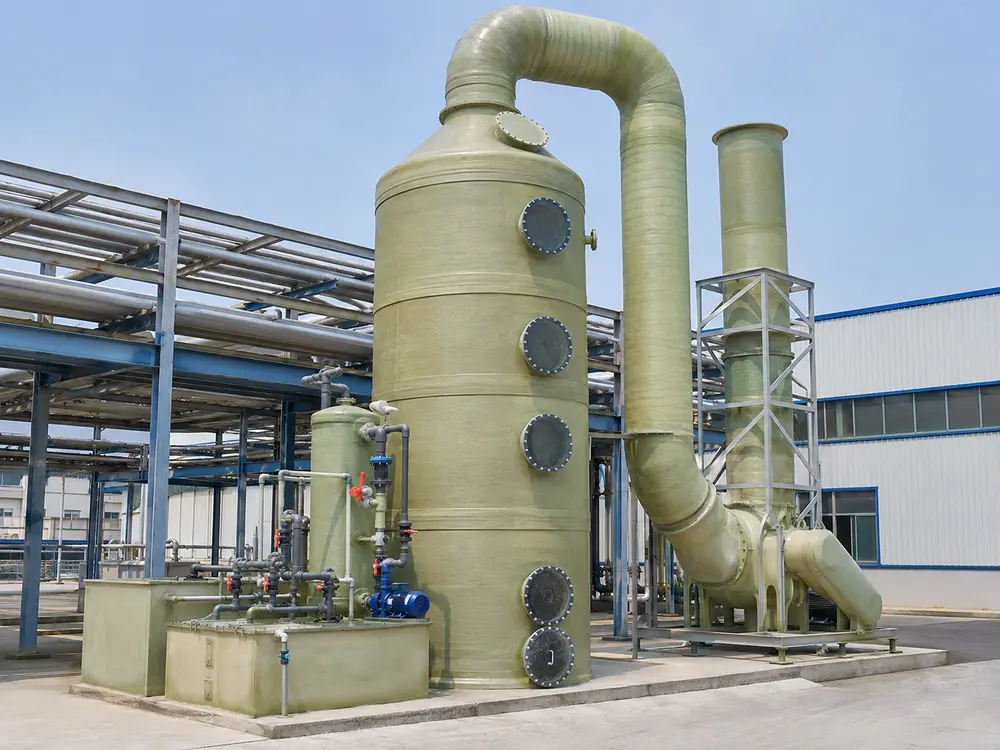
Equipment concept
Scrubber Configurations and Internal Flow
The vessel is one part of an engineered system. Gas capture, reagent chemistry, liquid recirculation, pressure drop and downstream treatment all affect performance.
Typical packed tower flow
- Cleaned gas outlet↑
- Mist eliminator↑
- Spray distribution↓
- Packing / contact bed↑
- Contaminated gas inlet↑
- Recirculation sump↻
Conceptual diagram; the actual flow arrangement depends on the approved design.
Packed Bed Scrubber
Provides a gas liquid contact surface for suitable soluble contaminants. Packing type, depth and liquid rate must be chosen for the actual chemistry and pressure drop.
Typical components: packing, spray headers, mist eliminator and recirculation system.
Swirl Plate Scrubber
Consider for selected particulate or mixed exhaust applications. Fouling and liquid carryover should be assessed against the gas stream and maintenance plan.
Typical components: contact stages, drainage and downstream demisting.
Horizontal Cross Flow Scrubber
An option where equipment height is limited. Duct routing, drainage, contact area and access for cleaning require design review.
Typical components: contact zone, spray distribution and mist elimination.
Material selection
Why Choose FRP for a Wet Scrubber?
Material selection depends on the actual gases, wash liquor, temperatures and outdoor environment. The complete vessel and internals must be specified together.
Resin options
Choose a compatible formulation for the process fluid and vapor.
Lightweight vessel
Handling and support design can benefit from lower material weight.
Custom construction
Inlets, manways and internals can be located to match the process layout.
Maintenance access
Plan packing removal, nozzle cleaning and instrument access.
| Consideration | FRP | 304 / 316L stainless steel | PP | Lined carbon steel |
|---|---|---|---|---|
| Chemical exposure | Resin specific | Alloy and medium specific | Grade and temperature specific | Liner integrity dependent |
| Structure | Engineered laminate and supports | Metal structural design | Temperature dependent stiffness | Metal shell plus liner |
| Outdoor use | Specify UV protection | Grade dependent | Specify UV protection | Coating and liner upkeep |
| Maintenance | Inspect liner and connections | Inspect corrosion | Inspect joints and supports | Inspect coating and liner |
No single material is universally resistant to HF, oxidizers, concentrated acids or solvents. Confirm compatibility and operating limits from the actual product formulation and process design. Removal efficiency and fire classification are project specific test results.
Applications
Industrial Exhaust and Odor Control Applications
Wet scrubbing is suitable for some contaminants and process conditions. A detailed gas analysis is required before selecting absorbent chemistry, stages and emissions targets.
Acid and Alkali Vapors
Review gas composition, concentrations and reagent needs for soluble inorganic vapors.
Discuss this exhaust →Etching & Process Exhaust
Assess mixed acids and specialist gases individually, including materials and safety controls.
Discuss this exhaust →Plating & Pickling Mist
Capture and wash selected mists with an appropriately engineered ventilation and scrubber system.
Discuss this exhaust →Process Fume Pretreatment
Review particulate loading, gas temperature and any upstream cooling requirement.
Discuss this exhaust →Odor Control Systems
Evaluate odor constituents and whether chemical washing, biological treatment or multiple stages are appropriate.
Discuss this exhaust →Washable Mist Components
Consider wet collection for suitable particulates and soluble compounds; many VOCs need other treatment technologies.
Discuss this exhaust →Technical RFQ
Specify the Gas Stream Before Sizing a Scrubber
Airflow alone cannot determine tower diameter, height, pump duty or removal efficiency. Share these inputs for a useful equipment proposal.
| Parameter | Information needed |
|---|---|
| Airflow | Normal, minimum and peak flow in m³/h, with reference conditions |
| Gas composition | Contaminants, inlet concentrations, moisture and particulate loading |
| Treatment target | Outlet limits, required removal and measurement method |
| Operating conditions | Temperature, pressure, daily run time and variability |
| Available utilities | Water quality, reagents, power, blowdown treatment and controls |
| Site geometry | Height, footprint, duct route, wind/seismic basis and maintenance access |
Tower dimensions, process stages, materials and package scope are quoted after engineering review. A typical model table cannot safely replace gas stream data.
Production & quality
Inspection Planned Around the Approved Design
Confirm the manufacturing method and acceptance checks for the specific tower. Vessel leak testing, flange fit and internal assembly should follow the agreed specification.
Materials & liner
Review selected resin, reinforcement and interior surface requirements.
Structural shell
Fabricate and check dimensions against the approved drawings and support design.
Internal components
Verify spray, packing supports, demister access, nozzles and connections.
Final inspection
Agree dimensional, visual and leak checks with the documentation needed at dispatch.
FAQ
FRP Wet Scrubber Selection Questions
How are airflow and tower diameter selected?
Start with measured normal and peak gas flows, contaminant loading, temperature and the required outlet limit. Gas velocity, pressure drop, packing and liquid rate are then evaluated as one process design.
What if the exhaust contains HF or oxidizing compounds?
These conditions require a specialist materials and process review. Provide detailed composition and concentrations; do not assume a standard fiberglass liner or resin is compatible.
How can nozzle clogging or packing fouling be managed?
Plan liquid filtration, accessible spray headers, suitable nozzles, blowdown and a cleaning schedule according to the circulating liquid chemistry.
Can a large tower be shipped in sections?
Discuss transport limits, flange design, lifting points and on site access during design. Feasibility and leak testing of the joints must be confirmed for the selected configuration.
Request a quotation
Tell Us About Your FRP Scrubber Project
Share the exhaust composition, airflow, inlet concentration and target emissions. Hebei Leihong FRP Technology Co., Ltd. can review the equipment configuration and clarify the proposed supply scope.
- Gas type and inlet concentration
- Normal and peak airflow
- Site constraints and required outlet limit