Pultruded FRP Grating Features Types and Applications
What is Pultruded FRP Grating?
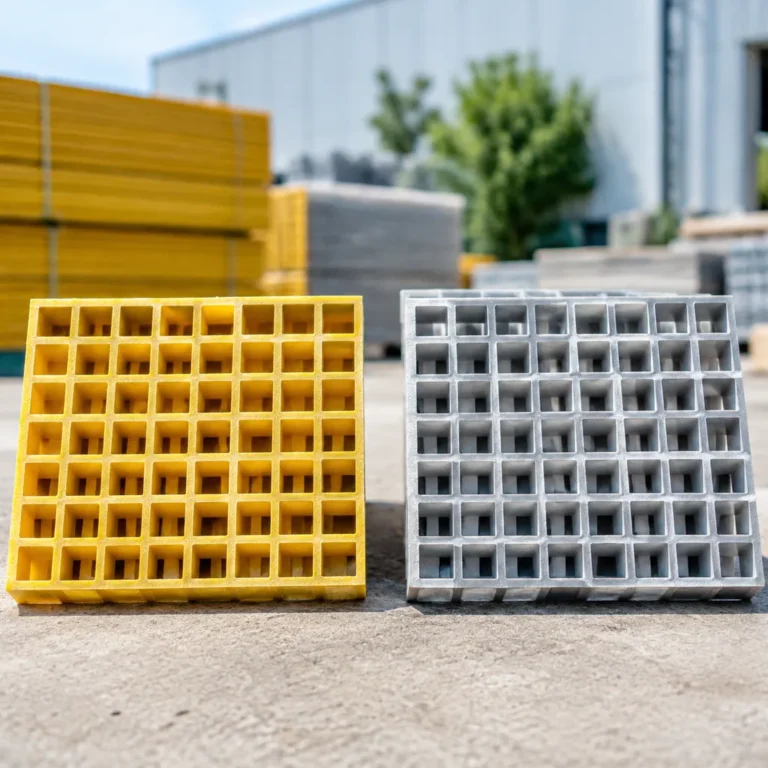
Pultruded FRP grating (Fiberglass Reinforced Plastic) is a high-performance, structural composite panel engineered for heavy-duty industrial platforms, walkways, and trench covers. Formed by assembling continuous pultruded profiles with interlocking cross-rods, this grating delivers exceptional unidirectional strength, structural stiffness, and long-term durability in demanding industrial environments.
Manufacturing Process and Structure
The pultrusion process is a continuous manufacturing method that guarantees consistent structural integrity and high mechanical performance:
- Continuous Fiber Reinforcement: High-strength glass fiber rovings and continuous strand mats provide dense structural reinforcement.
- Resin Bath Impregnation: The glass fibers are thoroughly pulled through a liquid thermosetting resin matrix formulated for specific chemical and thermal demands.
- Headed Die Curing: Saturated reinforcements pass through heated steel dies where the profile undergoes polymerization, hardening into exact geometric shapes.
- Mechanical Assembly: Precision-formed bearing bars (such as I-bar or T-bar shapes) are mechanically locked and bonded with perpendicular cross-rods to form rigid panels with a high glass-to-resin ratio.
Pultruded vs. Molded Fiberglass Grating
While both are composite solutions, their structural behavior and layout serve distinct engineering needs:
| Feature | Pultruded FRP Grating | Molded FRP Grating |
|---|---|---|
| Fiber Orientation | Unidirectional (aligned along the bearing bars) | Bidirectional (interwoven continuous strands) |
| Glass Content | High (~65% to 70% glass fiber) | Moderate (~30% to 35% glass fiber) |
| Span Capability | Exceptional; ideal for long spans with minimal deflection | Standard; best for shorter spans and multi-directional support |
| Primary Strength | Superior longitudinal tensile strength and stiffness | Uniform load distribution in both directions |
Pultruded FRP vs. Traditional Steel and Wood
Pultruded fiberglass grating outperforms conventional building materials across demanding operational settings:
- Compared to Steel:
- Delivers a high strength-to-weight ratio—up to 70% lighter than steel, significantly reducing structural dead loads and transport costs.
- Offers total corrosion resistance with zero rusting, peeling, or need for continuous repainting.
- Completely non-conductive both thermally and electrically, enhancing personnel safety around high-voltage equipment.
- Compared to Wood:
- Does not rot, splinter, warp, or degrade when exposed to moisture and industrial washdowns.
- Resists biological growth, harsh chemicals, and UV weathering over decades of service.
Key Features and Advantages of Pultruded FRP Grating
In demanding industrial environments, our pultruded FRP grating stands out as a reliable, high-performance alternative to traditional structural materials. By combining continuous glass fiber roving with formulated thermosetting resin systems, we manufacture grating panels that consistently outperform conventional steel in harsh working conditions.
| Performance Factor | Pultruded FRP Grating | Carbon / Galvanized Steel |
|---|---|---|
| Weight | Approx. 1/3 to 1/4 the weight of steel | Heavy; requires lifting machinery |
| Corrosion Resistance | Immune to rust, saltwater, and acids | Prone to oxidation and rust streaks |
| Conductivity | Non-conductive (electrically & thermally safe) | Highly conductive |
| Maintenance | Virtually maintenance-free (no recoating) | Requires periodic repainting/galvanizing |
High Strength-to-Weight Ratio
Pultruded panels feature an exceptionally high ratio of glass fiber reinforcements (up to 65–70% glass content), running unidirectionally along the bearing bars. This fiber-dense structure delivers:
- Exceptional Load Capacity: Supports heavy static and dynamic loads over longer spans without excessive deflection.
- Lightweight Handling: Weighs a fraction of structural steel, cutting transportation freight costs significantly.
- Rapid Installation: Panels can be carried and maneuvered manually on-site, eliminating the need for heavy crane rentals.
Superior Corrosion and Chemical Resistance
Unlike metal grating that oxidizes or wood that rots in humid environments, our pultruded fiberglass components provide thorough protection against aggressive chemical exposure:
- Broad Chemical Resistance: Resists continuous contact with acids, alkalis, harsh bleaches, and industrial solvents.
- Marine & Moisture Proof: Completely immune to saltwater corrosion, continuous splash zones, and high-humidity ambient air.
- UV Degradation Resistance: Integrated synthetic surface veils protect the inner structural fibers from ultraviolet degradation and weathering.
Enhanced Safety with Slip-Resistant Surfaces
Industrial facility safety relies on dependable walking surfaces under wet, oily, or icy conditions. Pultruded grating directly addresses workplace hazards through engineered safety features:
- Permanent Anti-Slip Grit: Quartz gritted top surfaces offer reliable traction underfoot, significantly reducing slip-and-fall incidents.
- Meniscus / Concave Finish: An economical anti-slip profile formed naturally during resin curing.
- Electrical & Thermal Insulation: High dielectric strength protects maintenance personnel working in sub-stations and high-voltage areas.
- Non-Sparking: Safe for flammable, explosive, or petrochemical operational zones.
Low Maintenance and Long Service Life
Evaluating the comprehensive FRP grating advantages and performance life reveals an exceptionally low total cost of ownership (TCO):
- Zero Painting or Sandblasting: Pigments are dispersed uniformly throughout the resin matrix during pultrusion, ensuring permanent color throughout the panel depth.
- Structural Integrity Over Decades: No swelling, warping, chipping, or rust-jacking over decades of continuous service.
- Minimal Downtime: Simple washdowns are all that is required to keep walkways and drainage trenches clean and fully operational.
Types and Material Options for Pultruded FRP Grating
We engineer pultruded FRP grating with multiple material formulations and structural profiles to match exact project specifications. Selecting the right combination of resin matrix, bearing bar shape, and surface texture ensures optimal structural capacity and long-term durability in aggressive operating environments.
Resin System Options (Isophthalic, Vinyl Ester, Phenolic)
The resin matrix binds the continuous glass fiber reinforcements together and determines the chemical, thermal, and fire-resistant performance of the grating panels.
| Resin Type | Corrosion Resistance | Thermal & Fire Performance | Typical Applications |
|---|---|---|---|
| Orthophthalic | Moderate / Standard | General fire retardance | Light industrial walkways, assembly lines, and dry packaging areas |
| Isophthalic (ISO) | High resistance to acids and moisture | Class 1 flame spread rating | Water and wastewater facilities, municipal plants, and plating shops |
| Vinyl Ester (VE) | Superior resistance to severe acids and alkalis | High thermal stability and flame retardance | Chemical processing, petrochemical refineries, and offshore marine rigs |
| Phenolic | High chemical resistance | Maximum fire retardance and ultra-low smoke toxicity | Offshore oil platforms, tunnels, enclosed vessels, and escape routes |
Bar Profiles and Mesh Styles
Pultruded grating utilizes continuous pull-extrusion bearing bars assembled with mechanical cross-lock rods to achieve high longitudinal stiffness:
- I-Bar Profiles: Engineered with an I-beam cross-section that maximizes the high strength-to-weight ratio. I-bars are the industry standard for industrial walkways, platforms, and stair treads where structural efficiency and reduced weight are essential.
- T-Bar Profiles: Feature a wider, flat top surface that provides greater contact area. T-bars are ideal for barefoot marine docks, pedestrian access paths, and rolling cart traffic.
- Open Area Ratios: Available in standard configurations ranging from 40% to 60% open area to balance fluid drainage, ventilation, and light transmission with load-bearing contact.
High Load Capacity (HL Capacity) Options
For heavy-duty applications requiring extended spans or vehicular traffic support, high-load pultruded profiles utilize deeper, thicker bearing bars and denser cross-rod tie systems. These heavy-duty configurations support forklifts, maintenance trucks, and heavy industrial machinery without excessive deflection, serving as an effective non-conductive and rust-proof alternative to heavy steel bar grating.
Surface Finish and Anti-Slip Options
To prevent workplace slip-and-fall hazards in oily, wet, or icy conditions, we offer multiple surface treatments:
- Quartz Gritted Top: Coarse silica grit bonded directly to the top bar surfaces to deliver maximum slip resistant traction in heavy oil and chemical splash zones.
- Concave (Meniscus) Top: A natural recessed groove along the bar surface that provides reliable traction without abrasive coatings.
- Smooth Top: A clean, ungritted surface suited for architectural screening, wash-down storage areas, or non-pedestrian racking.
- Solid Covered Top: A pultruded panel laminated with a solid fiberglass top plate, forming durable FRP covers designed to prevent tools from falling through, control chemical odors, and contain hazardous vapor emissions.
Common Applications and Industries
Pultruded FRP grating provides an ideal structural flooring solution for environments where traditional steel, aluminum, and timber quickly deteriorate. Thanks to its unidirectional strength, corrosion resistance, and anti-slip profiles, our pultruded fiberglass grating delivers long-term reliability across demanding global industrial sectors.
Chemical Processing and Wastewater Treatment
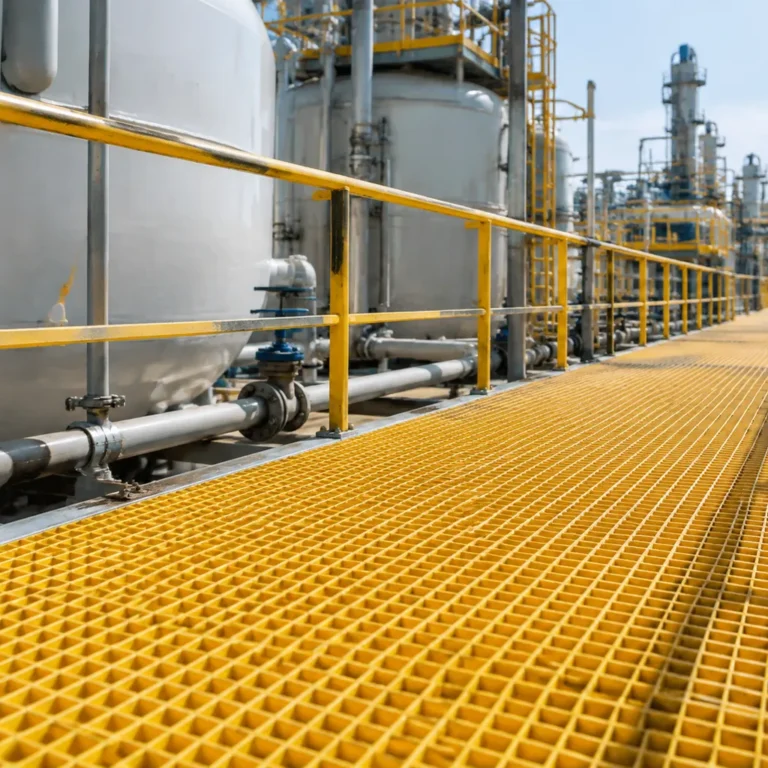
Aggressive chemicals, continuous moisture, and caustic fumes create severe hazards for conventional metallic walkways. We manufacture pultruded FRP panels with specialized isophthalic and vinyl ester resin systems to withstand:
- Acid and alkali washdown areas in chemical manufacturing plants.
- Flocculation tanks, clarifiers, and sludge processing platforms in municipal wastewater treatment facilities.
- Trench covers and drainage channels exposed to continuous chemical runoff.
Marine Dry Docks, Harbors, and Offshore Structures
Constant exposure to saltwater and high humidity leads to rapid rust and structural failure in carbon steel. Our marine-grade pultruded grating resists saltwater corrosion effortlessly:
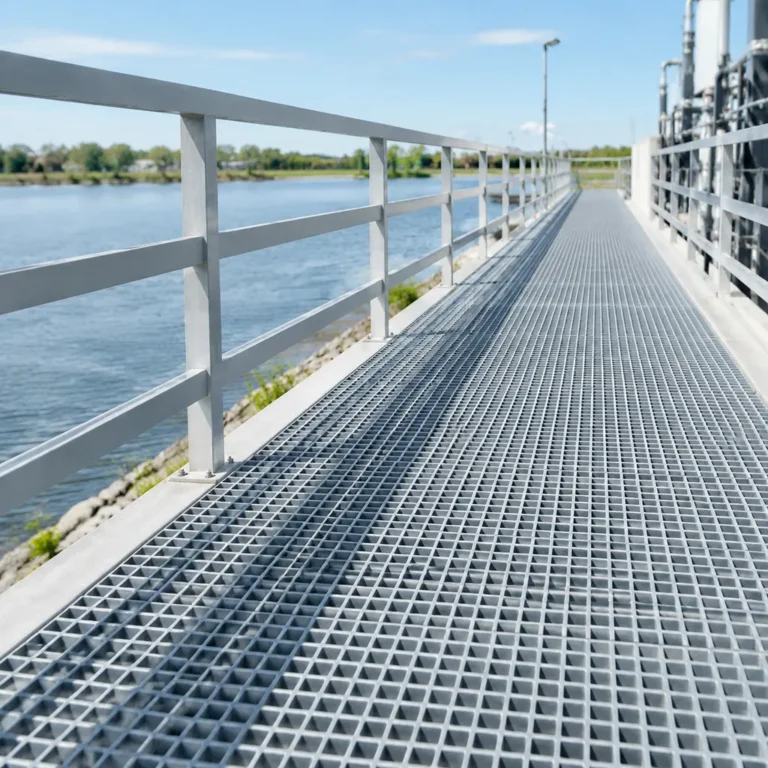
- Piers, boardwalks, and boat docks: Gritted tops maintain traction even when submerged or wet.
- Offshore oil rigs and drilling decks: High strength-to-weight ratio reduces overall top-side deadweight.
- Shipbuilding and dry docks: Resists marine growth and requires zero protective recoating or cathodic protection.
Power Plants and Oil & Gas Facilities
Safety and electrical isolation are critical in energy generation and refining operations. Because composite grating is inherently non-conductive and non-sparking, it prevents accidental electrical hazards and ignition risks:
- High-voltage substations and transformer platforms: Eliminates electrical conductivity hazards for plant personnel.
- Battery storage rooms and control rooms: Resists acid spills while providing clean, insulated subflooring.
- Refinery process units: Fire-retardant formulations ensure critical structural integrity under extreme operating temperatures.
Industrial Walkways, Platforms, and Stair Treads
For expansive factory floors, elevated conveyor walkways, and maintenance catwalks, pultruded I-bar and T-bar panels deliver maximum structural support over wide spans. Facilities choosing our industrial FRP grating solutions benefit from quick manual installation without heavy crane equipment, zero welding on-site, and dependable slip-resistant surfaces that protect workers in high-traffic zones.
How to Select and Order the Right Pultruded FRP Grating
Selecting the ideal pultruded FRP grating for your project requires matching your structural load needs with the surrounding operating environment. Because pultruded profiles carry high unidirectional strength along the bearing bars, pinpointing your exact span dimensions and chemical exposures ensures optimal safety, long-term durability, and cost-efficiency.
Determining Load, Span, and Dimension Requirements
The primary structural considerations are the unsupported span length and the type of load the panels will support. We design our bearing bar profiles to maintain high stiffness and minimal deflection across varying structural widths.
- Span Distance: Measure the clear distance between support beams. Longer spans generally require deeper I-bar or heavy-duty cross-sectional profiles.
- Loading Type: Distinguish between uniform pedestrian foot traffic and concentrated point loads or rolling equipment.
- Open Area Percentage: Choose the spacing between bars based on drainage, ventilation, and light-penetration requirements versus debris-blocking needs.
| Application Type | Recommended Bar Profile | Primary Advantage |
|---|---|---|
| Standard Walkways & Platforms | Standard I-Bar | Maximum strength-to-weight ratio, easy handling |
| Pedestrian & Trench Covers | T-Bar Profile | Flatter walking surface, comfortable foot traffic |
| Heavy Industrial & High Traffic | Heavy-Duty / High-Load Bar | Superior load capacity over extended spans |
Assessing Environmental and Working Conditions
Operating conditions determine the choice of resin matrix and surface treatment. Selecting the right combination guarantees maximum corrosion resistance and workplace safety.
- Resin Matrix Selection:
- Orthophthalic Resin: Ideal for standard industrial and commercial settings with mild chemical exposure.
- Isophthalic Polyester: Best for water, wastewater treatment, and moderate chemical splash zones.
- Vinyl Ester Resin: Essential for severe chemical plants, acidic/alkaline environments, and aggressive marine applications.
- Phenolic Resin: Specified where maximum fire resistance and low smoke generation are strictly required.
- Surface Finish: Select quartz-gritted tops for maximum slip resistance in wet, oily, or icy environments, concave surfaces for self-draining traction, or solid covered tops when complete odor containment and fluid containment are needed.
Choosing Custom Fabrication and Fastener Accessories
We supply custom-cut panels and specialized hardware to streamline on-site assembly and guarantee structural hold.
- Custom Sizing & Colors: Panels can be precision-cut at our factory to your structural drawings. Standard color options include safety yellow, industrial grey, and green, with custom RAL matching available for high-volume orders.
- Clip Assemblies: Secure installation requires compatible hardware. We provide marine-grade stainless steel hold-down clips (such as M-clips and saddle clips) engineered to prevent panel shifting under active loads.
- Inquiry & Sourcing: To receive technical load tables and a tailored quote, supply your panel dimensions, preferred resin system, bar profile, and quantity requirements.