FRP Odor Control Covers for Wastewater Tanks Design Guide
Odor Control Covers for Wastewater Tanks: FRP Design and Specification Guide
Odor control covers are engineered enclosures fitted over wastewater tanks, channels and process basins to contain odorous air and direct it to an extraction and treatment system. FRP (fiberglass reinforced plastic) is one material option for these covers, with resin systems and structural designs selected to suit chemical exposure, tank geometry and maintenance needs.
A cover contains emissions; the connected treatment system removes or reduces the captured odor compounds. Effective performance depends on panel joints, access hatches, penetrations, controlled air intake and correctly designed extraction.
This guide explains cover materials, panel configurations, span and load requirements, sealing, treatment connections and retrofit considerations. For product options and custom manufacturing enquiries, explore our FRP odor control covers for wastewater tanks.
Why Wastewater Tanks Are Covered: Odor, Corrosion, Safety
Whether a basin needs covering depends on its emissions, process conditions, local requirements and site risk assessment. A properly specified cover and extraction system can address odor containment, corrosion exposure and operational access.
1. Odor and Emissions Abatement
Wastewater processes generate foul air rich in nuisance compounds and hazardous pollutants. Enclosing process basins establishes an containment boundary for effective vapor containment.
- Hydrogen Sulfide Containment: Helps capture air containing H₂S for extraction and treatment; containment performance depends on seals, airflow and operating conditions.
- VOC Capture: Seals in volatile organic compounds and hazardous air pollutants (HAPs) for controlled routing to scrubbers, biofilters, or carbon adsorption units.
- Regulatory Compliance: Supports an emissions-control strategy; compliance must be assessed against applicable local limits and verified system performance.
2. Infrastructure and Asset Protection
The humid, gaseous headspaces above open tanks create an intensely destructive microclimate.
- Acidic Condensation: Gaseous hydrogen sulfide converts into sulfuric acid via bacterial action, causing biogenic sulfide corrosion on concrete tank walls, steel walkways, and nearby mechanical drives.
- Targeted Vapor Extraction: Enclosing the surface area limits the corrosive footprint. Capturing off-gases at the water line prevents plant-wide corrosion, extending the service life of peripheral machinery, instrumentation, and structural steel.
3. Personnel Safety and Process Stability
Tank covers deliver substantial operational benefits beyond environmental compliance:
- Fall Protection: Load-rated covers can form part of a fall-protection strategy. Hatches, openings, guardrails and access procedures still require a site-specific safety assessment.
- Hazardous Exposure Reduction: Minimizes operator exposure to pathogenic aerosols, bioaerosols, and carcinogenic off-gases.
- Algae and Debris Prevention: Reducing light and debris entry may help process operation. Rainwater exclusion depends on the cover slope, drainage and sealing details.
Cover types compared: FRP, aluminium, fabric and geomembrane
Selecting the right containment cover for a wastewater treatment plant comes down to balancing structural life, chemical exposure, and operational access. While multiple materials exist on the market, their performance under heavy vapor containment varies significantly.
| Cover Material | Service Life | Corrosion Resistance | Walkability / Structural | Upfront Cost | Maintenance Needs |
|---|---|---|---|---|---|
| Fiberglass Reinforced Plastic (FRP) | Project-specific | Depends on resin, laminate and exposure | High (Engineered walk-on panels) | Moderate | Very Low |
| Aluminum | Project-specific | Check alloy and acidic condensate compatibility | High (Geodesic domes, trusses) | High | Moderate (Joint corrosion) |
| Fabric (Coated Tensioned) | Project-specific | Check coating and vapor compatibility | None (Requires removal for tank access) | Low | High (Re-tensioning, tears) |
| Geomembrane (Floating/Tensioned) | Project-specific | Check membrane and seam compatibility | Limited to non-walkable | Low to Moderate | Moderate (Sludge buildup, puncture risk) |
- FRP Covers: An option for corrosive wastewater environments when the resin and laminate are compatible with the actual exposure. Chemical resistance and electrical properties require confirmation for the specified construction.
- Aluminum Covers: Used for engineered tank-cover structures; alloy, coatings, fasteners and condensate chemistry must be assessed together.
- Fabric & Geomembrane: Budget-friendly options for basic bio-solids or equalization basins, but they lack structural rigidity, cannot support maintenance pedestrian traffic, and suffer from UV and mechanical wear.
Panel configurations: flat, domed and arched
We design modular cover systems in three core geometries to match specific tank dynamics and headroom constraints:
- Flat Covers: Can reduce enclosed headspace, although required extraction flow also depends on gas generation, process air and containment requirements. Ideal for rectangular channels, grit chambers, and aeration basins.
- Domed Covers: Circular, self-supporting designs engineered for trickling filters and digester covers. Curvature can add stiffness, but snow loading and the need for intermediate supports require structural verification. Digester applications also require separate gas-pressure and process-safety assessment.
- Arched (Low-Profile) Covers: Balance rainwater runoff with controlled interior vapor volume. The arch adds structural stiffness to span medium-sized spans while remaining cost-effective.
Span, load rating and walk-on access
Cover structural integrity must meet strict live and dead load specifications to keep plant personnel safe. The project design must define dead load, maintenance loads, wind uplift, snow, seismic actions where applicable, and internal pressure or vacuum. Do not assume every FRP cover is walkable.
- Span Capability: Allowable span depends on geometry, laminate, supports, loading and deflection criteria. Wider spans may require engineered beams or intermediate supports; confirm these in project drawings and calculations.
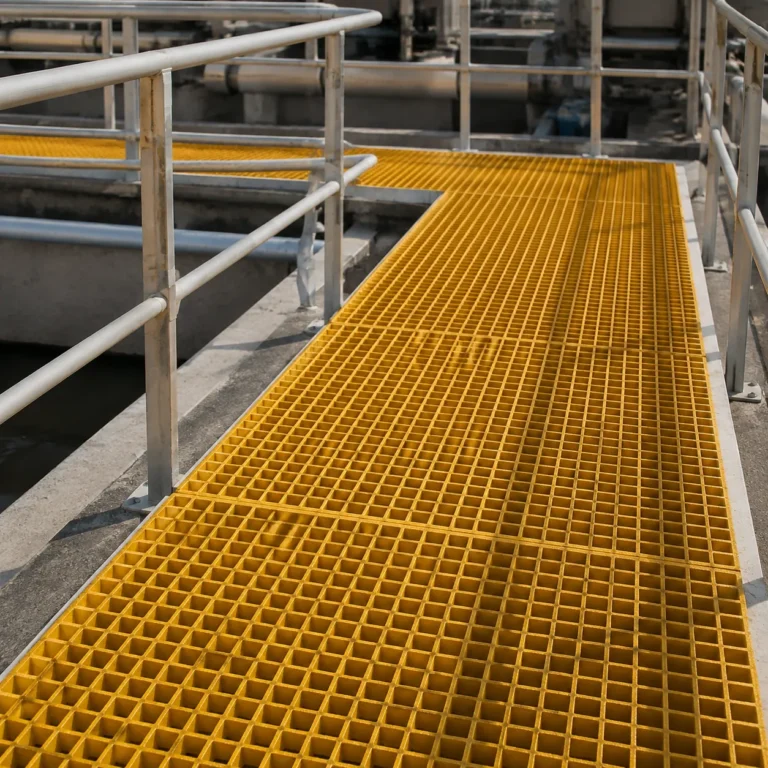
- Walk-On Safety: Walkable panels feature molded anti-skid grit tops to prevent slips in wet, greasy environments. For areas requiring continuous traffic alongside drainage, integrated sections of corrosion-resistant FRP grating panels provide safe, non-conductive platforms.
- Deflection Limits: Specify project-appropriate deflection limits, drainage slopes and ponding checks. Confirm both strength and serviceability before approving walk-on access.
Hatches, vents, sealing and chemical resistance
Containment is only as reliable as its seals and access penetrations. An effective odor cover system limits leakage through carefully detailed interfaces:
- Resin Selection: Built with premium isophthalic polyester or vinyl ester resin systems to stop chemical degradation caused by severe H₂S vapor, sulfuric acid condensation, and caustic washdowns.
- Vapor-Tight Gasketing: Closed-cell neoprene or EPDM elastomeric gaskets along all perimeter edges and modular tongue-and-groove joints help limit leakage under the specified operating pressure; gasket compatibility and compression require verification.
- Hatches & Ports: Quick-opening, hinged inspection hatches with stainless steel 316 hardware allow easy sampling, instrument reading, and mixer maintenance without pulling full structural panels.
- Penetrations & Vents: Factory-installed flanged connections integrate directly with foul air ductwork and pressure/vacuum relief valves to ensure balanced air movement throughout the plant.
Connecting covers to odor treatment
Putting a cover on a tank is only half the job. Without proper integration into an active extraction setup, pressurized headspace pushes foul air through any available seam. When we engineer FRP covers for a modern wastewater treatment plant, we configure the panels to operate seamlessly with wet scrubbers, biofilters, or activated carbon systems.
For a wet-scrubbing treatment stage, review our FRP scrubber towers for captured wastewater odors. Select treatment technology from the gas composition, concentration, flow, discharge target and operating requirements; a scrubber is not automatically suitable for every odor stream.
Designing for negative pressure
Effective vapor containment relies on continuous, slight negative pressure under the deck. This pressure differential ensures that ambient air pulls inward through maintenance interfaces rather than letting corrosive gases escape into the facility.
- Target draft settings: Specify operating negative pressure with the ventilation designer, based on leakage, process conditions and the cover’s allowable pressure and vacuum. Verify it during commissioning.
- Reduced air exchange rates: Well-sealed panels can reduce uncontrolled air ingress, but airflow must be calculated from gas generation, process air, tank geometry, occupational exposure and treatment requirements. Do not size extraction solely from a generic air-change rate.
- Hydrogen sulfide containment: Capturing H₂S-bearing air at source can reduce fugitive emissions when extraction and treatment operate effectively. Enclosed headspaces may remain highly corrosive and hazardous.
Duct connections and makeup air management
Connecting extraction ductwork to composite panels requires careful mechanical detailing to isolate vibration and handle dynamic process loads.
| Feature | Engineering Requirement | Operational Benefit |
|---|---|---|
| Molded Flanged Nozzles | Heavy-duty FRP stubs laminated integrally to structural panel profiles | Provides a defined duct interface; laminate reinforcement, chemical compatibility and external duct support must be verified. |
| Vacuum Relief Valves | Pressure/vacuum protection selected and set for the cover design limits and process transients | Protects panels from structural deflection during high-rate liquid drawdown or blower surges. |
| Intake Louvers | Low-profile, insect-screened makeup ports located opposite suction headers | Directs a sweeping cross-draft over the water surface to pull stagnant dead zones clean. |
Duct extraction points are best located along the tank perimeter or above turbulent drop structures where gas release peaks. Balancing these pickup points creates uniform air velocity across the liquid, moving all captured gases straight into treatment without lingering odors on site.
Retrofit and new-build options
Installing FRP odor control covers requires a different engineering approach depending on whether you are upgrading an active basin or designing a greenfield facility. We engineer modular cover systems to match both scenarios, ensuring seamless vapor containment without compromising plant operations.
Upgrading existing tanks (Retrofit projects)
Most retrofits involve aging concrete or steel tanks that cannot handle excessive perimeter loads. When retrofitting clarifier covers or equalization basins, we prioritize lightweight construction and rapid field assembly to minimize plant downtime.
- Handling out-of-round basins: Older concrete structures often settle unevenly. We use adjustable perimeter flashing and field-trimmable panels to compensate for irregular tank walls.
- Alternative support framing: If existing walls cannot carry the calculated reactions, assess independent framing or new foundations. A clear-span cover still transfers loads to its supports; verify the complete load path.
- Live plant installation: Modular panels can be lowered into place in sections, which may help stage installation. Continued operation depends on lifting access, gas exposure, isolation requirements and the approved site work plan.
Designing for new wastewater treatment plant installations
New-build projects give us complete design freedom to optimize both the cover profile and the tank integration from day one.
- Cast-in anchor systems: Embedded anchor channels can be cast directly into concrete tank copings, streamlining installation and creating a reliable seal.
- Optimized air extraction: We position foul air take-off ports, sample hatches, and mixer penetrations during factory fabrication, cutting down on-site adjustments.
- Integrated access planning: Span profiles, maintenance walkways, and structural supports are modeled concurrently with process equipment to ensure clean equipment clearance.
Retrofit vs. New-Build Comparison
| Feature | Retrofit Installations | New-Build Projects |
|---|---|---|
| Wall Load Limitations | Critical; requires lightweight composite sections | Engineered in advance into civil drawings |
| Tolerance Management | High; accommodates out-of-level tank walls | Standard factory fabrication tolerances |
| Downtime Constraints | High; staged installation required | Low; completed before commissioning |
| Duct & Penetration Layout | Customized around existing piping and mixers | Designed alongside the process package |
| Anchoring Method | Chemical anchors or clamp brackets | Cast-in embeds or standard 316 SS anchors |
Information to Prepare for an FRP Cover Quote
Before requesting a proposal, prepare the following information so the cover, extraction interfaces and installation scope can be reviewed together:
- Tank dimensions, shape, drawings, wall condition and available support details.
- Wastewater process, operating temperature, gas composition and expected chemical exposure.
- Required access: inspection hatches, removable panels, mixer openings and equipment lifting routes.
- Design loads, walk-on requirements, site location and applicable project standards.
- Extraction airflow and operating pressure, duct connection locations and treatment-system details, if available.
- Retrofit shutdown constraints, delivery requirements and project schedule.
Explore our FRP covers and custom tank-cover options, or send your tank drawings and request a cover quote. If ventilation information is not yet available, identify it as pending so it can be coordinated before the design is finalized.