FRP Grating Panels Types Uses Benefits and Selection
What is FRP Grating?
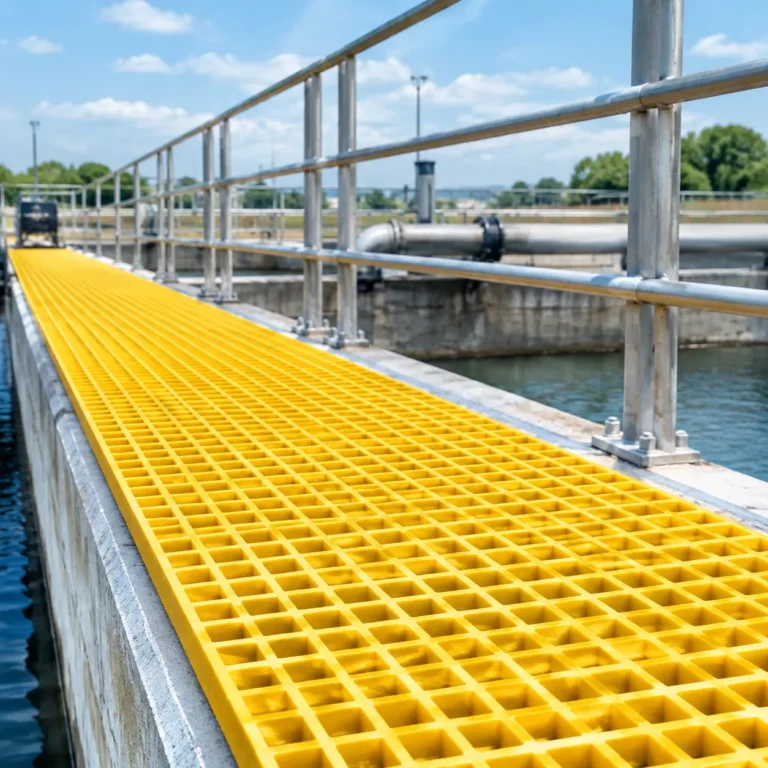
FRP grating (Fiberglass Reinforced Plastic grating) is a high-performance composite panel engineered for industrial walkways, platforms, trench covers, and structural flooring. Combining high-tensile glass fibers with resilient thermosetting resin matrices, FRP grating panels deliver exceptional strength, chemical resistance, and longevity in extreme operating environments where traditional steel, aluminum, and timber quickly degrade.
Definition and Key Materials
FRP grating panels are structural grid systems designed to distribute weight across open-mesh configurations while allowing light, liquid, and air passage. The superior performance of our composite panels stems from three core raw material components:
- Continuous Fiberglass Rovings: Provide exceptional tensile strength, rigidity, and impact resistance across the load-bearing framework.
- Thermoset Polymer Resins: Bind the fibers together, protect against harsh chemicals, and provide environmental stability. Common formulations include:
- Orthophthalic Polyester: Standard-grade corrosion resistance for light-to-moderate industrial use.
- Isophthalic Polyester: Superior resistance against aggressive industrial chemicals and marine conditions.
- Vinyl Ester: Maximum chemical resistance against severe acid, caustic, and solvent exposure.
- Phenolic Resin: Ultra-high fire retardancy and extremely low smoke emissions.
- Performance Additives: Integrated pigments for UV resistance, aluminum trihydrate (ATH) for fire retardation, and embedded quartz grit for extreme slip resistance.
How Fiberglass Reinforced Plastic Panels Are Made
The production of fiberglass reinforced plastic panels relies on specialized manufacturing techniques tailored to specific load-bearing and directional strength requirements:
-
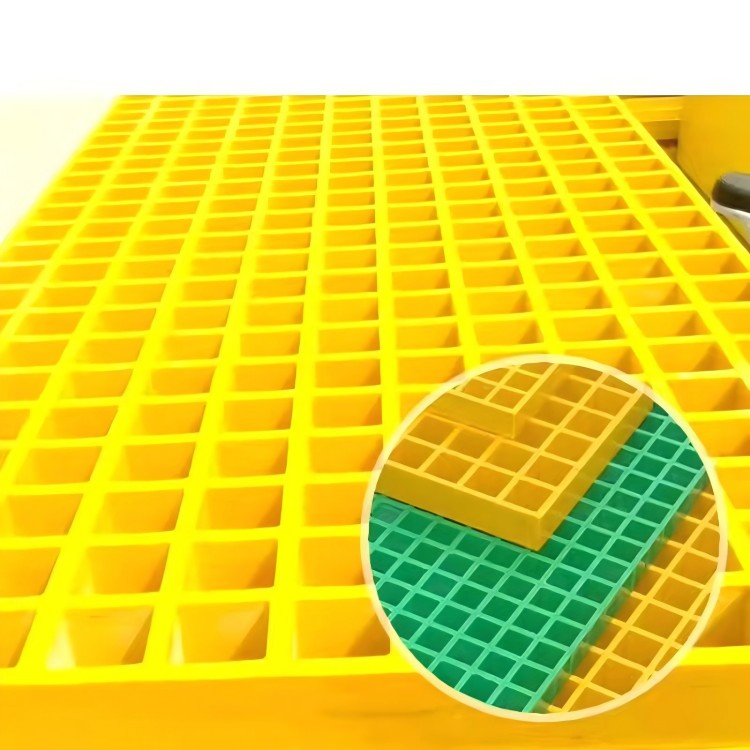
- Molded Grating Process: Continuous glass fibers are woven layer-by-layer in a specialized heated open mold in an alternating bidirectional grid pattern. Liquid resin is thoroughly injected to saturate the fibers completely. Once thermo-cured, the single-piece, monolithic structure provides equal load capacity in both directions, allowing for easy cutting with zero structural degradation.
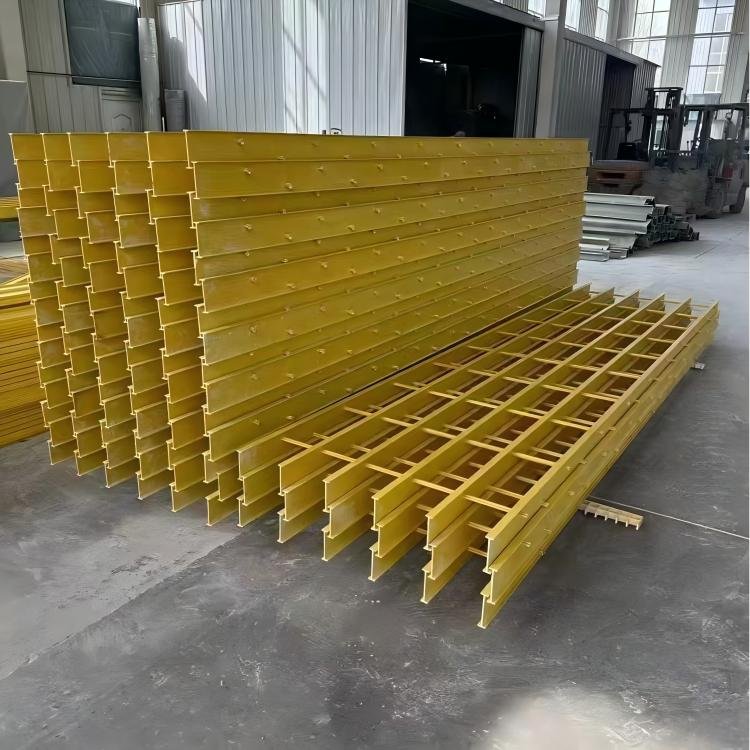
- Pultruded Grating Process: Continuous glass rovings and mats are pulled through a resin saturation bath, drawn through a heated steel forming die, and cured into rigid profiles (such as I-bars or T-bars). These load bars are mechanically assembled and locked using high-strength cross-rods, delivering an unmatched strength-to-weight ratio for long-span applications.
- Surface Finishing: Panels undergo secondary processing to apply anti-slip surfaces—such as integrated concave profiles, embedded quartz grit, or solid top plates—to maximize traction and safety in wet or oily environments.
Key Benefits and Advantages of FRP Grating Panels
Industrial environments require flooring solutions that withstand extreme conditions without degrading. We engineer high-performance FRP grating to solve the critical structural, safety, and longevity challenges associated with traditional steel, aluminum, and timber.
Corrosion and Chemical Resistance
Traditional metal gratings rust, peel, and weaken rapidly in harsh chemical settings. Fiberglass reinforced plastic panels deliver superior resistance to a broad spectrum of acids, alkalis, solvents, and saltwater. Understanding the full scope of FRP grating advantages and disadvantages highlights why composite materials consistently outperform carbon and galvanized steel in splash zones, chemical containment areas, and offshore platforms.
High Strength-to-Weight Ratio
FRP grating panels provide exceptional bidirectional load-bearing strength while weighing roughly one-third of equivalent steel panels.
-
- Reduced Structural Dead Load: Minimizes stress on underlying support structures and framing.
- Simplified Transport: Lower weight drastically reduces freight costs and handling logistics.
- Easy On-Site Installation: Two workers can easily maneuver and position panels without cranes or heavy hoisting equipment.
Non-Conductive and Fire Retardant Properties
Workplace safety is engineered directly into our composite formulations:
-
- Electrical Insulation: High dielectric strength eliminates electrical shock hazards, making grounding unnecessary around high-voltage equipment.
- Non-Sparking: Safe for explosive atmospheres where dropped tools or metal-to-metal contact could trigger catastrophic ignition.
- Flame Retardancy: Formulated with premium fire-retardant resin systems that meet ASTM E84 Class 1 flame spread ratings.
Low Maintenance and Long Service Life
Our panels integrate color pigments throughout the entire cross-section during manufacturing. As a result, they never need sandblasting, scraping, galvanizing, or repainting.
| Performance Feature | FRP Grating Panels | Carbon / Galvanized Steel | Timber / Wood |
|---|---|---|---|
| Corrosion Resistance | Excellent (Acids, Salts, Alkalis) | Poor (Rusts and oxidizes) | Poor (Rots and absorbs moisture) |
| Weight | Lightweight (~12–15 kg/m²) | Heavy (~35–45 kg/m²) | Moderate (~20–25 kg/m²) |
| Electrical Conductivity | Non-conductive | Highly conductive | Non-conductive (when dry) |
| Maintenance Need | Zero to minimal | High (Frequent recoating) | High (Sealing and replacement) |
| Expected Lifespan | 20+ Years | 5–10 Years (in corrosive zones) | 3–7 Years (outdoors) |
Types of FRP Grating Panels
We manufacture and supply several distinct types of fiberglass reinforced plastic panels, each engineered to address specific load requirements, span distances, and chemical environments. Choosing the right design ensures optimal structural performance and long-term durability for your installation.
Molded FRP Grating
Molded grating is produced in single-piece, heated mold operations by combining continuous glass fiber roving with thermosetting resin matrices. This process creates an interwoven, bidirectional structure with consistent strength in both directions.
-
- Bidirectional Strength: Supports weight evenly along both axes, making field cutouts for pipe penetrations quick and structurally secure without edge banding.
- High Impact Resistance: Resilient construction absorbs heavy point impacts without permanent deformation.
- Standard Mesh Configurations: Available in square mesh, mini-mesh, and micro-mesh designs to meet pedestrian safety and fall-through prevention requirements.
Pultruded FRP Grating
For applications requiring exceptional load-bearing strength across wider support spans, pultruded grating delivers unmatched performance. We build these panels by assembling high-strength FRP pultruded profiles—including I-bars and T-bars—locked into place with rigid cross-rods.
-
- High Glass Content: Boasts a glass-to-resin ratio of up to 70%, providing superior stiffness and tensile capacity along the span direction.
- Long-Span Capability: Deflects significantly less under heavy industrial equipment and rolling cart loads compared to molded options.
- Targeted Efficiency: Ideal for large decking projects, long walkways, and bridge gangways where unidirectional load distribution is the primary concern.
Phenolic FRP Grating
Phenolic panels are specifically developed for critical environments where fire safety is the top priority. Engineered with a specialized phenolic resin system, this grating offers industry-leading fire endurance.
-
- Superior Fire Resistance: Meets stringent US Coast Guard and IMO standards for structural integrity under direct flame exposure.
- Low Smoke & Non-Toxic Emissions: Produces negligible smoke and toxic fumes when exposed to high heat, ensuring safe escape paths in enclosed spaces.
- Primary Deployments: Offshore drilling rigs, marine vessels, refineries, and underground transit tunnels.
Resin Systems and Material Formulations
The choice of resin directly determines how well the panel withstands chemical attack, ultraviolet exposure, and extreme temperatures. We tailor our grating using four primary resin systems:
| Resin System | Corrosion Resistance Level | Primary Working Environments |
|---|---|---|
| Orthophthalic (Ortho) | Moderate | Light industrial, general municipal, and water distribution facilities |
| Isophthalic (Iso) | High | Chemical processing plants, marine decks, and industrial splash zones |
| Vinyl Ester (VE) | Maximum / Severe | Harsh acid exposure, caustic chemical plants, and heavy battery storage areas |
| Phenolic | High / Extreme Fire Rating | Offshore platforms, confined areas, and heavy marine transit environments |
FRP Grating Panel Product Options and Features
We design our FRP grating panels with a wide variety of surface finishes, dimensions, and configurations to match the structural, safety, and environmental demands of any facility.
Surface Textures and Slip Resistance
Slip-and-fall prevention is one of the primary reasons engineers choose fiberglass grating. We offer multiple top-surface treatments tailored to specific working conditions:
-
- Integrally Applied Grit Top: Quartz or silica grit embedded directly into the resin matrix during production delivers maximum traction in wet, oily, or chemical-heavy industrial walkways.
- Meniscus (Concave) Top: A naturally formed concave top surface that provides standard slip resistance with a smooth, easy-to-clean profile suitable for light industrial zones.
- Chequered / Solid Top: A smooth or diamond-plate fiberglass cover laminated over the grating panel to contain spills, block vapor, and provide a solid walking platform.
- Smooth Top: Best suited for decorative, architectural, or non-traffic partitioning applications.
| Surface Texture | Slip Resistance Level | Common Environments |
|---|---|---|
| Grit Surface | Maximum (R13+) | Offshore rigs, chemical plants, food processing |
| Meniscus Top | Moderate (R10) | Drainage areas, light industrial platforms |
| Chequered Covered | High Traction | Odor control, trench covers, cleanrooms |
| Smooth Surface | Standard | Machine guards, screens, architectural grilles |
Standard Panel Sizes, Mesh Patterns, and Colors
To minimize cutting waste and reduce field labor, we manufacture FRP grating panels in a range of standard structural profiles:
-
- Panel Thicknesses: Available in standard depths of 25 mm (1 in), 30 mm (1.25 in), 38 mm (1.5 in), and 50 mm (2 in) to meet specific span and load-bearing requirements.
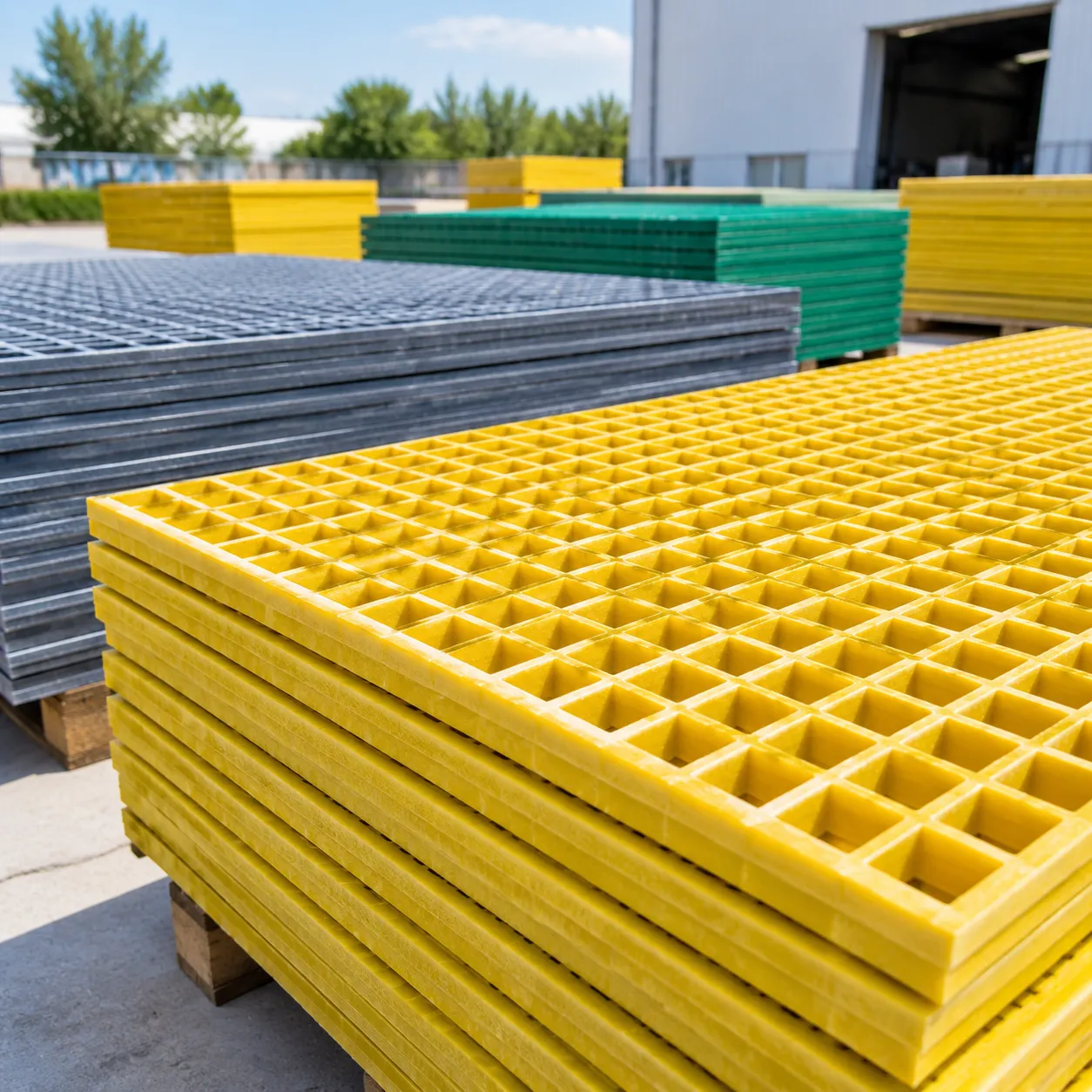
- Standard Stock Sizes: Standard production footprints include 4 ft x 8 ft, 4 ft x 12 ft, 3 ft x 10 ft, and 1 m x 2 m.
- Mesh Configurations:
- Square Mesh (Bidirectional): Distributes loads evenly across both axes, allowing cutouts without losing structural integrity.
- Rectangular Mesh (Unidirectional): Ideal for long trench covers and direct linear spans.
- Mini-Mesh and Micro-Mesh: Designed with tight apertures to prevent small tools from falling through while remaining 100% ADA-compliant and comfortable for barefoot marina traffic.
- Standard Colors: Molded with UV-inhibited pigments throughout the resin. Standard options include Safety Yellow, Industrial Dark Gray, Light Gray, Green, and Orange.
FRP Stair Treads, Handrails, and Accessories
Complete structural safety systems require matched composite components. We supply fully engineered accessories designed to integrate directly with your grating layout:
-
- FRP Stair Treads: Pre-cut panels featuring an integrated, high-visibility solid grit nosing (typically in contrasting yellow or black) to clearly define step edges and prevent slips.
- Stainless Steel Installation Hardware: Grade 316 and 304 stainless steel fastener clips—including M-clips (for securing panel to support frame), C-clips (to join panel edges), L-clips, and G-clips (for clamp-on fastening without drilling).
- Structural Handrails & Ladders: Non-conductive FRP round and square tube handrail systems that connect directly onto your grating walkway layouts.
For specialized layout requirements, custom resin colors, or hardware kits, contact our structural team to review panel dimensions and fastener specifications for your project.
Common Uses and Applications of FRP Grating
We engineer structural composite solutions built to withstand harsh, corrosive, and high-impact conditions where traditional materials rapidly fail. Because of their adaptability and structural integrity, high-performance FRP grating panels serve as the standard surfacing solution across a broad range of demanding commercial and industrial sectors.
Industrial and Manufacturing Facilities
In standard factory environments, safety and structural longevity are paramount. FRP grating delivers dependable support across daily operations:
-
- Workstations and Walkways: Provides ergonomic, slip-resistant flooring that reduces worker fatigue and slips.
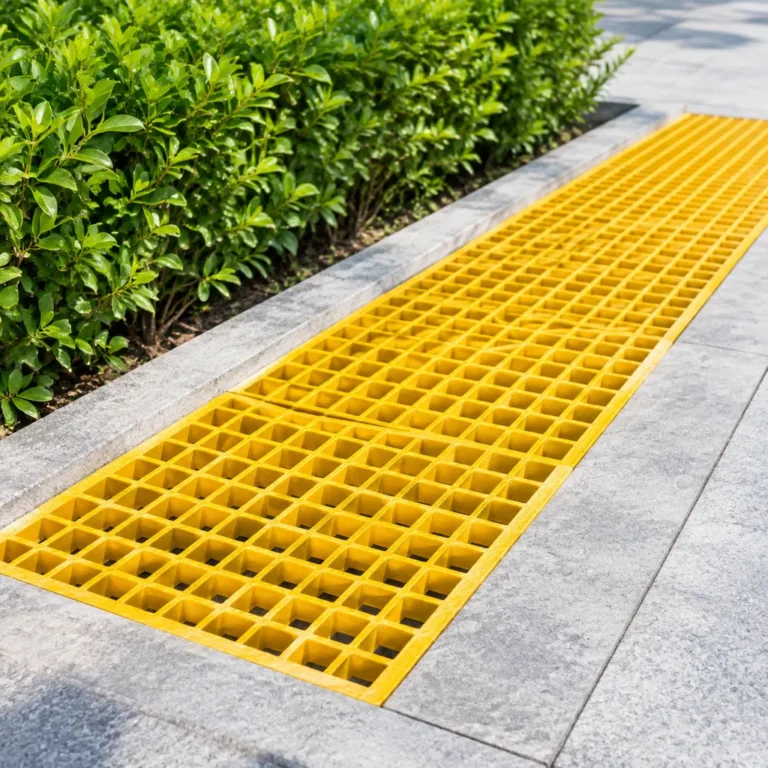
- Trench Covers and Drainage Systems: Withstands frequent washdowns, chemical spills, and heavy foot traffic without rusting.
- Assembly Line Platforms: Non-conductive surfaces create a safer environment around electrical wiring and automated machinery.
Offshore Oil, Gas, and Chemical Plants
Harsh chemical exposure and volatile atmospheres require non-sparking, fire-retardant infrastructure:
-
- Catwalks and Drilling Decks: Delivers high load capacity with lightweight structural profiles, easing platform load weights.
- Refinery Walkways: Resists aggressive acids, alkalis, and solvents that degrade galvanized steel.
- Safety Platforms: Non-sparking properties minimize ignition risks in explosive or combustible vapor zones.
Docks, Marinas, and Marine Environments
Constant water exposure rapidly destroys wood and corrodes steel. Composite grating solves marine decay issues:
-
- Pier Decking and Floating Docks: Immune to saltwater corrosion, algae growth, rot, and marine borers.
- Open-Mesh Configurations: Allows sunlight to penetrate for marine vegetation and lets storm surges pass through without lifting dock structures.
- Barefoot-Friendly Surfacing: Grit-top surfaces provide reliable wet traction without splinters or excessive heat absorption.
Water and Wastewater Treatment Facilities
Wastewater environments generate high concentrations of corrosive gases like hydrogen sulfide ($H_2S$), which eat through conventional metals:
-
- Clarifier Walkways and Bridge Floors: Maintains structural strength despite perpetual humidity and chemical splashing.
- Screening Channels and Chemical Dosing Areas: Unaffected by chlorination agents, coagulants, and acidic neutralizers.
- Odor Control Covers: Seals trenches effectively while providing easy removal for maintenance access.
FRP Grating vs. Traditional Steel and Wood Grating
When we build industrial walkways, decking, and platform floors, material selection directly affects long-term reliability and site safety. While carbon steel, galvanized steel, and treated wood have historically served as standard flooring solutions, fiberglass reinforced plastic (FRP) has set a new benchmark for demanding operating environments.
Performance and Durability Comparison
Traditional steel rusts when exposed to moisture and chemicals, while wood rots, warps, and splinters over time. Our FRP grating panels eliminate these failure points entirely by combining structural strength with complete chemical inertness.
| Feature / Metric | FRP Grating Panels | Steel / Galvanized Grating | Wood Decking |
|---|---|---|---|
| Corrosion Resistance | Immune to acids, salts, alkalis, and moisture | Prone to rust, oxidation, and chemical pitting | Prone to rot, fungal decay, and insect damage |
| Strength-to-Weight | High load capacity at 1/3 the weight of steel | High strength, but exceptionally heavy | Low strength-to-weight; degrades over time |
| Electrical / Thermal Safety | Non-conductive and thermally insulative | Highly conductive (shock and heat hazard) | Non-conductive, but poor flame resistance |
| Service Life | 20 to 50+ years in aggressive conditions | 5 to 15 years (requires recoating) | 3 to 8 years in exposed outdoor areas |
| Impact Recovery | Elastic memory resists permanent deformation | Prone to permanent bending under impact | Cracks and splits under heavy point loads |
-
- Zero Rust, Zero Rot: FRP walkways and trench covers withstand continuous washdowns, chemical spills, and saltwater spray without degrading.
- Safer Working Surfaces: Embedded quartz-grit top surfaces retain slip resistance far longer than smooth steel serrations or wet timber.
- No Sparking Hazards: Unlike steel grating, FRP does not create mechanical sparks when dropped tools strike the surface, making it safe for volatile environments.
Cost-Efficiency and Installation Advantages
The real value of FRP grating lies in its total cost of ownership (TCO). While steel may occasionally have a comparable raw purchase price, the combined costs of shipping, crane rentals, on-site welding, and recurring maintenance make steel far more expensive across its operational life.
-
- Rapid Field Fabrication: We cut and adjust FRP grating on-site using standard handheld circular saws fitted with diamond blades. There is no need for torches or hot-work permits.
- Reduced Transport and Labor Costs: Because panels weigh up to 70% less than steel alternatives, two crew members can easily handle and position sections manually without cranes or heavy hoisting equipment.
- Elimination of Maintenance Downtime: Our molded and pultruded panels never require sandblasting, galvanizing, or repainting, saving significant labor budgets year after year.
- Zero Scrap Value: Unlike stainless steel or aluminum, FRP carries no scrap metal value, eliminating the risk of site theft during construction.
How to Choose and Size FRP Grating Panels
Selecting the right FRP grating panels comes down to matching your site conditions with the right profile, span, and resin formulation. We guide projects through three critical factors to ensure structural safety and cost-efficiency.
Evaluating Load-Bearing Capacity and Deflection Data
To determine the right panel thickness and depth, you must evaluate the clear span distance and the type of load the panels will support:
-
- Pedestrian Walkways: Standard pedestrian traffic typically requires a maximum deflection of 1/4 inch (6.4 mm) or L/200 to prevent a bouncy feel underfoot. A 1-inch or 1.5-inch panel depth is standard for spans between 24 and 36 inches.
- Heavy Rolling Loads: For forklifts, maintenance vehicles, and heavy equipment, opt for high-depth pultruded panels or heavy-duty molded grating designed to handle concentrated wheel loads without structural fatigue.
- Support Spacing: Wider support spans demand thicker grating profiles to prevent excessive deflection and maintain safe load distribution across the substructure.
| Grating Type | Primary Strength | Best Application | Span Capability |
|---|---|---|---|
| Molded Grating | Bi-directional | Trench covers, walkways with cutouts, corrosive chemical areas | Short to medium spans |
| Pultruded Grating | Uni-directional | Long-span platforms, heavy-duty industrial decking, bridges | Long continuous spans |
Selecting Between Molded vs. Pultruded Panels
Choose between molded and pultruded fiberglass reinforced plastic panels based on layout complexity and span requirements:
-
- Pick Molded Panels when your installation requires extensive cutouts for pipes, valves, or columns. Molded grating distributes weight evenly in both directions, meaning cut panels retain full structural integrity without additional edge framing.
- Pick Pultruded Panels when you need to bridge long spans with minimal intermediate steel supports. With high glass content in the load bars, pultruded panels deliver superior stiffness and maximum load capacity in the span direction.
Custom Fabrication and Cutting Considerations
FRP grating panels are easy to cut and customize on-site without hot-work permits or welding gear:
-
- Cutting Tools: Use standard circular saws, jigsaws, or angle grinders equipped with diamond-tipped masonry or continuous-rim abrasive blades.
- Sealing Cut Edges: Always coat exposed edges with a compatible resin sealing kit. This seals raw glass fibers and stops chemical ingress, preserving corrosion resistance.
- Installation Clearances: Allow a 3/16-inch to 1/4-inch (5–6 mm) gap between panel edges and adjacent walls or framework to account for natural thermal movement.
- Fastening Systems: Secure panels to structural supports using stainless steel M-clips, C-clips, or G-clips spaced every 3 to 4 feet along the perimeter and interior supports.