FRP Trench Covers Solid Top Grating Top Load Ratings
Discover FRP trench covers with solid top and grating designs load ratings sizes applications and expert selection tips for durable safe protection
Are you struggling to choose the right composite covers for your facility?
Tired of rusted steel plates and cracked concrete slabs that cost a fortune to replace?
You’re in the right place.
Whether you’re designing high-traffic industrial walkways or protecting underground utility channels, selecting the right FRP grating stair setups and FRP trench covers: solid top and grating top types, load ratings and sizes is critical for long-term safety and structural integrity.
In this comprehensive guide, you’ll learn the exact differences between solid and grating surfaces, how to match load capacities—from pedestrian foot traffic to heavy-duty AASHTO H-20 standards—and how to choose the right dimensions and resin systems for your project.
Let’s dive right in.
What Are FRP Trench Covers?
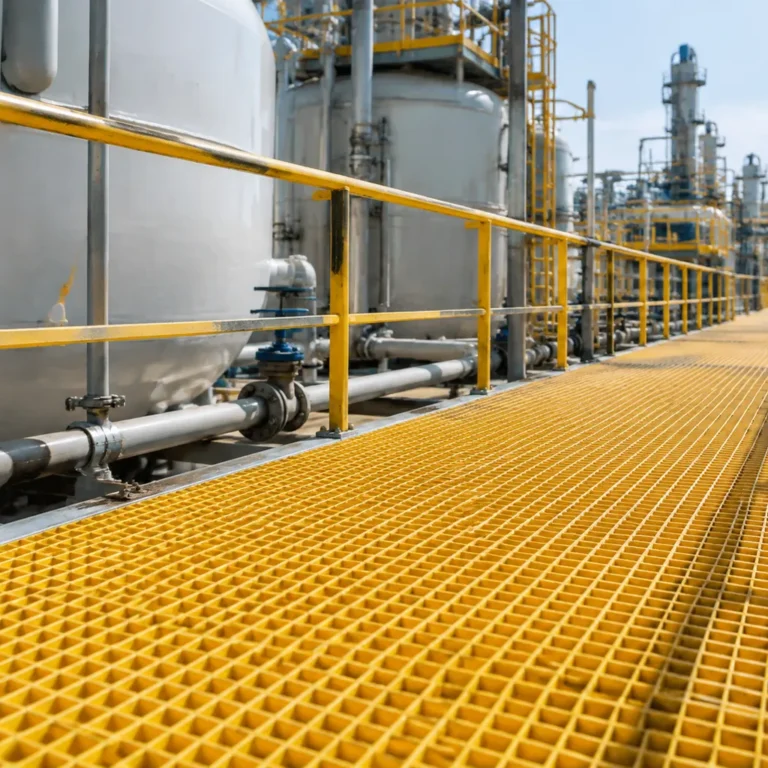
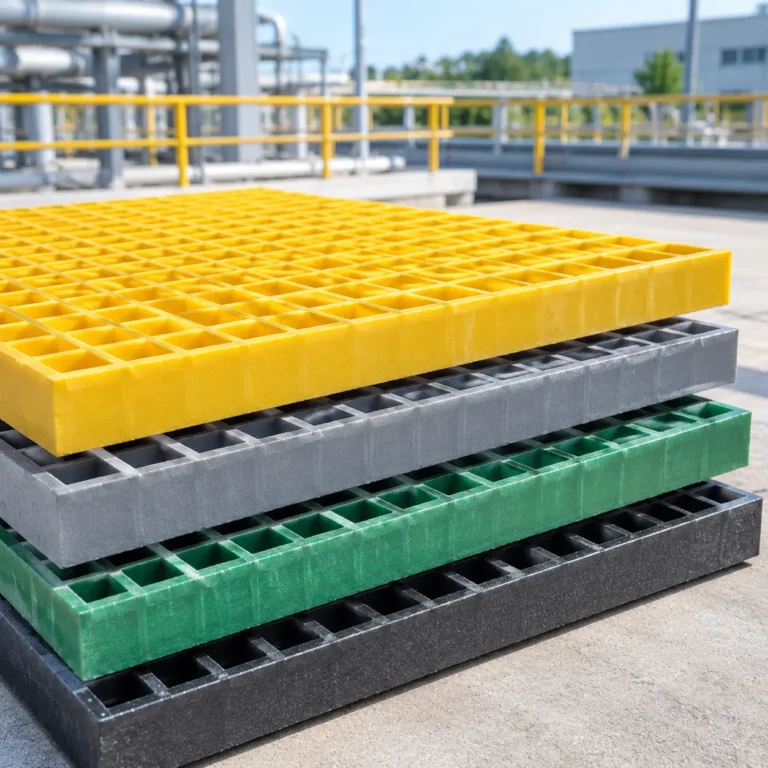
FRP trench covers (Fiberglass Reinforced Polymer covers) are engineered composite panels designed to bridge drainage trenches, cable pathways, and access vaults. Manufactured as either an open fiberglass grating surface or a sealed solid profile, these covers deliver extreme load-bearing capabilities in demanding commercial, industrial, and civil environments.
Overview and Material Composition
Our composite trench covers are fabricated using high-strength composite materials optimized for hostile operating conditions:
Continuous Fiberglass Roving: High-tensile continuous E-glass fibers layered bidirectionally to provide exceptional bending, tensile, and impact strength.
Thermosetting Polymer Resin: Premium matrix resins (Isophthalic Polyester, Vinyl Ester, or Phenolic) that lock the fibers in place and provide distinct levels of chemical and flame resistance.
Synthetic Surface Veil: A resin-rich outer layer incorporating UV inhibitors and specialized additives to prevent fiber bloom and environmental degradation.
Integrated Quartz Grit: Embedded anti-slip surface coatings to ensure maximum traction and worker safety.
Core Benefits Over Steel and Concrete Covers
Traditional trench solutions like cast iron, fabricated steel, and precast concrete suffer from severe corrosion, excessive weight, and difficult handling. Advanced composite trench covers eliminate these vulnerabilities entirely.
Performance Metric FRP Trench Covers Structural Steel Reinforced Concrete
Corrosion Resistance Immune to rust, salts, acids, and alkalis Requires frequent painting; rusts quickly Susceptible to spalling, cracking, and moisture attack
Weight Efficiency 1/3 the weight of steel; 1/5 of concrete Heavy; requires lifting machinery Extremely heavy; high transport and crane costs
Installation & Handling Rapid two-person lift; cut with standard tools Labor-intensive; hot work permits required to cut Requires specialized heavy rigging equipment
Electrical Safety Non-conductive and non-sparking Conductive; posing stray voltage hazards Mildly conductive when damp
Lifecycle Maintenance Zero maintenance over decades of service High recoating and rust-mitigation costs Costly edge repair and replacement cycles
Theft Deterrence Zero scrap resale value High target for scrap metal theft Negligible scrap value
Unmatched Strength-to-Weight Ratio: Supports high-load vehicular traffic while remaining light enough for rapid, manual access.
Ergonomic & Safe Operations: Dramatically reduces back injury risks during routine utility and trench maintenance.
Complete Environmental Resistance: Operates continuously across broad temperature swings without thermal expansion warping, rot, or chemical breakdown.
FRP Trench Cover Types: Solid Top vs. Grating Top
Selecting the right cover profile comes down to how your facility manages liquid drainage, airflow, and trench contents. We supply and engineer two primary configurations: open-mesh grating tops and solid-surface covered tops. Both rely on premium thermoset resin systems, but they serve distinct operational roles across industrial environments.
Grating Top FRP Covers for Drainage and Ventilation
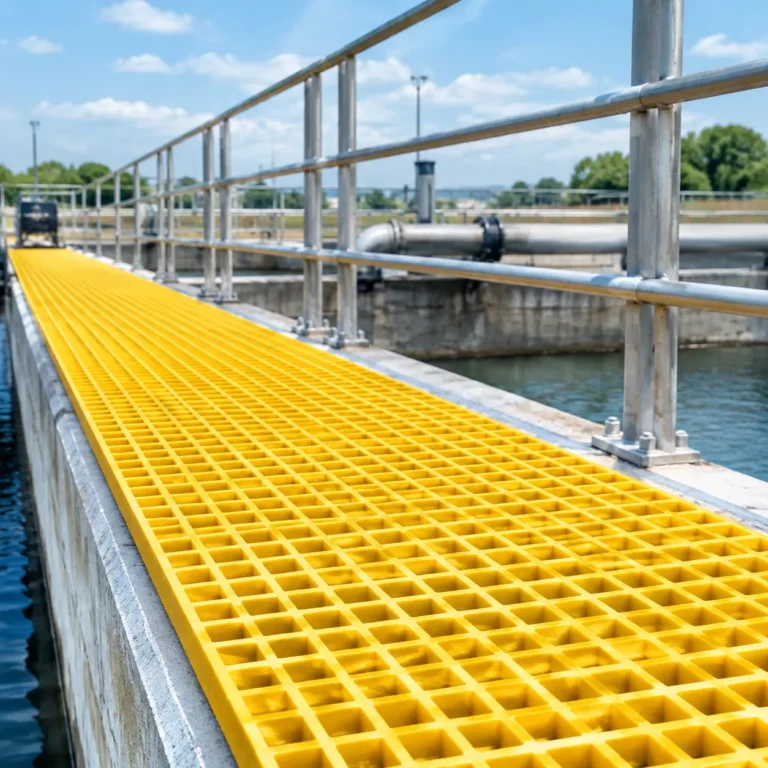
Grating top profiles utilize an open-mesh structure that maximizes flow and ventilation while delivering high slip resistance. We design these panels primarily for wet environments where surface liquid accumulation creates slip hazards or where underlying utilities need steady airflow.
Continuous Fluid Drainage: The open mesh design allows water, oils, and process chemicals to drain directly into the trench, eliminating surface pooling on walkways and work decks.
Passive Aeration: Open areas prevent volatile or damp air pockets from building up inside the trench, cutting down on condensation around underlying pipes.
Slip-Resistant Textures: Top surfaces come with an integrated quartz grit finish, providing traction under oily or wet foot traffic.
Debris Monitoring: Operators can inspect fluid levels and pipe runs through the open mesh without lifting panels.
Solid Top FRP Covers for Odor and Vapor Containment
Solid top covers feature a continuous fiberglass plate chemically bonded or molded directly over an underlying structural grating core. This sealed configuration transforms standard fiberglass grating into impermeable composite trench covers that stop environmental cross-contamination.
Odor and Fume Mitigation: Facilities dealing with sour gases, hydrogen sulfide, or chemical fumes use solid top FRP odor control covers to trap volatile organic compounds (VOCs) and corrosive gases within the trench network.
Foreign Object Barrier: The solid surface stops small parts, tools, gravel, and litter from dropping into sensitive drainage channels, protecting underlying pumps and utility lines.
Smooth Wheeled Traffic: Solid tops with a fine-grit surface offer an uninterrupted surface for hand carts, pallet jacks, and small-wheeled maintenance equipment that struggle over open mesh.
Molded vs. Pultruded Construction Types
How we manufacture the core panel determines its load paths, span thresholds, and field workability. Both solid top and grating top covers are available in molded and pultruded structural variations.
Parameter Molded FRP Trench Covers Pultruded FRP Trench Covers
Glass Content ~35% by weight (woven continuous fibers) ~65%–70% by weight (dense roving strands)
Load Distribution Bi-directional (strength evenly spread in both directions) Uni-directional (maximum strength along the bar length)
Long-Span Performance Best for spans under 36 inches (900 mm) Superior stiffness over spans exceeding 36 to 60 inches
Field Modifications Cut panels anywhere to fit piping penetrations without losing structural integrity Cutouts require extra edge support along severed load bars
Application Profile Intricate trench runs, sumps, and multi-angle junctions Straight trench corridors requiring pultruded FRP grating for heavy-duty access covers
Molded covers work best when trenches feature frequent turns, odd angles, or multiple pipe penetrations. For wide clear spans that handle heavy concentrated wheel weights, pultruded construction delivers lower panel deflection and higher stiffness per pound.
FRP Trench Cover Load Ratings and Standards
Selecting the right cover starts with knowing the exact load your trench needs to support. Whether managing foot traffic in a processing plant or heavy freight crossing a utility trench, choosing covers engineered to recognized load standards prevents deflection, structural fatigue, and jobsite hazards.
Pedestrian vs. Light Vehicular Load Capacities
For walkways, catwalks, and maintenance trenches, pedestrian-rated covers are the standard choice. These panels typically support a uniform design load of 50 to 100 psf (pounds per square foot) with minimal deflection, maintaining stability under continuous foot traffic.
When utility carts, pallet jacks, or light maintenance vehicles cross the span, light vehicular ratings are required. We engineer these composite trench covers to withstand concentrated point loads, ensuring the panel does not exceed the standard deflection limit of L/200 (span length divided by 200) or 0.25 inches. Reviewing detailed FRP grating load capacity for heavy industrial applications ensures the correct balance between panel thickness, span width, and safety factors.
AASHTO H-20 and HS-20 Heavy Traffic Ratings
Trenches located in roadways, loading bays, and industrial driveways must handle continuous, heavy axle weights. For these critical areas, fiberglass grating covers must meet or exceed AASHTO standards:
AASHTO H-20: Designed to safely support a single axle load of 32,000 lbs (16,000 lbs wheel load) plus impact factors, representing a typical two-axle semi-truck.
AASHTO HS-20: Covers the same 32,000 lb axle loading as H-20, but calculates for tractor-trailer combinations with tandem axle configurations.
Our heavy-duty access covers designed for H-20 and HS-20 ratings utilize high-depth pultruded profiles or reinforced solid-top molded panels to prevent failure under dynamic, moving traffic.
EN 124 Load Classification Standards
For projects following European and international project specifications, we test and verify covers against the EN 124 structural classifications:
Class Test Load Typical Application
A 15 15 kN (1.5 tonnes) Pedestrian walkways, cycling paths, and green spaces
B 125 125 kN (12.5 tonnes) Footpaths, pedestrian precincts, and private car parking
C 250 250 kN (25 tonnes) Curb channels, roadside shoulders, and parking lots
D 400 400 kN (40 tonnes) Carriageways, hard shoulders, and industrial loading docks
Matching your trench opening to these load thresholds ensures your installation remains secure, code-compliant, and maintenance-free for decades.
Standard Sizes, Thicknesses, and Dimensions
Getting the right dimensions for composite trench covers ensures structural integrity, easy handling, and rapid installation. We manufacture our covers to fit standard concrete trench profiles or supply them custom-fabricated to match unique field measurements.
Clear Span Requirements and Panel Widths
The clear span is the open distance between the inner walls of your trench. Proper installation requires an adequate bearing surface on the trench shoulder or embedded angle iron to handle vertical loads safely:
Minimum Bearing Edge: Panels must sit on a minimum bearing support of 1.5 inches to 2 inches (38 mm to 50 mm) on both sides.
Thermal and Fitting Clearance: We cut panel widths with a 0.25-inch (6 mm) gap allowance to accommodate thermal expansion and slight concrete casting variations.
Standard Stock Widths: Panels generally come in standard 3-foot (915 mm), 4-foot (1220 mm), and 5-foot (1524 mm) widths before custom slicing to trench dimensions. Refer to our FRP grating standard size overview for full panel dimensions and stock metrics.
Clear Span Range Recommended Profile Depth Top Style Primary Application
Up to 12 in (300 mm) 1.0 in (25 mm) Grating or Solid Plate Foot traffic, light carts
12 to 24 in (300–600 mm) 1.5 in (38 mm) Grating or Solid Plate Industrial walkways, light equipment
24 to 36 in (600–915 mm) 2.0 in (50 mm) Grating or 2″ + 1/4″ Solid Top Heavy industrial, vehicular crossing
36 to 48 in (915–1220 mm) 2.5 in to 3.0 in (pultruded) Grating or Structural Solid High-load drainage channels, utilities
Standard Thickness and Depth Options
Panel depth dictates the structural deflection under load. For standard open fiberglass grating covers, common structural depths are 1.0″ (25 mm), 1.5″ (38 mm), and 2.0″ (50 mm).
For solid top covers, a solid fiberglass plate is integrally molded or bonded onto the base grid: 1.5″ Base + 1/8″ Plate (total ~1.62″ / 41 mm): Typical for odor-containment walkways. 1.5″ Base + 1/4″ Plate (total ~1.75″ / 44 mm): Ideal for forklift-rated, high-traffic solid trench setups. 2.0″ Base + 1/4″ Plate (total ~2.25″ / 57 mm): Designed for heavy-duty access covers supporting heavy equipment.
Custom Cutting and Mesh Pattern Sizing
Selecting the correct mesh pattern affects wheel rollover, drainage rate, and debris filtration:
Standard Square Mesh (1.5″ x 1.5″ / 38 x 38 mm): Offers 70% open area; standard for rapid drainage and washdown trenches.
Mini-Mesh (0.75″ x 0.75″ / 19 x 19 mm top layer): ADA-compliant; prevents small objects from falling into the trench and allows smooth transit for small-wheeled carts.
Rectangular Mesh (Pultruded): Designed for unidirectional high strength along long spans.
We cut panels to exact job-site blueprints using CNC routers and diamond-grit cutting blades. For specialized drop-in layouts, pipe cutouts, and lifting-handle integration, check out our FRP grating sizes standard and custom options guide to specify exact edge-banding and cutout requirements.
Key Applications Across Industries
We engineer our FRP trench covers and fiberglass grating systems for environments where traditional steel and concrete fail prematurely. From corrosive processing zones to high-voltage utility trenches, these composite trench covers deliver long-term durability and eliminate costly maintenance cycles.
Chemical Plants and Industrial Facilities
Harsh acids, caustics, and continuous chemical washdowns quickly destroy conventional steel covers. We supply molded and pultruded solid top covers and open mesh profiles specifically built to withstand aggressive splash-and-spill environments.
Acid and Alkaline Processing: Resists pitting, structural weakening, and surface degradation. Learn more about our targeted corrosion-resistant solutions for chemical plants.
Battery Storage and Plating Shops: Immune to electrolyte leaks and heavy sulfuric acid exposure.
Secondary Containment: Solid top panels isolate toxic chemical runoffs, preventing soil and groundwater contamination.
Facility Area Recommended Cover Type Key Benefit
Washdown Bays Grating Top (Grit Surface) Rapid drainage + maximum slip resistance
Chemical Storage Trenches Solid Top (Smooth or Grit) Complete containment of hazardous fumes
Forklift Aisles Heavy-Duty Pultruded Solid Top High wheel-load capacity without warping
Municipal Drainage and Wastewater Treatment
Municipal infrastructure faces continuous moisture and corrosive hydrogen sulfide (H2S) gases. Traditional cast iron covers corrode and seize in place, creating safety hazards for service crews.
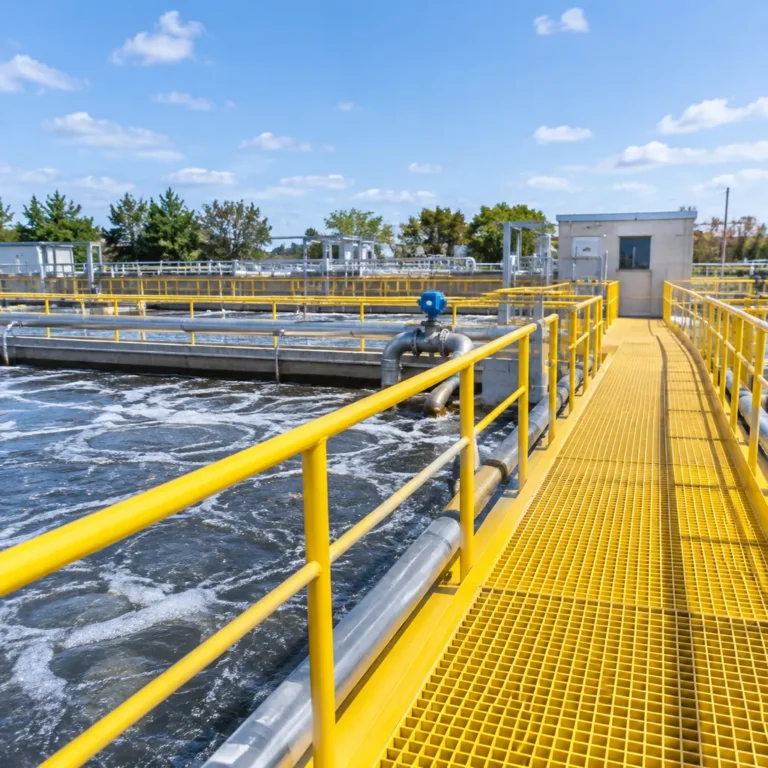
Odor Control at Clarifiers: Solid top composite trench covers seal in odors and dangerous volatile organic compounds (VOCs).
Stormwater Runoff Channels: Grating top covers allow high-volume water passage while catching coarse debris.
Ergonomic Maintenance Access: Being up to 70% lighter than precast concrete slabs, our covers allow two-person manual removal without heavy cranes or lifting gear.
Electrical Utilities and Cable Trench Protection
Electrical infrastructure requires non-conductive, spark-free trench covers to protect workers and secure sensitive underground wiring. Metal covers pose short-circuit and theft hazards, while concrete is prone to chipping and cable damage.
Substation Cable Trenches: Non-conductive FRP materials eliminate stray voltage risks. Discover our specialized approach to safety protocols in electrical substations.
Data and Telecom Vaults: Heavy-duty access covers provide secure, radio-frequency transparent protection that does not interfere with wireless telemetry signals.
Power Generation Facilities: Fire-retardant resin formulations meet strict utility safety standards in boiler rooms and turbine halls.
How to Select the Right FRP Trench Cover
Selecting the ideal cover comes down to matching your operational demands with structural design. I always look at three core variables first: structural load, operating environment, and footing safety. Getting these right prevents premature failure, reduces replacement costs, and keeps your facility running safely.
Evaluating Traffic Type, Load Rating, and Span
Clear span width and traffic type dictate panel thickness and structure:
Trench Span Width: A wider open trench requires deeper profile thickness or pultruded sections to limit deflection under load.
Traffic Categories:
Pedestrian Access: Requires 25 mm to 38 mm standard panels rated for safe foot traffic.
Occasional Light Vehicles: Maintenance carts and light equipment need molded mesh with minimum 38 mm thickness.
Heavy Wheel Loads: Forklifts and trucks demand engineered heavy-duty access covers with reinforced support frames.
Allowable Deflection: Industrial standards typically limit deflection to L/200 or 6 mm (0.25 inches) to maintain stability under peak load conditions.
Choosing Resin Systems for Chemical Resistance
Resin selection defines how well composite trench covers survive corrosive spills, chemical fumes, and weather exposure:
Resin Matrix Corrosion Resistance Level Common Applications
Orthophthalic Polyester Moderate Urban drainage, light washdown areas, general commercial use
Isophthalic Polyester High Industrial chemical splash zones, wastewater plants, marine docks
Vinyl Ester Maximum / Severe Battery storage, acid processing lines, aggressive chemical storage
Phenolic High Heat & Low Smoke Confined spaces, rail tunnels, offshore oil platforms
Always verify the chemical concentrations, pH levels, and exposure temperatures in your trenches before locking in a resin matrix.
Selecting Surface Textures for Slip Resistance
Surface traction prevents slips, trips, and falls around open gutters and utility trenches. I match surface profiles directly to moisture and debris levels using proven anti-slip options for FRP grating:
Embedded Quartz Grit: A coarse, baked-in silica grit bonded directly to the panel. It provides the highest coefficient of friction in greasy, oily, or wet environments.
Concave Meniscus Surface: Formed naturally during curing on molded open-mesh grates. It delivers reliable multi-directional traction for standard pedestrian drainage walkways.
Chequered Diamond Plate: Common on solid-top fiberglass grating. It allows smooth rolling traffic for small carts while maintaining decent shoe-sole grip in dry conditions.
Smooth Surface: Best suited for dry, clean-room environments or cable trenches where walking safety is not a primary concern and easy cleaning is prioritized.
Installation and Maintenance Guidelines
Proper installation and upkeep ensure that your FRP trench covers deliver maximum structural safety and service life in heavy-traffic or corrosive environments.
Trench Support Frame and Bearing Surface Prep
Before placing panels, the trench rebate or embed angle must be checked for levelness and continuous support. Uneven bearing ledges create point loads that can cause premature flexural cracking.
Minimum Bearing Depth: Ensure at least 1.5 to 2.0 inches (38 to 50 mm) of direct bearing surface along all trench ledges.
Surface Leveling: Clear all debris, grout splatter, and irregularities from the concrete seat before drop-in.
Support Frames: For vehicular traffic, embed structural stainless steel or pultruded fiberglass curb angles directly into the concrete pour.
Thermal Expansion Gaps: Maintain a 3/16-inch (5 mm) clearance between adjacent panels and perimeter edges to allow for thermal movement without buckling.
Fastener Types and Hold-Down Clip Systems
Securing composite trench covers prevents lateral shift, rattling, and dislodgement under dynamic loads. Match your clip assembly directly to your specific grating profile and environment:
Fastener Type Best Applied To Material Spec Function
M-Clips Open mesh grating top 316 Stainless Steel Secure two adjacent load bars to the support ledger
G-Clips Flange mounting without drilling 316 Stainless Steel Friction-clamp directly to structural steel trench frames
C-Clips Panel-to-panel joints 316 Stainless Steel Tie two adjacent panel edges together to limit differential deflection
Countersunk Washers Solid top trench covers 316 Stainless Steel Flush-mounted hardware to eliminate pedestrian trip hazards
When retrofitting drainage channels with high-traction FRP anti-skid grating, use pre-drilled countersunk holes and 316 stainless steel bolts to maintain a flush, trip-free walking deck.
Inspection and Routine Maintenance Tips
FRP materials do not rust or rot, keeping lifetime upkeep minimal compared to coated steel or cast iron. A straightforward periodic review maintains regulatory compliance and peak performance:
Visual Surface Checks: Inspect panels semi-annually for deep gouges, exposed glass fibers, or delamination caused by impact.
Fastener Torque: Check clip assemblies annually; retighten any hardware loosened by cyclic vibration from plant vehicles.
Drainage Clearing: For open mesh covers, wash away grit, slurry, and chemical residues using a standard low-pressure industrial washdown hose.
Grit Integrity: Inspect high-traffic zones to ensure top surface grit remains bonded and continues to deliver necessary slip resistance.