Difference Between FRP and GRP Grating Explained
Are you struggling to figure out the real difference between frp and grp grating for your next industrial project?
You’re not alone.
Engineering specs often toss these two terms around interchangeably, leaving project managers confused about whether they’re buying the same material or compromising on structural integrity.
Here’s the quick truth: while all GRP grating is technically FRP grating, the specific fibers, resin matrices, and regional standards make a massive impact on your project’s load capacity, corrosion resistance, and total budget.
In this straightforward guide, you’ll learn the exact material distinctions, regional terminology quirks, and how to choose the right composite grating for your specific environment.
Let’s dive in.
Understanding Composite Gratings: What Are FRP and GRP?
Industrial flooring systems demand materials that withstand harsh chemicals, heavy impacts, and extreme environments. Traditional steel and timber quickly deteriorate under such conditions, leading industries worldwide to adopt advanced composite grating. The terms FRP and GRP appear constantly in engineering specifications, structural procurement, and architectural designs. While often used interchangeably, understanding their precise definitions and relationship ensures proper material selection for demanding industrial projects.
What is FRP Grating (Fiber Reinforced Plastic)?
FRP grating (Fiber Reinforced Plastic, also referred to as fibre reinforced polymer) is a high-performance structural panel manufactured by combining high-strength reinforcing fibers with a protective polymer matrix.
- The Reinforcement: High-tensile fibers—including glass, carbon, aramid, or basalt—provide mechanical strength, rigidity, and load-bearing capacity.
- The Matrix: A liquid thermoset resin (such as isophthalic polyester, vinyl ester, or phenolic resin) binds the fibers together, shielding them from environmental degradation and chemical attack.
Through precise curing processes, this combination yields an exceptionally durable, lightweight, and non-corrosive structural mesh suitable for platforms, walkways, and drainage systems.
What is GRP Grating (Glass Reinforced Plastic)?
GRP grating (Glass Reinforced Plastic), widely known as fiberglass grating or fiberglass reinforced plastic, is a specific composite material where the sole reinforcing agent is glass fiber.
In GRP grating, continuous glass roving strands are thoroughly wetted with a thermoset resin system inside specialized molds or pultrusion dies. The primary characteristics include:
- E-Glass Reinforcement: High-strength electrical-grade glass fibers deliver multidirectional or unidirectional tensile strength.
- Resin Saturation: Formulated polyester or vinyl ester resins seal the glass fibers, creating complete resistance against moisture, acids, and alkalis.
- Market Prevalence: Due to the balance of high mechanical performance and cost efficiency, GRP represents the vast majority of industrial composite gratings manufactured globally today.
Terminology and Scope: Is GRP Just a Type of FRP?
The short answer is yes: all GRP is FRP, but not all FRP is GRP.
The fundamental difference lies in classification and material scope:
- FRP is the Umbrella Category: FRP encompasses all fiber-matrix combinations, including glass, carbon fiber reinforcement, aramid (Kevlar), and natural fibers.
- GRP is a Specific Material Type: GRP identifies exclusively the glass-fiber-reinforced segment within the broader FRP family.
| Parameter | FRP (Fiber Reinforced Plastic) | GRP (Glass Reinforced Plastic) |
|---|---|---|
| Material Scope | Broad classification (Glass, Carbon, Aramid, Basalt) | Specific subset (Glass fiber only) |
| Primary Reinforcement | Any engineered structural fiber | Exclusively glass roving / fibers |
| Common Resins | Vinyl ester, polyester, epoxy, phenolic | Polyester, vinyl ester, phenolic |
| Industry Adoption | Encompasses ultra-high-end aerospace to civil infrastructure | Standard for industrial walkways, marine decking, and platforms |
When a project specification calls for GRP grating, it strictly requires glass-fiber reinforcement. When a tender requests FRP grating, glass fiber is usually the standard choice, though high-load or specialized applications may utilize carbon or alternative advanced fibers.
Key Differences Between FRP and GRP Grating
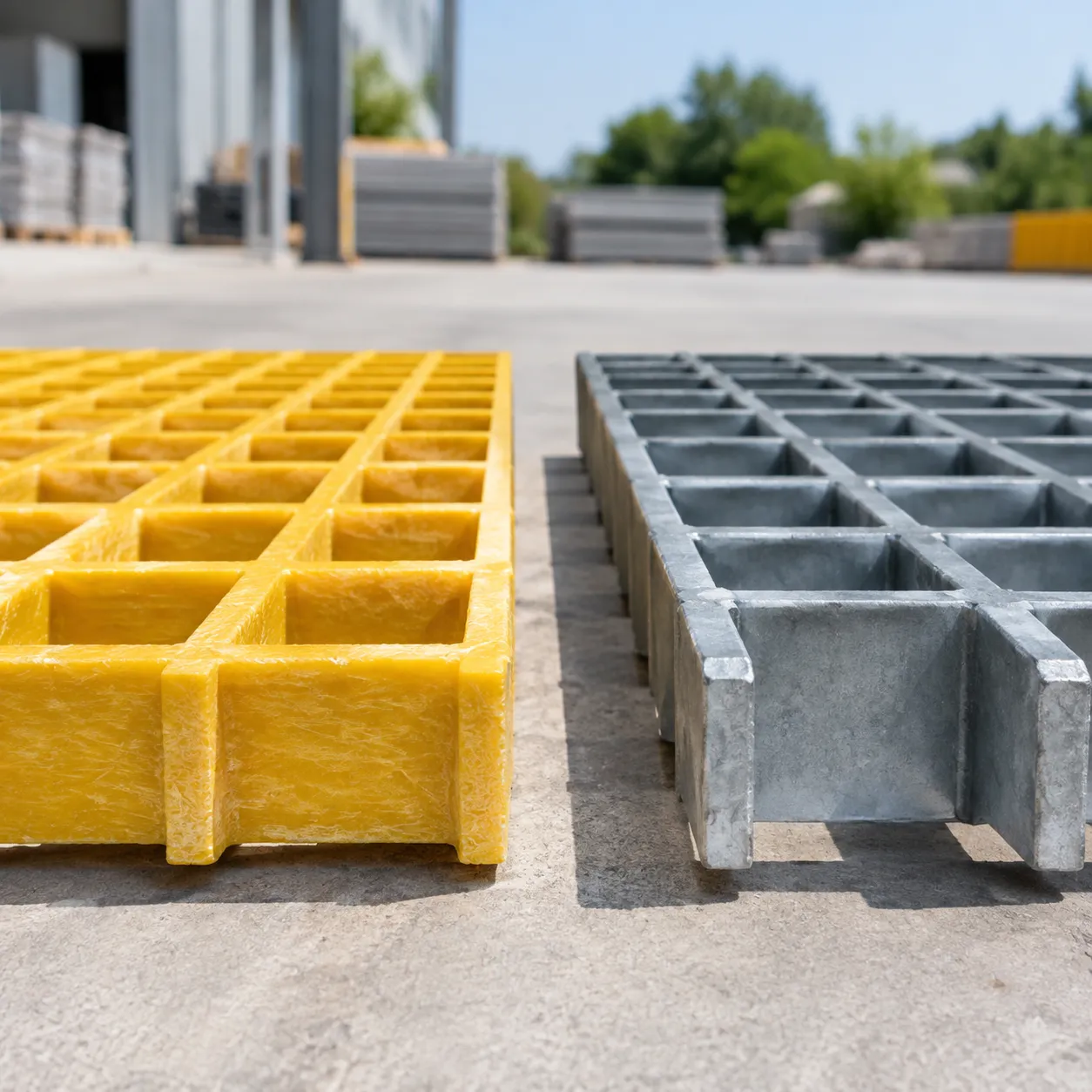
When buyers ask us about the real difference between frp and grp grating, the short answer comes down to terminology versus technical scope. While people often use the terms interchangeably in daily business, distinct variations exist in their raw fiber makeups, performance metrics, and sourcing dynamics.
| Feature / Factor | GRP Grating (Glass Reinforced Plastic) | FRP Grating (Broad Fiber Reinforced Polymer) |
|---|---|---|
| Reinforcement Type | Exclusively glass fibers (E-glass, E-CR glass) | Glass, carbon, aramid, or basalt fibers |
| Polymer Matrix | Polyester, vinyl ester, or epoxy resin | Polyester, vinyl ester, epoxy, phenolic |
| Tensile Performance | High (standard industrial grade) | High to ultra-high (application dependent) |
| Material Cost | Budget-friendly and highly economical | Varies from standard to premium |
| Market Prevalence | Standard commercial/industrial standard | Broad category including specialized designs |
Material Composition and Reinforcement Fibers
The fundamental variance lies in what goes into the composite matrix:
- GRP Grating: Relies solely on glass strands bonded within a liquid thermoset resin system. It uses woven rovings or continuous glass filament mats to give the panel its rigidity.
- FRP Grating: Serves as the overarching umbrella term. While over 95% of industrial FRP panels use glass reinforcement, specialized FRP products can feature carbon fibre reinforcement, aramid (Kevlar), or basalt fibers to handle extreme mechanical or thermal thresholds.
To explore how these material layouts perform under real-world stresses, review our detailed FRP grating guide on types, benefits, and applications.
Mechanical Strength and Durability
In everyday industrial operations, standard glass-based panels provide exceptional load support and flexural endurance.
- Glass-Reinforced Formulations (Standard GRP): Deliver robust bidirectional load-bearing capacity, absorbing heavy impacts without taking permanent bends or dents.
- Engineered FRP Variants: When an industrial specification calls for extreme rigidity, reduced deflection across massive spans, or ultra-lightweight performance, advanced FRP formulations with hybrid or carbon fibers deliver significantly higher tensile strength-to-weight ratios than base glass composites.
For standard walkways, trenches, and platforms, standard fiberglass composites easily handle pedestrian and vehicular loads while remaining fully corrosion-resistant.
Manufacturing Cost and Availability
Cost directly reflects the fibers inside the panel:
- GRP Solutions: Glass fibers are widely manufactured and cost-effective. This makes standard glass-reinforced mesh the most economical choice for corrosive flooring applications.
- Advanced FRP Solutions: If a high-spec FRP panel requires specialty carbon fibers or high-tier phenolic resins for extreme fire protection, the raw material and production costs climb rapidly.
For the vast majority of our industrial clients, evaluating the core FRP grating advantages and disadvantages ensures they don’t overspend on exotic fiber blends when standard glass panels provide multi-decade service life at a fraction of the cost.
Regional Usage: US vs. UK and European Terminology
Much of the confusion around these terms is geographic rather than technical:
- United States & North America: Engineers and project managers almost universally refer to composite structural profiles and mesh as FRP (Fiberglass Reinforced Plastic or Fibre Reinforced Polymer).
- United Kingdom, Europe, and the Middle East: Buyers and structural consultants routinely specify the exact same glass-filled composite products under the name GRP (Glass Reinforced Plastic).
If a project specification from Europe calls for heavy-duty GRP floor panels, a standard high-grade industrial fiberglass grating manufactured to standard US FRP specs will meet identical structural, chemical, and load requirements.
Key Features and Advantages of FRP/GRP Grating
When we supply composite grating to industrial projects worldwide, the goal is always the same: replace high-maintenance metals with a material that lasts. Whether labeled as fiberglass reinforced plastic or glass reinforced plastic, this material brings core engineering advantages that traditional steel or aluminum simply cannot match.
Superior Corrosion and Chemical Resistance
Traditional steel mesh begins to oxidize the moment it faces salt spray, industrial acid, or wastewater fumes. In contrast, composite grating uses an advanced polymer matrix that creates an impermeable barrier against aggressive chemical attack.
- Zero Rust: Unaffected by constant moisture, saltwater, and humidity.
- Chemical Immunity: Withstands acids, alkalis, solvents, and chlorine splash.
- Extended Life: Outlasts galvanized steel by decades in harsh environments, making FRP grating for chemical plants the industry standard for walkways and drainage trenches.
High Strength-to-Weight Ratio
One of the greatest benefits of fiberglass grating is how much load it carries relative to its weight. It delivers the structural rigidity of carbon steel at roughly one-third of the total weight.
| Feature | Structural Steel Grating | FRP / GRP Grating |
|---|---|---|
| Weight | Heavy (~100% baseline) | Lightweight (~30–35% of steel) |
| Corrosion Resistance | Poor (Requires coatings) | Exceptional (Built into the matrix) |
| Installation | Requires cranes and welders | Manual carry, easy field cuts |
| Electrical Conductivity | Highly conductive | Completely non-conductive |
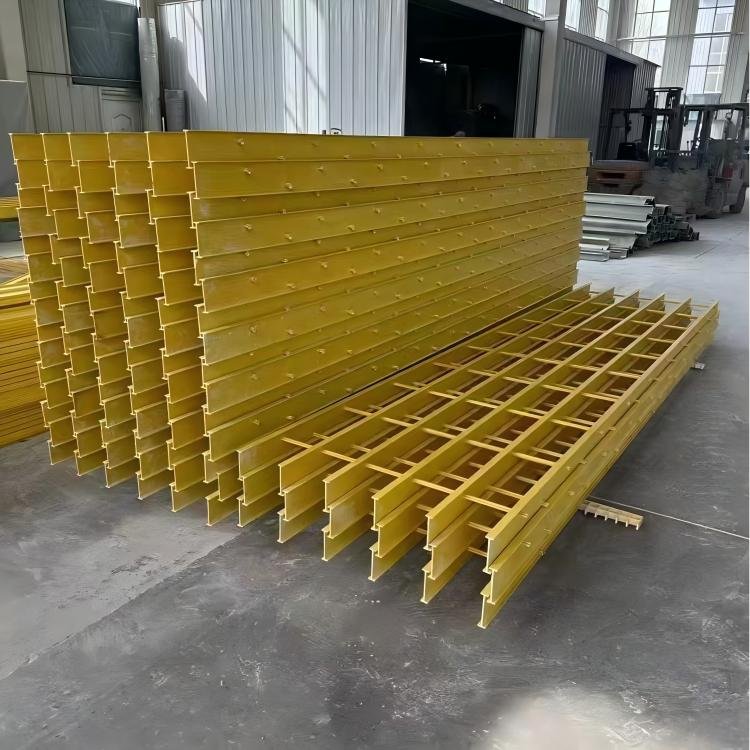
Because our grating is lightweight, installation teams handle panels manually without relying on heavy lifting cranes, drastically reducing freight costs and jobsite labor hours. For heavy-duty linear spans, pultruded FRP grating provides even higher unidirectional load capacities for high-traffic platforms.
Slip Resistance and Worker Safety
Slips, trips, and falls represent the majority of industrial workplace injuries. Metal checker plates and smooth steel bars quickly turn hazardous when covered in grease, water, or oil.
- Embedded Quartz Grit: Graded silica grit is cured directly onto the walking surface, delivering maximum traction.
- Concave Meniscus Surfaces: Molded panels naturally form a concave top edge that provides continuous, bi-directional shoe grip.
- Ergonomic Deflection: Unlike unforgiving concrete or rigid steel, composite materials offer slight natural elasticity, significantly reducing worker fatigue on long shifts.
Non-Conductive and Low-Maintenance Properties
For electrical substations, rail transit, and electronics manufacturing, electrical and thermal insulation is mandatory. Composite grating is completely non-conductive and non-sparking, removing the risk of stray currents or arc flashes. It is also non-magnetic and radio-frequency transparent.
Once installed, it requires zero ongoing maintenance. You never need to blast rust, apply anti-corrosion primer, or touch up industrial paint. The molded-in color pigments run entirely through the material thickness, keeping walkways looking clean and performing reliably for decades.
Common Applications of FRP and GRP Grating
When clients ask us about the practical difference between FRP and GRP grating in field applications, our answer comes down to environmental demands. Because both fiberglass reinforced plastic (FRP) and glass reinforced plastic (GRP) rely on glass-fiber reinforcements locked inside a resilient thermoset resin, they serve as the premier alternative to traditional steel in aggressive operating conditions.
We manufacture and supply these composite grating systems across critical industrial and municipal sectors worldwide.
Industrial and Chemical Processing Plants
Chemical processing facilities subject flooring to persistent chemical splashes, extreme pH levels, and acid vapors. Steel gratings corrode quickly in these conditions, leading to dangerous structural thinning.
- Electroplating and Pickling Lines: Unaffected by continuous acid drip and high-moisture air.
- Chemical Storage and Mixing Areas: Molded grating forms chemical-resistant spill containment floors that do not degrade.
- Battery Manufacturing Facilities: Acid-resistant resins prevent floor damage caused by electrolyte leaks.
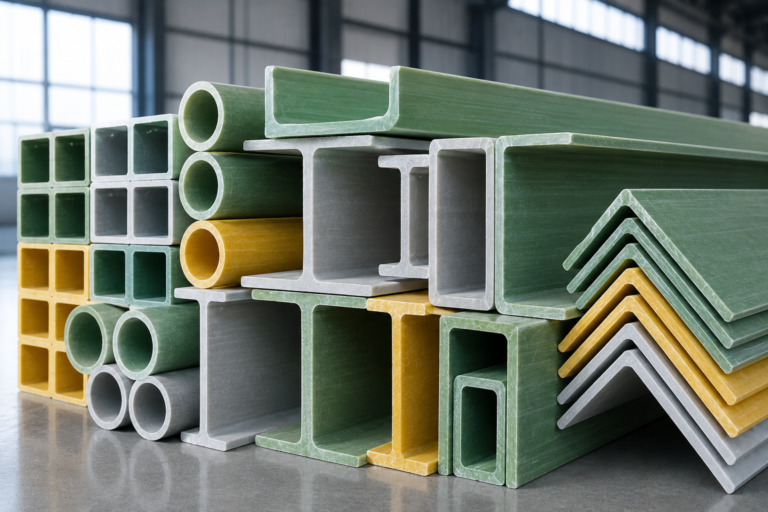
- Structural Framing Integration: Our gratings frequently pair with heavy-duty FRP pultruded structural profiles to build completely non-metallic, maintenance-free mezzanine systems.
Marine, Offshore, and Coastal Environments
Saltwater rapidly oxidizes standard steel and degrades galvanized coatings. We install marine-grade fiberglass grating on offshore platforms, boat docks, and ship decks to prevent salt spray deterioration.
- Offshore Oil and Gas Rigs: Pultruded grating panels withstand heavy wave impact while shaving tons of dead weight off topside platform loads.
- Marinas and Commercial Piers: Gritted walking surfaces provide reliable slip resistance for dockworkers navigating wet, algae-prone decks.
- Desalination Plants: Immune to high-salinity brine discharge that destroys typical metallic ductwork and walkways.
Water and Wastewater Treatment Facilities
Wastewater plants harbor damp, biological environments that generate caustic hydrogen sulfide ($H_2S$) gas. We routinely deploy GRP grating across treatment basins, clarifiers, and filtration stations where steel loses integrity within years.
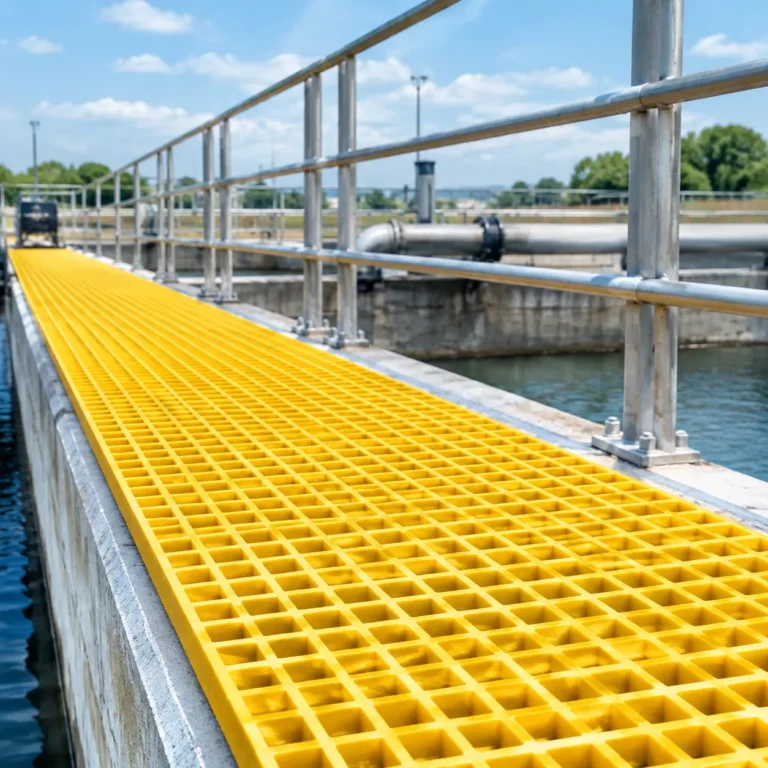
- Walkways over Aeration and Settlement Tanks: The non-corrosive composite profiles stand up to continuous microbial action and humidity.
- Screening and Pumping Stations: Molded mesh panels allow liquid to drain easily while sustaining reliable foot and cart traffic.
- Vapor Containment Zones: Our grating seamlessly integrates alongside specialized FRP odor control covers for wastewater tanks to protect operators while containing hazardous biological vapors.
Public Infrastructure, Walkways, and Trench Covers
Municipalities and public utility providers consistently choose composite grating to solve everyday safety and maintenance problems.
- Drainage and Utility Trench Covers: Molded FRP covers handle steady pedestrian and light-vehicular traffic across roadway sidewalks, wash-down bays, and maintenance yards.
- Electrical Utilities and Rail Transit: Because composite grating is inherently non-conductive and non-sparking, it protects workers around third rails, electrical substations, and high-voltage transformer yards.
- Pedestrian Footbridges and Nature Boardwalks: Lightweight panels make remote installation easy without requiring heavy lifting cranes, and the natural UV inhibitors keep paths solid in public parks for decades.
FRP vs GRP: How to Choose the Right Grating for Your Project
When evaluating the real-world difference between frp and grp grating, the choice rarely hinges on name alone. Since GRP is simply a fiberglass-specific subgroup of FRP, your decision comes down to matching resin chemistry, reinforcement type, and structural profiles to your job site conditions. We always advise assessing operational demands first to avoid overpaying for unnecessary specs or risking early material failure.
Evaluating Load Requirements and Environmental Exposure
Start by auditing the daily stress your walkways and platforms will face:
- Chemical Exposure: Identify whether the grating will encounter mild washdowns or aggressive acids. A standard polyester thermoset resin handles common industrial moisture, while vinyl ester matrices are mandatory for concentrated acids and alkalis.
- Mechanical Load & Span: Calculate foot traffic versus vehicular traffic. For large spans requiring high load-bearing capacity with minimal deflection, engineered FRP grating for bridge decking lightweight solution provides high structural integrity without burdening foundation steel.
- Safety Factors: In wet, oily, or coastal settings, select integrated meniscus or quartz-grit tops. Evaluating proven anti-slip options for FRP grating ensures worker safety and OSHA compliance in harsh slip-and-fall zones.
Balancing Budget and Performance Needs
Standard fiberglass reinforced plastic (GRP) serves roughly 90% of industrial access needs at a manageable price point. Advanced FRP options featuring specialized resin mixtures or carbon fibre reinforcement command higher initial costs but solve extreme structural or thermal challenges that standard glass fibers cannot survive.
| Grating Type | Primary Matrix & Fiber | Relative Cost | Best For |
|---|---|---|---|
| Standard GRP / FRP | Isophthalic Polyester + E-Glass | Economical | General industrial walkways, light wash areas, trench covers |
| Premium GRP / FRP | Vinyl Ester + E-Glass | Moderate to High | Chemical manufacturing, plating facilities, marine saltwater |
| Specialty FRP | Phenolic / Epoxy + Carbon/Hybrid | Premium | Offshore fire barriers, extreme temperature zones, aerospace |
Molded vs Pultruded Grating Options
Choosing between molded and pultruded fiberglass grating depends directly on your installation layout and support spacing:
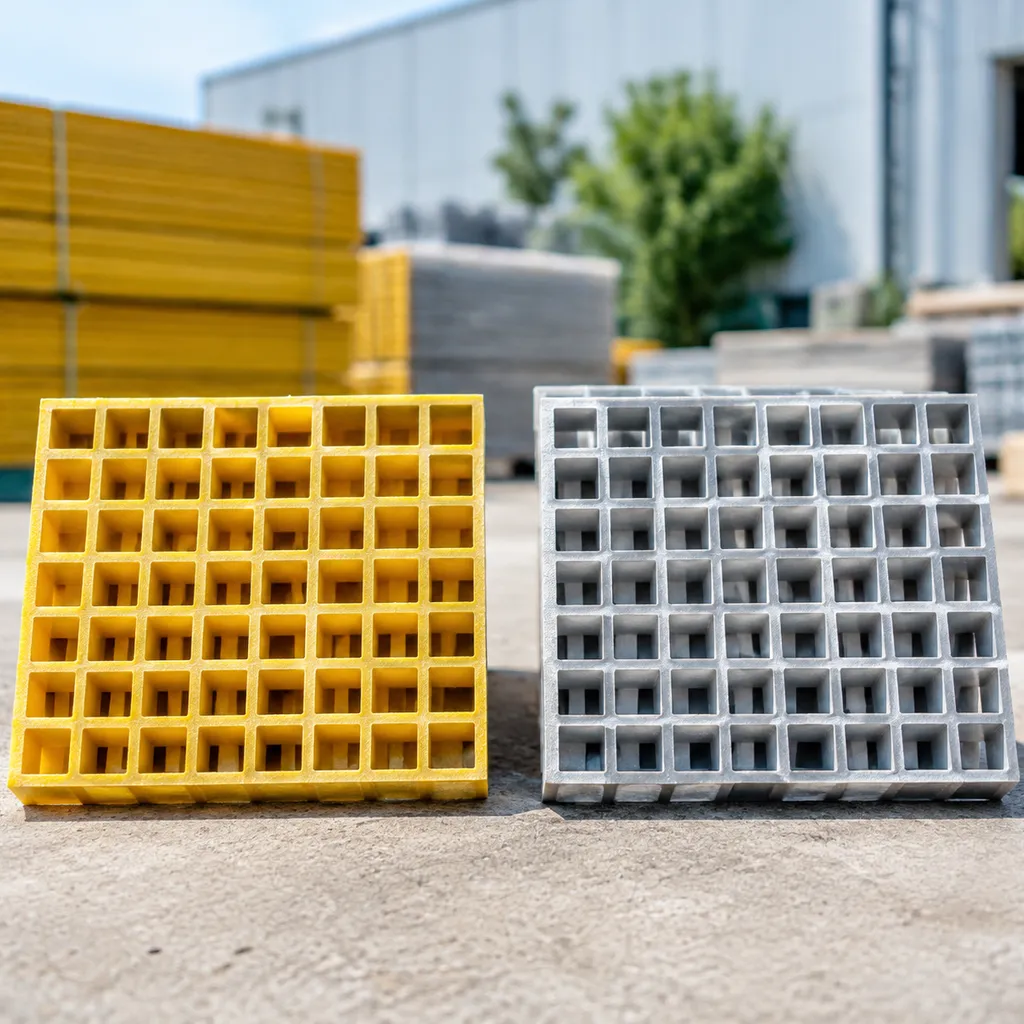
- Molded Grating: Features an interwoven mesh design providing bidirectional strength. It contains a high resin-to-glass ratio (roughly 65% resin to 35% glass), making it exceptionally resistant to chemical corrosion. It is ideal for complex layouts because field cutouts for pipes or penetrations do not compromise the overall panel strength.
- Pultruded Grating: Manufactured by pulling continuous glass strands through a die, creating high unidirectional strength (roughly 70% glass to 30% resin). It excels at long, unsupported spans and high load capacities, making it the superior choice where support beams are spaced far apart.