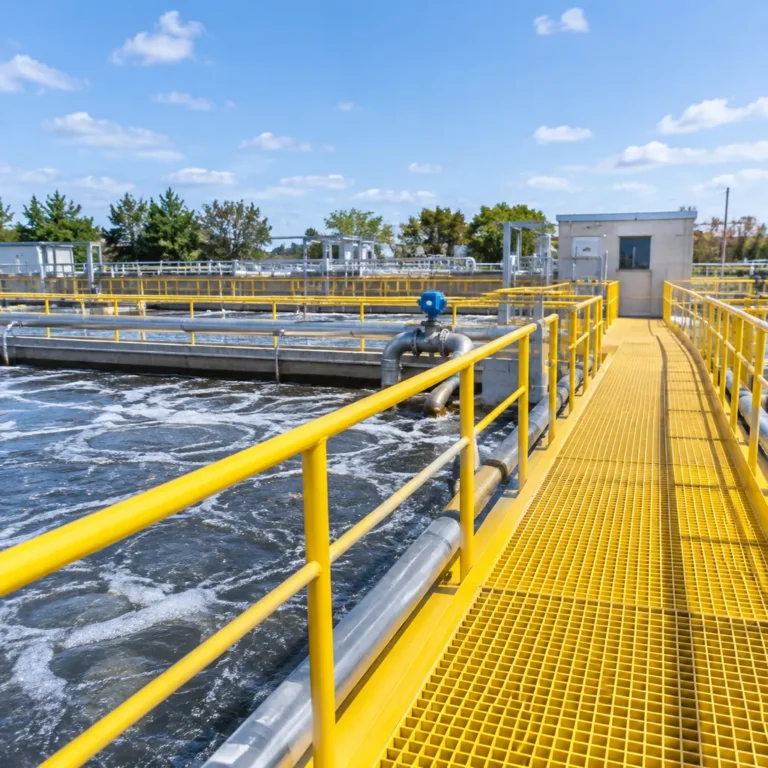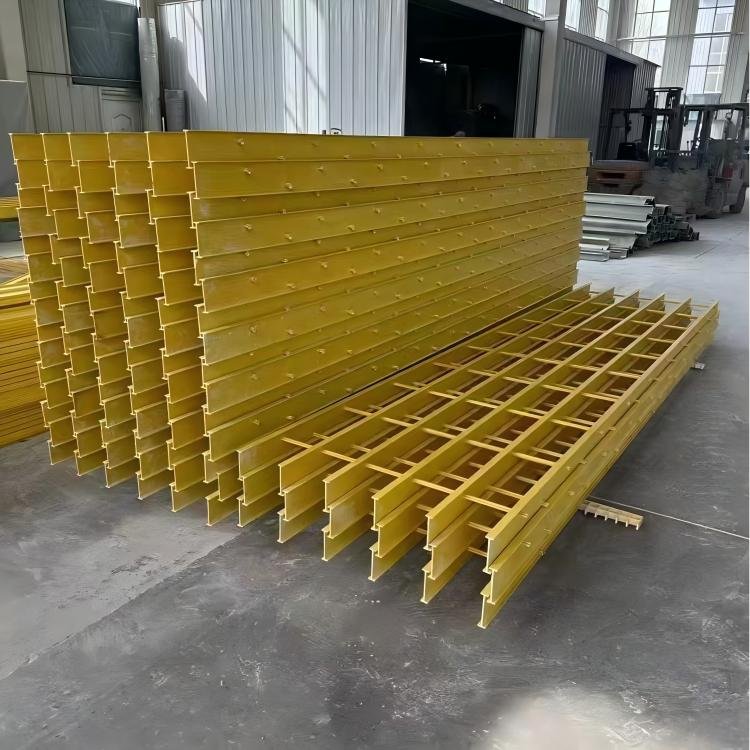
Pultruded Fiberglass Tube Sizes Round Square Rectangular
Explore pultruded fiberglass tube sizes in round square and rectangular profiles with lightweight corrosion resistant FRP options for structural indus
Tired of dealing with corroded metal or guessing which composite profile can actually handle your structural load?
Choosing the right FRP tubing makes all the difference in your project’s performance, safety, and lifespan.
That is why we put together this complete guide to Pultruded Fiberglass Tube: Square, Rectangular and Round Tube Sizes.
From standard wall thicknesses and load-bearing capacities to real-world industrial applications, you’ll find the exact dimensions and specs you need to select the perfect profile.
Let’s dive right in.
What Are Pultruded Fiberglass Tubes?
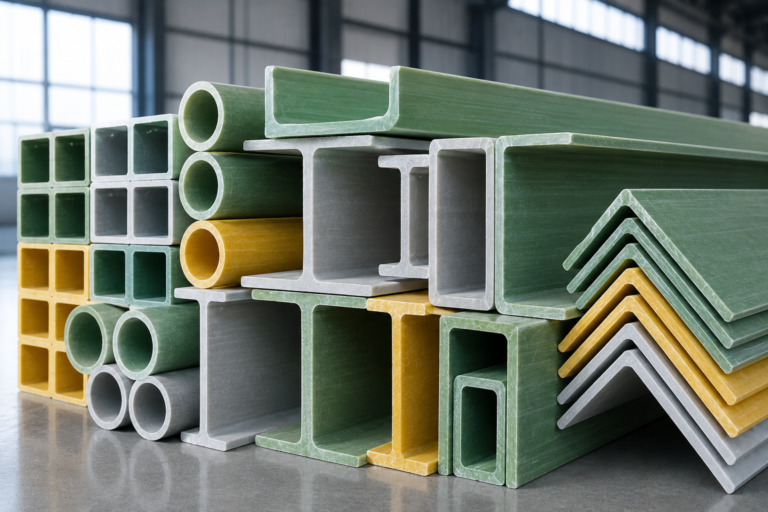
Pultruded fiberglass tubes are high-performance composite profiles engineered for structural applications across severe industrial, marine, and commercial environments. Often designated as FRP tubes (Fiber-Reinforced Polymer) or GRP tubing (Glass-Reinforced Plastic), these hollow structural fiberglass tubing components deliver reliable strength, dimensional consistency, and lasting durability without the excessive weight or corrosion risks of traditional steel and aluminum.
Manufactured in uniform round, square, and rectangular geometries, these tubes serve as rigid structural members designed to carry axial, bending, and torsional loads in demanding installations worldwide.
The Pultrusion Manufacturing Process
Pultrusion is a continuous, automated molding process specifically engineered to produce composite profiles with constant cross-sections. Unlike extrusion, which pushes molten material through a shaping die, pultrusion pulls reinforced raw materials through a high-temperature zone to ensure optimal fiber alignment and high structural density.
Fiber Infeed: Continuous glass rovings and stitched non-woven surface veils are pulled from tension creels to establish both longitudinal strength and surface durability.
Resin Impregnation: The fiber reinforcement passes through an engineered bath containing thermoset resin, wetting agents, pigments, and specialized fire-retardant or UV inhibitors.
Die Forming and Curing: The saturated reinforcements enter a precision-machined, heated steel die. The die compacts the composite mass into the targeted shape—round, square, or rectangular—while initiating an exothermic reaction that completely polymerizes and hardens the resin.
Continuous Pulling and Cutting: Reciprocating pullers steadily draw the fully cured, rigid structural profile out of the die, where an integrated diamond-tipped saw cuts each tube to specified lengths.
Key Material Composition and Properties
The mechanical performance of pultruded GRP tubing depends directly on the composite interaction between the reinforcing fibers and the surrounding thermoset polymer matrix:
Glass Fiber Reinforcement (60%–70% by weight): High-yield continuous rovings deliver maximum axial tensile and flexural strength along the length of the profile. Cross-directional mats reinforce the profile wall to resist radial bursting, twisting, and crush stresses.
Thermoset Resin Matrix (30%–40% by weight): Specialized formulations—such as isophthalic polyester, vinyl ester, or polyurethane—encapsulate the glass filaments. The resin shields against chemical attack, preserves geometric tolerances, and evenly distributes applied structural loads.
Surface Veil: A protective synthetic surface layer covers the outer perimeter, locking in glass fibers to eliminate fiber bloom, prevent UV degradation, and ensure a clean, resin-rich finish.
Key Benefits and Features of Pultruded Fiberglass Tubing
When we engineer structural profiles, performance under harsh conditions is our primary benchmark. Pultruded fiberglass tube profiles deliver a balanced combination of mechanical strength, environmental resilience, and long-term cost efficiency. Whether deployed as round, square, or rectangular sections, this composite material replaces traditional metals across heavy-duty industrial settings.
Feature Structural Fiberglass Tubing Structural Steel Aluminum
Weight Lightweight (approx. 75% lighter than steel) Heavy Lightweight
Corrosion Resistance Immune to rust, acids, and salts Requires coatings / rusts Vulnerable to galvanic corrosion
Electrical Conductivity Non-conductive (Insulator) High conductor High conductor
Thermal Conductivity Extremely low High High
Maintenance Needs Virtually zero Periodic repainting and treatment Moderate
High Strength-to-Weight Ratio
Our structural fiberglass tubing delivers exceptional tensile and flexural strength while weighing up to 75% less than structural steel and roughly 30% less than aluminum. Continuous longitudinal glass fibers combined with reinforcement mats produce a dense, uniform wall structure capable of handling substantial structural loads. This low weight drastically cuts freight expenses, simplifies installation, and eliminates the need for heavy lifting machinery on job sites.
Corrosion and Chemical Resistance
Unlike steel or aluminum, FRP tubes will not rust, rot, pit, or scale when exposed to moisture, saltwater, caustic chemicals, or acidic vapor. The resin matrix fully encapsulates the glass reinforcement, creating an impermeable barrier against severe degradation. For aggressive industrial environments, combining these tube profiles with dedicated frp grating for chemical plants creates an entirely non-metallic structural infrastructure that requires zero ongoing painting or anti-corrosion treatments.
Electrical and Thermal Insulation
Dielectric safety is an essential feature of pultruded GRP tubing. Because our fiberglass profiles do not conduct electricity, they eliminate spark and stray-current hazards in utility, rail, and telecommunication projects. Additionally, the composite material acts as an effective thermal insulator with minimal thermal expansion, maintaining structural dimensions across broad temperature shifts without thermal bridging.
Weather Durability and UV Resistance
Extended outdoor exposure often degrades inferior plastics, but our pultruded profiles are built for continuous open-air use. We formulate the resin system with integrated UV inhibitors and apply a synthetic surfacing veil during the pultrusion run. This barrier locks out solar degradation, prevents fiber bloom, and protects the structural tube wall from moisture absorption, ice expansion, and wind erosion.
Pultruded Fiberglass Round Tube Sizes and Specifications
We manufacture and supply high-performance round FRP tubes designed for demanding industrial environments. These tubular profiles offer continuous reinforcement along their entire length, delivering exceptional rigidity and uniform strength while remaining lightweight.
Standard Round Tube Diameters and Wall Thicknesses
Our structural fiberglass tubing comes in a wide variety of standard outer diameters (OD) and wall thicknesses to match global project requirements. We also provide custom lengths and sizing tailored to specific engineering loads. Selecting the proper profile geometry alongside our broader catalog of FRP pultruded profiles ensures maximum structural efficiency.
Outer Diameter (OD) Wall Thickness Standard Length
1.00 in (25.4 mm) 0.125 in (3.2 mm) 20 ft (6.1 m) / Cut-to-length
1.25 in (31.8 mm) 0.125 in (3.2 mm) 20 ft (6.1 m) / Cut-to-length
1.50 in (38.1 mm) 0.125 in – 0.250 in (3.2 – 6.4 mm) 20 ft (6.1 m) / Cut-to-length
1.75 in (44.5 mm) 0.125 in – 0.156 in (3.2 – 4.0 mm) 20 ft (6.1 m) / Cut-to-length
2.00 in (50.8 mm) 0.125 in – 0.250 in (3.2 – 6.4 mm) 20 ft (6.1 m) / Cut-to-length
2.50 in (63.5 mm) 0.156 in – 0.250 in (4.0 – 6.4 mm) 20 ft (6.1 m) / Cut-to-length
3.00 in (76.2 mm) 0.200 in – 0.250 in (5.0 – 6.4 mm) 20 ft (6.1 m) / Cut-to-length
Mechanical Properties of Round FRP Tubes
The cylindrical profile provides equal strength distribution across all radial axes, making it highly effective against torsional stress and deflection.
Tensile Strength: High longitudinal tensile capacity up to 30,000 psi (207 MPa) minimum, depending on resin configuration.
Flexural Modulus: Rigid load deflection resistance averaging 2.5 to 2.8 × 10⁶ psi (17 to 19 GPa).
Dielectric Properties: Completely non-conductive with a high dielectric strength, ensuring safety in active electrical environments.
Impact Resilience: High impact resistance that absorbs stress without permanent denting or bending.
Common Uses for Round Fiberglass Tubing
Round GRP tubing excels in outdoor, corrosive, and utility installations where traditional metals quickly degrade.
Industrial Safety Rails: Ideal for chemical plant walkways, water treatment facilities, and coastal handrails.
Electrical Utility Tooling: Used extensively for hot sticks, maintenance poles, and conduit framing.
Antenna and Communications Masts: Transparent to RF frequencies, eliminating signal interference.
Marine Infrastructure: Framing, supports, and dock structures exposed to continuous saltwater spray.
Pultruded Fiberglass Square Tube Sizes and Profiles
We manufacture and supply heavy-duty pultruded fiberglass square tubes engineered for demanding industrial environments. These square structural fiberglass tubing profiles provide exceptional torsional rigidity and flat fastening surfaces, making them far easier to bolt, join, and integrate than traditional round sections. When you need structural reliability without the dead weight or rust of metal, our square GRP tubing profiles deliver dependable performance.
Standard Square Tube Dimensions and Wall Thicknesses
Our pultruded fiberglass square tube sizes cover both lightweight utility tasks and high-load structural frameworks. We supply standard lengths with uniform wall dimensions to guarantee predictable engineering values across every batch:
1.0″ x 1.0″ (25.4 mm x 25.4 mm): Wall thickness of 0.125″ (3.2 mm) for light equipment frames, brackets, and protective covers.
1.5″ x 1.5″ (38.1 mm x 38.1 mm): Wall thicknesses of 0.125″ (3.2 mm) and 0.250″ (6.4 mm) for commercial handrails and lightweight framing.
2.0″ x 2.0″ (50.8 mm x 50.8 mm): Wall thicknesses of 0.125″ (3.2 mm), 0.187″ (4.7 mm), and 0.250″ (6.4 mm), widely used as industrial handrail posts and structural uprights.
3.0″ x 3.0″ (76.2 mm x 76.2 mm): Wall thickness of 0.250″ (6.4 mm) for heavy load-bearing columns and primary support beams.
4.0″ x 4.0″ (101.6 mm x 101.6 mm): Wall thicknesses of 0.250″ (6.4 mm) and 0.375″ (9.5 mm) for large-span substructures and structural towers.
We maintain high tooling precision to ensure uniform wall thickness and tight corner radiuses across our entire inventory of frp pultruded profiles.
Structural Load-Bearing Capabilities
Square FRP tubes offer balanced resistance to axial compression and bending forces:
High Flexural Strength: The uniform outer wall profile delivers equal moment of inertia on both the X and Y axes, preventing lateral twisting under concentrated loads.
Axial Column Strength: Continuous longitudinal glass roving combined with structural reinforcement mats provides superior compression resistance for load-bearing posts.
Impact Dissipation: Unlike thin-gauge steel or aluminum, our composite tubes flex slightly under extreme shock loads without taking a permanent bend or denting.
Common Applications for Square Tubing
Industrial builders and plant managers rely on our square fiberglass sections for projects where metal fails:
OSHA-Compliant Handrail Systems: 2-inch square FRP tubes serve as upright stanchions, mid-rails, and kick plates in corrosive water treatment and chemical facilities.
Access Platforms and Walkways: Ideal for support posts, cross-bracing, and framework beneath industrial flooring and non-conductive access systems.
Modular Equipment Racks: Non-magnetic, non-conductive framing for electrical utilities, switchgear enclosures, and data center support grids.
Corrosive Processing Framings: Structural skeletons for washdown booths, marine docks, and pickling plants exposed to continuous chemical vapor and salt spray.
Pultruded Fiberglass Rectangular Tube Sizes and Dimensions
We produce rectangular structural fiberglass tubing designed to deliver directional strength where standard shapes fall short. Unlike square or round profiles, rectangular pultruded sections offer asymmetric section properties, giving you higher load-bearing capacity along the major axis without adding unnecessary dead weight. These GRP tubing profiles serve as dependable alternatives to structural steel beams in chemically aggressive environments.
Common Rectangular Profile Dimensions
Our manufacturing lines accommodate a wide range of width, depth, and wall configurations. Below are common reference dimensions for structural layouts:
Outside Dimensions (Width x Depth) Wall Thickness Options Typical Section Application
50 mm x 25 mm (2.0″ x 1.0″) 3.2 mm, 4.0 mm Light conduit supports, enclosures
76 mm x 38 mm (3.0″ x 1.5″) 4.8 mm, 6.4 mm Secondary framing, ladder rails
100 mm x 50 mm (4.0″ x 2.0″) 4.8 mm, 6.4 mm Structural crossbeams, floor joists
152 mm x 50 mm (6.0″ x 2.0″) 6.4 mm, 9.5 mm Heavy stringers, support beams
200 mm x 100 mm (8.0″ x 4.0″) 9.5 mm, 12.7 mm Primary structural frameworks
Every rectangular profile is pulled through heated steel dies using premium continuous strand mats and unidirectional rovings, ensuring uniform wall thickness and dimensional consistency across the entire production run.
Architectural and Framing Specifications
When you design with rectangular FRP tubes, directional orientation determines performance:
High Moment of Inertia: Orienting the deeper dimension vertically maximizes bending resistance across spans, preventing deflection under heavy operational loads.
Connection Versatility: The broader flat face provides ample surface area for mechanical fasteners, gusset plates, or adhesive bonding without crushing the core.
Corrosion Resistance: Formulated with high-grade polyester or vinyl ester matrices to resist acid fumes, moisture, and chemical exposure commonly found across demanding industrial facilities.
Flame and UV Retardance: Produced with Class 1 fire-retardant resins and heavy-duty surface veils to protect the glass fibers from degradation caused by severe sunlight.
Industrial Applications for Rectangular Tubes
Our rectangular structural fiberglass tubing replaces structural steel channels and timber across diverse environments:
Pedestrian Walkway Stringers: Functioning as primary side rails and load supports paired with heavy-duty platforms.
Chemical Plant Racks: Supplying non-reactive support structures for piping, cable trays, and monitoring hardware.
Cooling Tower Frameworks: Serving as rot-proof framing elements that run continuously in hot, saturated conditions.
Modular Equipment Skids: Providing rigid, lightweight sub-bases for water treatment equipment and power distribution units.
Industrial Applications for Pultruded FRP Tubes
We manufacture our pultruded fiberglass tubes to handle demanding environments where traditional steel, aluminum, and timber quickly degrade. Thanks to their high strength, dimensional stability, and resistance to environmental stress, our round, square, and rectangular profiles serve as core building blocks across multiple heavy industries.
Construction and Structural Framing
In modern commercial and industrial construction, structural fiberglass tubing provides an exceptional load-bearing alternative to heavy carbon steel. We supply contractors and builders with square and rectangular tubes for assemblies that require fast installation and zero ongoing maintenance.
Modular Frameworks: Lightweight support frames for platforms, access bridges, and cooling towers.
Stair and Rail Systems: Round and square FRP tubes engineered for structural handrails, guardrails, and safety barriers.
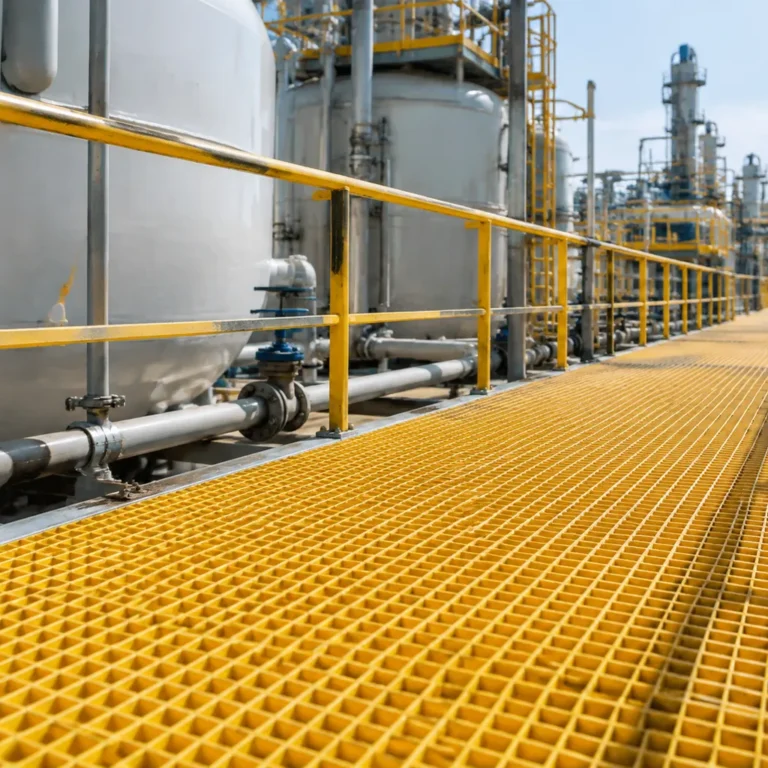
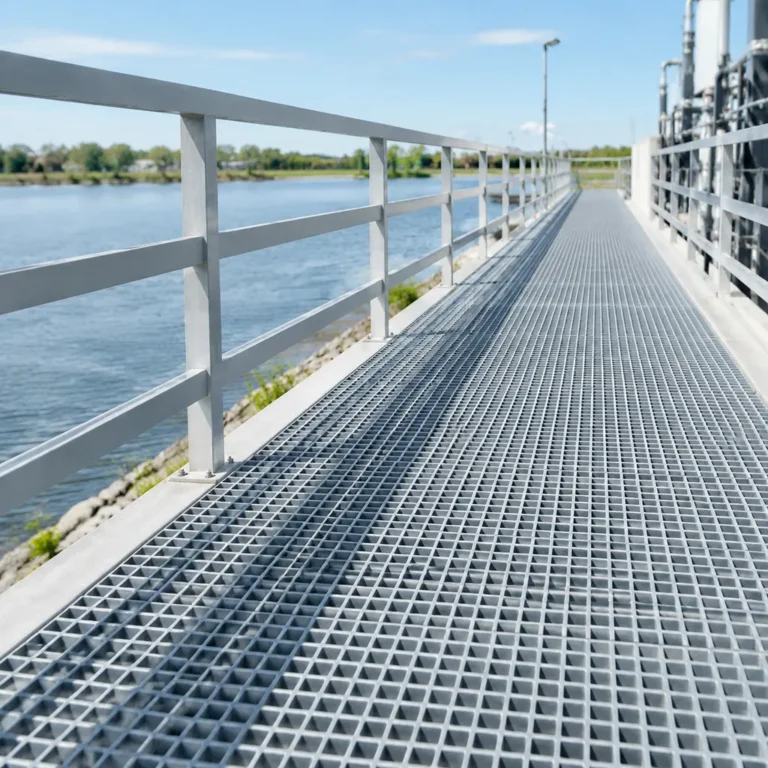
Integrated Walkways: Structural framing built with GRP tubing pairs seamlessly with FRP pultruded grating to create complete, non-corroding walkway systems.
Architectural Features: Clean-lined profiles used for sunshades, facades, and screen walls with consistent wall thickness and long-term structural integrity.
Electrical, Utilities, and Telecommunications
Because our FRP tubes are non-conductive and transparent to electromagnetic frequencies, they are essential across the energy and communications sectors. They protect technicians from electrical hazards while ensuring high reliability for sensitive hardware.
Utility Infrastructure: Crossarms on utility poles, transformer barriers, and transmission line spacers.
Telecommunications: Radomes, 5G antenna masts, and housing structures that require complete RF transparency without signal distortion.
Tooling and Safety Gear: Lineman hot sticks, reach tools, and non-conductive ladder rails designed to prevent arc-flash and electrical shock hazards.
Marine, Offshore, and Chemical Processing
Saltwater, harsh splash zones, and corrosive chemical vapors destroy bare and galvanized metals over time. We supply pultruded fiberglass tube profiles formulated with premium resin matrices specifically to resist acid, alkali, and moisture damage.
Chemical Facility Infrastructure: Framing for tank battery supports, chemical pipe racks, and valve-access platforms operating alongside FRP grating in chemical plants.
Offshore and Coastal Installations: Pier pilings, dock framing, seawall supports, and boat lift structures that resist barnacle buildup and constant saltwater exposure.
Water and Wastewater Plants: Scum baffles, aerator supports, and sludge handling catwalk frames that stand up to constant humidity, chlorine, and hydrogen sulfide.
How to Select the Right Fiberglass Tube Profile and Size
Choosing the ideal profile depends on how your structure handles mechanical loads, environmental exposure, and connection points. We engineer every pultruded fiberglass tube—square, rectangular, and round tube sizes alike—to meet distinct structural and architectural challenges.
Round vs. Square vs. Rectangular Profiles
Each profile geometry offers unique structural advantages:
Profile Shape Best Use Cases Structural Advantage Connection Method
Round Handrails, antenna masts, conduit, tool handles Uniform torsional resistance, low wind resistance Sleeve connectors, threaded inserts, rivets
Square Framework, cross-bracing, equipment supports Balanced multi-axis bending strength Flat gusset plates, bolted angle brackets
Rectangular Beams, joists, lintels, horizontal rails Maximum single-axis bending and load resistance Bolted through-plates, end-caps, brackets
Round FRP tubes excel when forces hit from any direction or when fluid and aerodynamic drag must stay low.
Square GRP tubing provides flat, flush surfaces that make mechanical joining straightforward for modular framing systems.
Rectangular structural fiberglass tubing handles heavy directional bending moments, functioning efficiently as horizontal support beams.
Determining Wall Thickness and Load Requirements
Selecting the proper wall thickness ensures your assembly supports design loads without unnecessary weight or cost:
Identify primary load directions: For pure vertical or horizontal loads, rectangular sections provide higher moment of inertia with a thinner wall. For multidirectional or rotational stress, choose square or round tubing.
Calculate span limits: Longer, unsupported spans require thicker walls or larger cross-sections to minimize deflection under working loads.
Evaluate impact zones: Heavy industrial walkways and impact-prone machinery guards require thicker wall sections to avoid localized puncture or crushing.
Account for environmental stresses: Thermal shifts, wind shear, and continuous chemical exposure influence your total safety margin when sizing the profile wall.
Custom Sizing, Cutting, and Fabrication Options
Off-the-shelf catalog dimensions do not fit every engineering challenge. When standard profiles fall short of specific project demands, our custom FRP fabrication team delivers precision solutions built to print:
Precision cutting and miter angles: Tubes pre-cut to exact lengths for field assembly without job-site delays.
CNC drilling and slotting: Factory-machined bolt holes, connection patterns, and slots that maintain fiber integrity.
Custom wall builds: Specialized continuous roving and mat layer configurations tailored for elevated axial or hoop strength.
Protective finishes: Factory-applied polyurethane coatings for extended UV protection and color matching in harsh outdoor sites.
Frequently Asked Questions About Pultruded Fiberglass Tubing
How do fiberglass tubes compare to steel and aluminum?
Pultruded fiberglass tubes deliver a superior balance of strength, weight, and environmental endurance compared to traditional metals. While structural steel offers high rigidity, it is heavy and prone to rust, requiring expensive ongoing coatings. Aluminum is lightweight, yet it corrodes in chemical environments and conducts electricity.
Our pultruded fiberglass tube: square, rectangular and round tube sizes offer specific structural advantages:
Weight: FRP tubes weigh roughly 70% less than steel and 30% less than aluminum, dramatically reducing freight and installation labor.
Corrosion Resistance: GRP tubing will not rust, rot, or degrade when exposed to acids, saltwater, or industrial chemicals.
Conductivity: Unlike metal tubing, structural fiberglass tubing is non-conductive both electrically and thermally, ensuring worker safety around live equipment.
Impact Memory: Fiberglass absorbs heavy impacts and deflects without permanent bending, whereas aluminum and thin-wall steel dent easily.
In structural layouts where frames integrate with other profiles, pairing these tubes with components like FRP grating embed angles creates an entirely non-corrosive, maintenance-free framework.
Can pultruded fiberglass tubes be cut and drilled on-site?
Yes. You can fabricate, cut, and drill structural fiberglass tubing directly in the field using standard mechanical tools. You do not need hot-work permits, welding equipment, or specialized fabrication rigs on-site.
Cutting: Use standard circular saws, chop saws, or angle grinders equipped with continuous-rim diamond grit or carbide-tipped abrasive blades to produce clean, chip-free cuts across any tube profile.
Drilling: Standard high-speed steel (HSS) or carbide drill bits work effectively. Maintain steady pressure and moderate drill speeds to avoid heat buildup.
Edge Sealing: Whenever you cut through the profile wall, we recommend applying a polyurethane or resin sealant to the exposed cut edges to preserve moisture resistance and long-term durability.
What are the standard lengths available for FRP tubing?
We produce and stock pultruded fiberglass tubes in standard factory lengths of 20 feet (6.1 meters) and 10 feet (3.05 meters) to fit container shipping and flatbed transport requirements. Because pultrusion is a continuous manufacturing process, we also manufacture custom cut-to-length sections to eliminate on-site waste for your project. Whether your design requires square, rectangular, or round geometry, our standard wall profiles can be tailored to meet your target span, deflection limits, and installation specs.