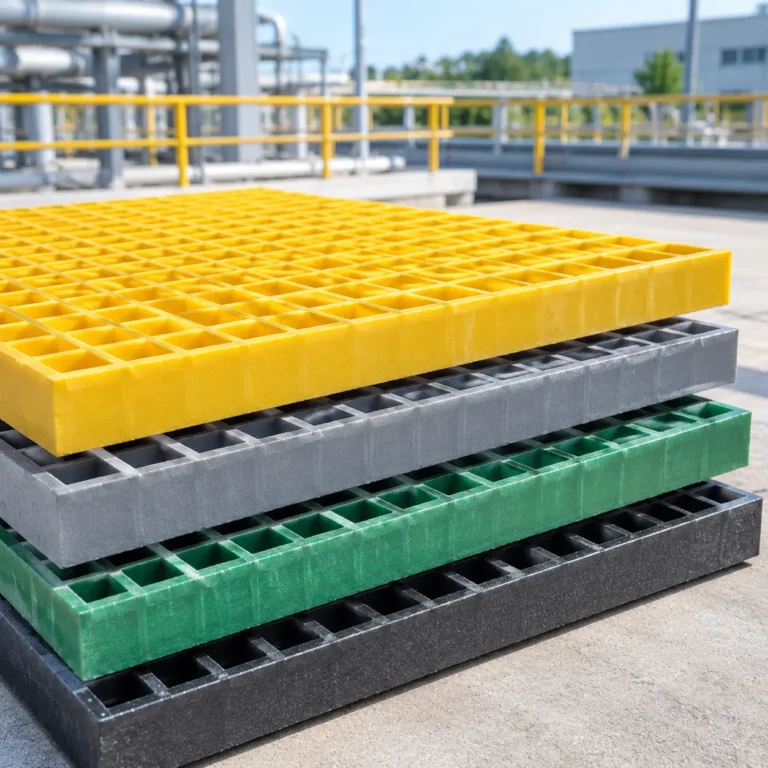
FRP Grating for Chemical Plants Benefits and Uses
Core Engineering Benefits of FRP Grating in Chemical Plants
Operating a chemical processing facility means constantly fighting aggressive media, safety liabilities, and costly structural upkeep. When metallic systems deteriorate under continuous exposure to acidic fumes and caustic washdowns, operational risk escalates. We design our structural composite grating to replace failing traditional materials, delivering predictable performance across extreme processing zones.
Chemical Resistant Grating Performance Against Aggressive Acids and Caustics
Chemical environments rapidly destroy carbon steel and pit stainless alloys. We formulate our chemical resistant grating using premium resin systems, including premium vinyl ester, to resist extreme pH ranges.
- Acid and alkali immunity: Withstands continuous exposure to sulfuric acid, hydrochloric acid, nitric splashes, and sodium hydroxide without delamination or softening.
- Corrosion barrier: Molded continuous fiberglass rovings are completely encapsulated in resin, blocking corrosive penetration into the core laminate.
- Zero structural degradation: Unlike galvanized walkways that rust from the inside out, our composite profile retains its structural integrity in saturated chemical vapor areas.
High Strength-to-Weight Ratio Reducing Structural Dead Load
Structural loads dictate the engineering and support steel requirements of your access infrastructure. Our molded and pultruded fiberglass systems match or exceed the working load capacity of traditional steel while weighing up to 70% less.
- Lower dead weight: Significantly decreases structural load demands on elevated platforms, secondary containment structures, and pipe bridges.
- Manual handling ergonomics: Lighter panels mean two technicians can move and place panels manually, cutting crane rental requirements and installation staging time.
Plant Safety with Slip Resistant Industrial Flooring and Non-Conductive Access Platforms
Slip-and-fall injuries and electrical contact remain primary hazards in chemical plants. We directly integrate safety features into the grating structure:
- Superior traction: Gritted quartz or concave top surfaces create high-traction slip resistant industrial flooring that prevents hydroplaning even when coated in wet chemicals, lubricants, or polymers.
- Dielectric safety: Glass-reinforced polymer matrices possess exceptionally high dielectric strength, creating non-conductive access platforms that protect personnel around transformers, MCC rooms, and electrolysis cells.
- Anti-static mitigation: For classified processing areas, our conductive grating options discharge static electricity to neutralize ignition sources near volatile solvents.
Fire Retardant Properties Meeting ASTM E-84 Class 1 Grating Standards
Fire containment is non-negotiable across chemical processing facilities. We formulate our fire-retardant industrial composite grating to suppress combustion and smoke propagation:
- Certified flame resistance: Independently tested to meet ASTM E-84 Class 1 fire performance with a Flame Spread Index of 25 or lower.
- Self-extinguishing matrix: High concentrations of alumina trihydrate (ATH) and halogenated resin systems starve flame spread immediately when the heat source is removed.
Zero Hot-Work Permits and Rapid On-Site Fabrication
Modifying steel flooring requires hot-work permits, fire watches, operational line shutdowns, and welding rigs. Our FRP systems eliminate these operational bottlenecks completely.
- Standard tool cutting: Panels can be resized, cut out for pipe penetrations, and edge-trimmed directly in the field using circular saws with diamond or carbide-grit blades.
- No spark hazards: Cold-cutting operations generate no sparks, eliminating permit delays in volatile production zones.
- Instant sealing: Cut edges require only a brush-on resin coat to restore chemical resistance, allowing maintenance crews to complete retrofits during active operations.
| Performance Metric | Carbon / Galvanized Steel | Stainless Steel (304/316) | Molded FRP Grating |
|---|---|---|---|
| Acid & Caustic Resistance | Poor (Rapid rust/corrosion) | Moderate (Pitting risk with chlorides) | Superior (Chemically inert matrix) |
| Weight per Square Meter | Heavy (~100% baseline) | Heavy (~100% baseline) | Lightweight (~30% of steel) |
| Slip Hazard Mitigation | Low (Slick when wet/oiled) | Low (Smooth/serrated wears down) | Maximum (Embedded quartz grit/concave) |
| Electrical Conductivity | Highly Conductive | Highly Conductive | Non-Conductive (Dielectric) |
| Field Cutting & Fitting | Hot-work permit required | Hot-work permit required | Cold cut on-site (Zero spark risk) |
| Fire Retardancy | Non-flammable | Non-flammable | ASTM E-84 Class 1 (FSI ≤ 25) |
Total Cost of Ownership: FRP Grating vs. Steel in Chemical Plants

When evaluating FRP grating for chemical plants, benefits extend far beyond initial procurement specs. Looking strictly at purchase price per square meter misses the point. In aggressive chemical operating environments, traditional metals become bottomless operational expense pits. We routinely see plants replace carbon steel or even higher-grade metals years ahead of schedule due to continuous acid vapor attack. Assessing real value requires looking at the total cost of ownership across a 20-year structural lifecycle.
CapEx vs. OpEx Over a 20-Year Operational Lifecycle
Carbon steel carries an attractive upfront invoice, but the initial capital savings vanish within three to four years. Stainless steel (304 or 316) demands an extreme CapEx premium, yet it remains prone to stress corrosion cracking and pitting in chloride or acidic washdown conditions.
Our molded and pultruded composite products flip this equation. While initial acquisition tracks slightly higher than galvanized steel, operating expenses drop to near zero immediately after installation. When evaluating FRP grating advantages and disadvantages through a lifecycle lens, composites clearly outperform standard structural metals.
| Evaluation Metric | Carbon Steel (Galvanized) | Stainless Steel (316) | Heavy-Duty Vinyl Ester FRP Grating |
|---|---|---|---|
| Initial Purchase Cost (CapEx) | Low | High to Extreme | Moderate |
| Handling & Rigging Equipment | Heavy cranes required | Heavy cranes required | Minimal (up to 70% lighter) |
| Maintenance & Recoating | Every 2–4 years | Periodic passivating/clearing | Zero maintenance required |
| Corrosion Downtime Risk | High (acid/alkali attack) | Moderate (chlorides/pitting) | Virtually zero |
| Typical Chemical Lifespan | 3–6 years | 8–12 years | 20+ years |
| Total 20-Year Cumulative Cost | Extremely High | High | Lowest Total Cost |
Eliminating Sandblasting, Repainting, and Corrosion Downtime
Maintaining metal platforms around chemical reactors and pickling tanks requires ongoing sandblasting, priming, and epoxy recoating. These tasks do not just cost paint and labor—they demand planned shutdowns, containment tents to trap blast media, and complex environmental disposal procedures.
- No surface coating failure: Our chemical resistant grating uses through-body resin pigmentation. Chemical spills, gouges, and deep scuffs cannot expose an unprotected substrate to rust or rot.
- Continuous plant uptime: Because composite grating will not scale, flake, or structurally degrade in solvent or acid atmospheres, routine maintenance stops completely.
- No environmental blast mitigation: Maintenance crews avoid the safety overhead and environmental containment measures associated with stripping lead- or epoxy-coated steel.
Long-Term Cost Savings from Reduced Labor and Equipment Replacement
Because our composite grating weighs roughly one-third of structural steel, crew installation productivity doubles. Field retrofits do not require structural cranes, heavy lifting gear, or certified hot-work crews. Standard carbide hand tools allow workers to quickly shape panels around piping headers, vessel nozzles, and structural columns on the spot.
Over decades of service in corrosive environments, plant owners eliminate repeated structural replacements, emergency structural bracing, and secondary containment damage. Investing in targeted structural composites directly protects bottom-line capital efficiency while permanently securing facility walkways.
Technical Grating Selection Guide for Chemical Facilities
Selecting the proper composite system requires matching your plant’s specific chemical exposures, mechanical spans, and safety classifications directly to the right resin matrix and fabrication style. We manufacture our profiles to eliminate corrosion failures before they start, ensuring every square foot meets your operational demands. When planning layouts, consulting our standard and custom FRP grating sizes guide helps match exact span dimensions to specific chemical exposures.
Resin Matrix Options: Isophthalic vs. Vinyl Ester Resin Grating
The resin matrix determines how well your grating holds up against aggressive reagents over decades of contact:
- Isophthalic Polyester Resin: Our standard industrial formulation. It offers dependable resistance against splash-and-spill exposure to moderate acids, mild caustics, and water-treatment reagents.
- Vinyl Ester Resin Grating: Formulated specifically for harsh, continuous chemical abuse. This system resists hot organic acids, concentrated alkalis, chlorine, and aggressive solvents where conventional resins break down.
| Grating Type | Primary Structural Benefit | Recommended Chemical Plant Application |
|---|---|---|
| Molded Vinyl Ester | Bi-directional load capacity, maximum chemical barrier | Chemical containment sumps, pump skids, trench covers |
| Pultruded Industrial | High stiffness-to-weight ratio, long span support | Pipe bridge walkways, wide structural platforms |
| Covered FRP | Solid-top sealing, vapor and fluid barrier | Odor control areas, overhead walkway drip prevention |
| Conductive / Anti-Static | Surface static discharge, non-sparking | Solvent storage areas, Class I Division 1 classified zones |
Molded FRP Grating for Multi-Directional Load Capacity and Skid Sumps
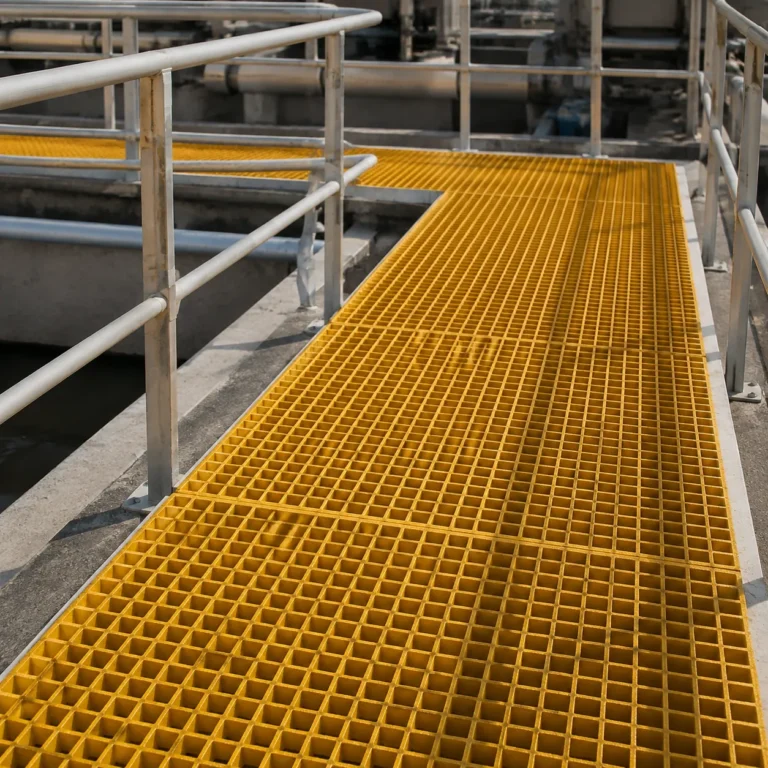
Our molded FRP grating features a one-piece, interwoven mesh construction with continuous glass roving. This bi-directional architecture delivers equal strength along both axes, allowing field cuts for piping penetrations, circular sumps, and complex machinery footprints without sacrificing structural integrity. It is our top recommendation for chemical plant walkways, pump pads, and drainage trenches subjected to multi-directional rolling loads.
Pultruded Fiberglass Grating for Wide Structural Spans
When platforms require wide structural support spans with minimal intermediate steel supports, our pultruded fiberglass grating delivers the necessary unidirectionally aligned glass density. Utilizing high-fraction roving and continuous strand mats, these profiles provide maximum stiffness and minimal deflection across long spans. For deeper structural frame integration, engineers evaluate our pultruded profiles and resin selection guide to pair load-bearing I-beams with pultruded panels.
Covered FRP Grating for Odor Control and Chemical Vapor Containment
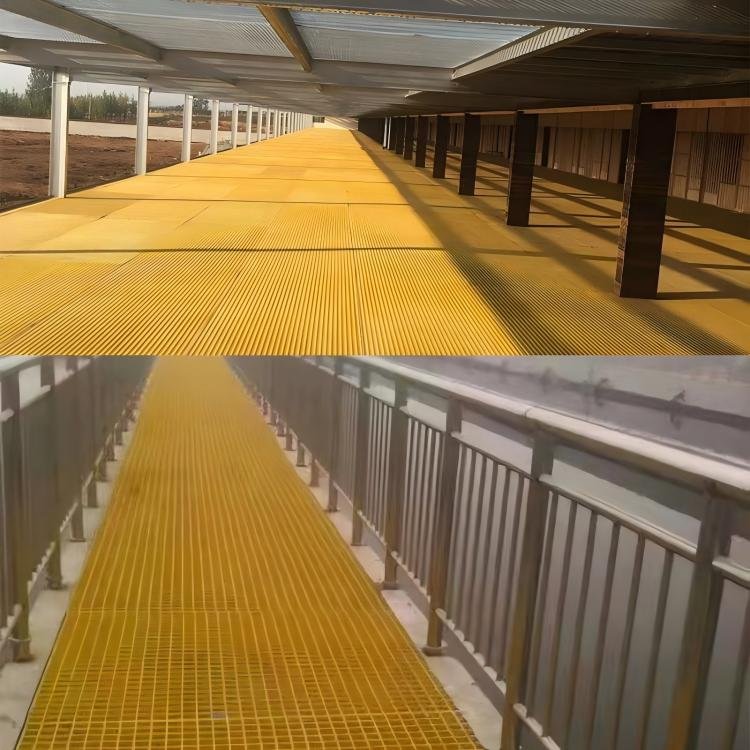
Covered FRP grating bonds a solid fiberglass plate directly to a molded or pultruded base panel. This creates a continuous, high-traction walking surface that prevents hazardous chemical spills from dripping onto equipment below. Chemical plants rely on this design over process trenches, acid neutralization pits, and bioreactors to lock in fugitive chemical fumes, toxic vapors, and industrial odors.
Anti-Static FRP Grating for Volatile, Explosion-Risk Zones
Standard composites are natural electrical insulators. In classified, explosion-risk environments—such as solvent handling units, alcohol storage farms, and fine chemical processing bays—accumulated static charge introduces catastrophic ignition hazards. We formulate our conductive and anti-static FRP grating with carbon-black additives embedded throughout the surface and matrix. This design safely dissipates electrostatic buildup to ground, providing reliable non-sparking safety across hazardous zones.
Key Application Scenarios Across Chemical Processing Infrastructure
In severe chemical processing environments, structural materials face constant exposure to splash, vapor, and mechanical stress. We engineer our fiberglass systems specifically for high-risk plant zones where coated carbon steel and galvanized metals fail prematurely.
Corrosion Resistant Trench Covers and Chemical Containment Sumps
Drainage trenches and secondary containment pits routinely collect high-concentration acid wash, caustic runoff, and aggressive solvents. Standard steel grates rapidly thin out, warp, and create serious fall hazards.
- Fluid flow & isolation: Molded open-mesh panels permit immediate drainage into sumps while maintaining bi-directional strength across channel walls.
- Odor & splash containment: In areas requiring vapor suppression or direct spill shielding, our solid-surface fiberglass trench covers seal off hazardous fumes while handling daily plant pedestrian traffic.
- Chemical immersion: Vinyl ester formulations withstand constant immersion in acidic and alkaline effluents without structural degradation.
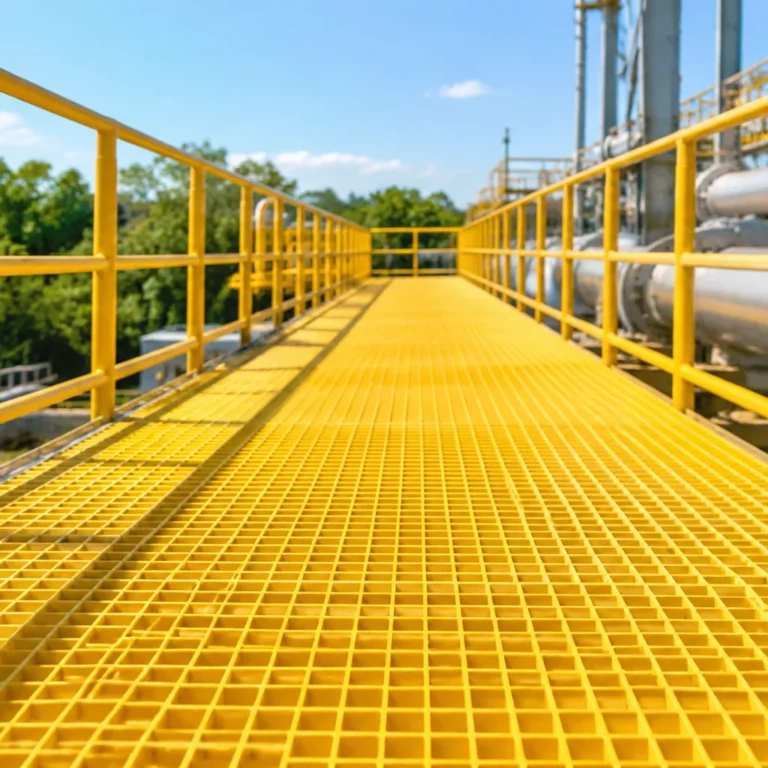
Elevated Industrial Catwalk Grating and Reactor Access Walkways
Catwalks flanking reactor heads, distillation columns, and mixing vessels are subject to continuous acid vapors and airborne condensates.
- Weight reduction: Being up to 70% lighter than structural steel, our heavy-duty FRP grating drastically cuts structural dead load on elevated frameworks and vessel brackets.
- Workplace traction: Integral gritted surfaces deliver reliable slip resistance around process vessels where condensation, foam-over, or chemical residue create slick walking conditions.
- Non-sparking operations: During reactor maintenance and catalyst changeouts, the non-sparking composite construction eliminates ignition risks near volatile processing ports.
Storage Tank Farms, Loading Bays, and Acid Washdown Stations
Tank diked areas, railcar discharge racks, and truck load-in bays experience heavy industrial foot traffic combined with sporadic chemical spills during fluid transfers.
- Washdown resilience: Cleaning crews can spray high-pressure hot water, caustic detergents, or acid rinses across floors without stripping protective coatings or inducing rust.
- Impact tolerance: Continuous fiberglass strand weaving gives our panels the elasticity to absorb accidental tool drops and heavy drum placement without permanent deformation.
- Dielectric safety: Ground-level unloading bays benefit from the composite’s electrical non-conductivity, protecting line operators from stray currents around pumping machinery.
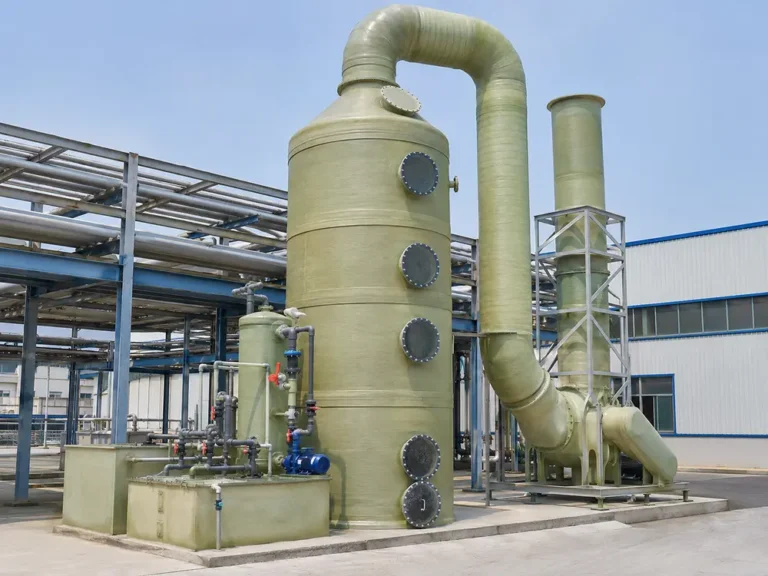
Scrubber Platforms, Cooling Tower Decks, and Acid-Unloading Docks
Gas scrubbers, cooling towers, and dockside transfer lines combine constant moisture, chemical off-gassing, and environmental weathering.
| Application Area | Primary Hazard | FRP Structural Advantage |
|---|---|---|
| Scrubber Platforms | Acidic exhaust gas, caustic mist, and process condensation | Total immunity to pitting and rust; zero painting required |
| Cooling Tower Decks | Continuous high humidity, biocides, and treated water spray | Rot-proof composite body; prevents moss and slick algae buildup |
| Acid-Unloading Docks | Bulk splash risk, mechanical wear, outdoor UV exposure | High strength-to-weight ratio with UV inhibitors for extended outdoor service |
Case Study: Structural Retrofit in an Operational Chemical Facility
When aggressive acid vapors attack standard metal flooring, structural failure is only a matter of time. We worked with a major chemical manufacturing facility in Germany facing severe infrastructure degradation across their active processing aisles and transfer corridors.
The Challenge: Severe Structural Steel Corrosion from Acid Vapor Exposure
The plant’s existing galvanized carbon steel walkways and platform covers had reached a critical failure state:
- Pitting and structural thinning: Continuous exposure to hot hydrochloric and sulfuric acid vapors oxidized the zinc coating within months, eating into the structural steel web.
- Elevated safety risks: Severe rusting compromised floor load-bearing capacity and created jagged, compromised edges across elevated catwalks.
- Escalating OpEx: The maintenance team had to schedule repeated sandblasting and protective recoating every 12 to 18 months, causing costly workflow interruptions and safety inspection red flags.
- Severe slip hazards: Chemical residues mixed with water on corroded, slick steel plates created dangerous footing for field technicians.
The Solution: Installing Heavy-Duty Molded Vinyl Ester FRP Grating
To permanently resolve the corrosion cycle without halting facility operations, we engineered and supplied custom-fabricated panels of molded vinyl ester FRP grating.
- Targeted resin matrix: Formulated with premium vinyl ester resin to deliver maximum chemical resistance against concentrated acid spills, alkaline splashback, and aggressive vapor condensates.
- Integrated grit surface: Built with a hard-wearing quartz gritted profile bonded directly into the top surface, providing dependable slip resistance even in wet, chemical-slick areas.
- Rapid cold installation: Panels were easily handled and custom-trimmed on-site around complex piping manifolds using standard cutting wheels—eliminating the need for hot-work permits, welding gear, or overhead cranes. For adjacent processing bays requiring long-span structural walkways, our high-stiffness FRP pultruded grating was incorporated to maintain load requirements across broad support beams.
The Result: Zero Maintenance Overhead, Eliminated Slip Hazards, and Sustained Durability
Replacing corroded metal with engineered composite flooring delivered immediate, measurable benefits for the plant’s operational budget and plant safety records:
- Zero recurring maintenance: Post-installation inspections confirmed zero chemical attack, flaking, or structural degradation, completely eliminating routine sandblasting, repainting, and unscheduled maintenance downtime.
- Accident prevention: The high-traction gritted profile eliminated slip-and-fall incidents across previously slick acid-transfer walkways.
- Immediate ROI: Lower initial handling weights cut installation labor time by 40%, and the rust-free design eliminated recurring capital expenditure for structural floor replacements.
- Sustained durability: The walkways maintain their original load-bearing integrity and dimensional stability despite continuous 24/7 exposure to aggressive corrosive fumes.
Industrial Compliance and Quality Standards for Chemical Plants
Operating an industrial chemical facility leaves zero room for substandard materials. When we engineer composite systems, every production run adheres to rigorous international testing protocols to guarantee mechanical safety and legal compliance.
ASTM E-84 Class 1 Flame Spread and Smoke Ratings
Fire safety is non-negotiable around volatile solvents and chemical processing units:
- Flame Spread Index (FSI): Our resin formulations achieve an ASTM E-84 Class 1 rating with a flame spread index of 25 or lower.
- Self-Extinguishing Properties: Specialized fire-retardant additives stop combustion as soon as the direct flame source is removed.
- Low Smoke Toxicity: The cured matrix minimizes dense smoke generation, keeping escape routes and walkways visible during an emergency.
Verifying Resin-to-Glass Ratios for Structural Load Capacity
Load-bearing reliability depends directly on maintaining the exact ratio of reinforcing fiberglass to thermoset resin:
| Metric | Molded FRP Grating | Pultruded FRP Grating |
|---|---|---|
| Glass Content (by weight) | Approx. 30% – 35% | Approx. 65% – 70% |
| Resin Content (by weight) | Approx. 65% – 70% | Approx. 30% – 35% |
| Primary Structural Advantage | Bi-directional strength and maximum chemical shielding | High unidirectional stiffness across wide platform spans |
| Inspection Standard | Complete resin wet-out with zero dry fiber exposure | Continuous roving alignment without internal voids |
We monitor every batch to prevent structural fatigue, ensuring our fiberglass grate systems handle specified design loads without creep or unexpected deflection.
ISO 9001 and Heavy-Duty Certifications for Harsh Exposure
Chemical resistance requires continuous quality verification from raw materials to final curing:
- ISO 9001 Management: Factory-level process controls govern resin batching, molding temperatures, and post-cure cycles across our production lines.
- ABS Certified Quality: Marine and offshore certifications confirm our composite products resist salt spray, prolonged immersion, and corrosive washdowns.
- RoHS & CE Compliance: All structural composites remain free of hazardous heavy metals, providing long-term structural integrity for demanding industrial facilities worldwide.
Frequently Asked Questions About FRP Grating in Chemical Plants
How long does vinyl ester FRP grating last in continuous acid exposure?
In continuous contact with aggressive acids, alkalis, and solvent vapors, our vinyl ester resin grating routinely delivers a service life of 15 to 20+ years. Conventional carbon or galvanized steel platforms in the same chemical environments often corrode structurally within 12 to 36 months. Because the resin completely encapsulates the glass fiber reinforcement, the matrix will not delaminate, pit, or lose load capacity under daily acid washdowns and fumes.
Can FRP grating handle heavy vehicular and equipment traffic?
Yes, provided the panel depth and structural profile match the design load. While standard molded mesh is ideal for pedestrian catwalks and inspection platforms, heavy forklift traffic and chemical delivery bays require heavy-duty pultruded fiberglass grating or thicker molded structural composite grating. By sizing the bearing bar depth and span correctly, composite panels handle heavy axle loads and rolling equipment with minimal deflection.
How does the upfront price of FRP compare to galvanized and stainless steel?
On an initial material-only basis, FRP grating typically costs slightly more than hot-dip galvanized steel, but substantially less than 304 or 316 stainless steel. Looking at the complete installed cost, FRP is often cheaper on day one:
Weight savings: Being up to 70% lighter than steel, panels require no cranes or heavy rigging crews.
Maintenance savings: Zero sandblasting, recoating, or chemical-wash paint touchups.
Direct supply: Sourcing factory-direct on a project-quote basis avoids distributor markups and matches exact site dimensions.
Is fiberglass grating truly non-sparking in explosive environments?
Standard fiberglass composite is inherently non-sparking and non-conductive, meaning dropped hand tools or impact with steel equipment will not produce mechanical friction sparks. For classified hazardous spaces—such as solvent extraction units, chemical reactors, or volatile organic storage areas—we manufacture specialized anti-static FRP grating. This conductive grating incorporates carbon-rich surface matrices that continuously drain static charges to earth ground, eliminating electrical discharge hazards in explosive atmospheres.
What tools do I need to cut and install FRP grating on-site?
Field installation requires standard shop tools and zero hot-work permits:
Cutting: A standard circular saw or handheld angle grinder equipped with a masonry or diamond-grit abrasive blade.
Edge Sealing: A fast-drying vinyl ester or polyurethane resin coating brushed onto cut edges to preserve corrosion protection.
Fastening: Type 316 stainless steel hold-down clips (M-clips, C-clips, or G-clips) installed with an everyday cordless driver.
To further reduce plant downtime, our custom FRP fabrication shop can pre-cut, band, and tag complex panel geometries directly to your plant layout drawings before shipping.