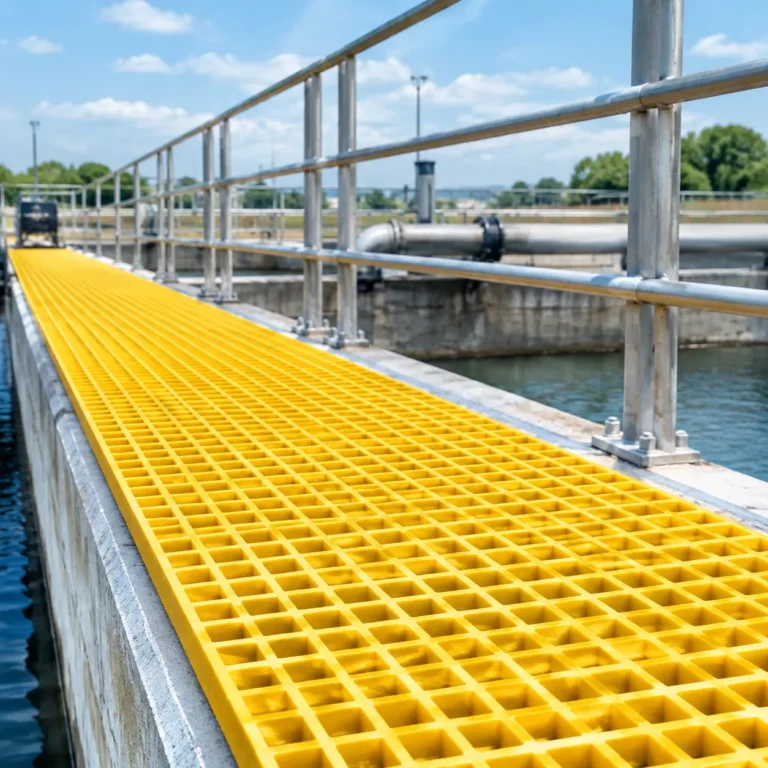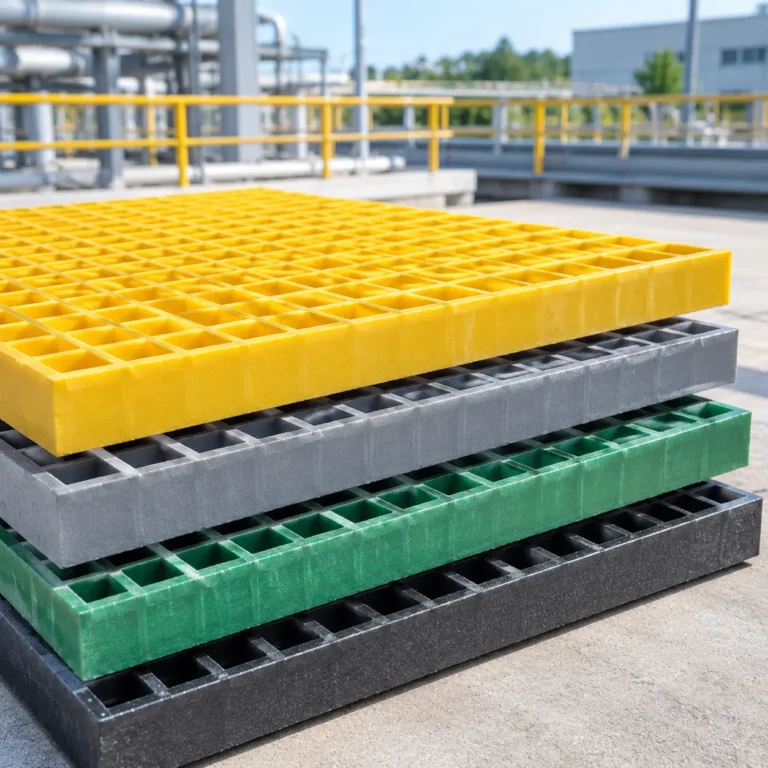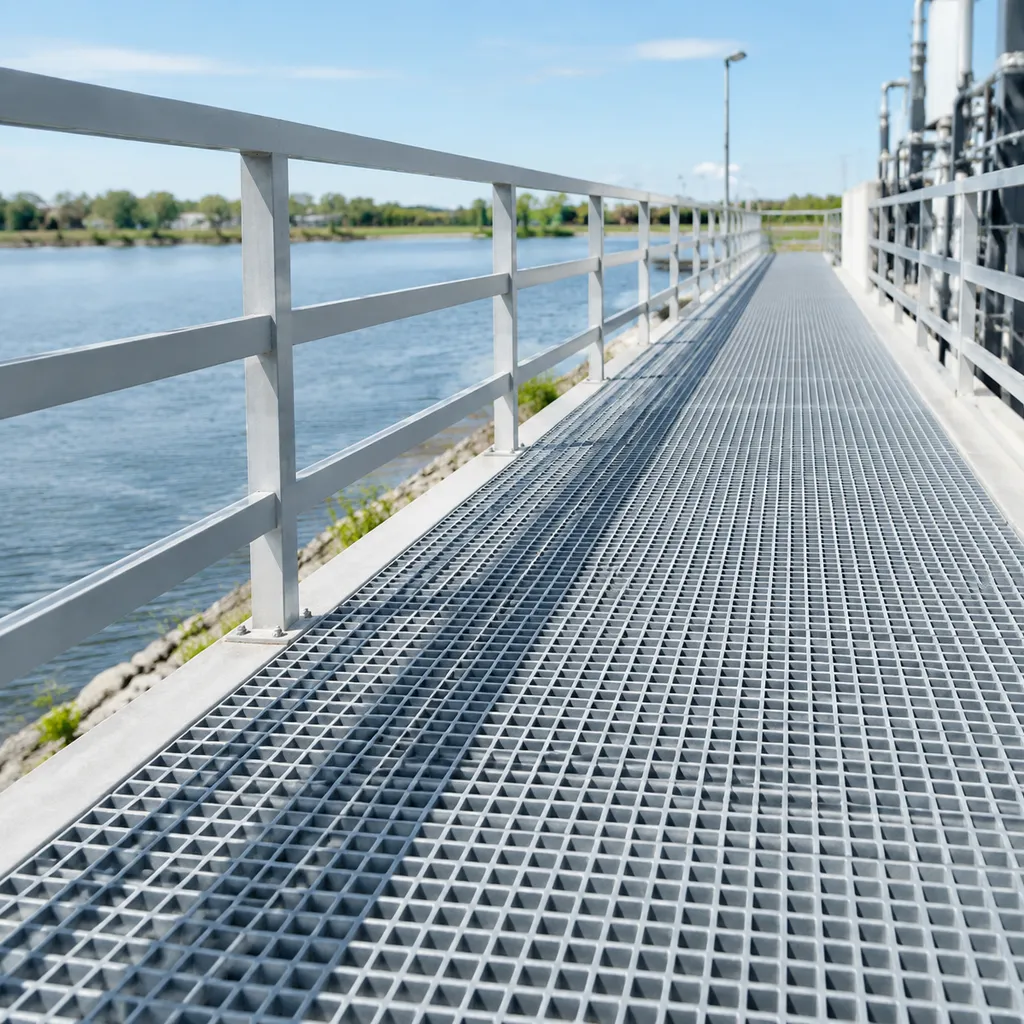
FRP Grating for Bridge Decking Lightweight Solution
What is FRP Grating for Bridge Decking?
FRP grating for bridge decking is an advanced structural composite system engineered to replace heavy concrete and corrosion-prone steel across infrastructure networks. Designed as a high-performance, lightweight solution, it serves as the primary walking or driving surface on pedestrian bridges, cantilevered sidewalk extensions, maintenance catwalks, and light vehicular access spans.
By combining industrial-grade glass fibers with specialized resin formulations, this decking technology delivers extreme structural integrity while significantly minimizing the overall weight burden on the bridge support structure.
Overview of Fiber Reinforced Polymer (FRP) Composites
Fiber Reinforced Polymer (FRP) bridge decking panels are composite systems manufactured using two primary production methods to suit specific structural demands:
- Pultruded FRP Grating & Planks: Manufactured with a high unidirectional glass fiber content pulled through a heated die, delivering high longitudinal stiffness and maximum load-bearing capacity for long-span bridge stringers.
- Molded FRP Grating: Produced through interlaced continuous glass fiber roving embedded in a molded liquid resin matrix, providing multi-directional load distribution and impact resistance.
- Engineered Resin Matrices: Formulated with Isophthalic Polyester (ISO) for general outdoor weatherability, Vinyl Ester (VE) for aggressive marine and chemical resistance, or Phenolic Resin for maximum fire retardance and low smoke toxicity.
Why Lightweight Decking Solutions Matter for Modern Bridges
Selecting lightweight FRP decking transforms bridge engineering and rehabilitation projects by addressing critical structural and economic challenges:
- Substantial Dead-Load Reduction: Weighing approximately one-third to one-fourth the weight of structural steel, FRP composite decking dramatically lowers dead loads, enabling aging bridge piers and substructures to safely carry higher live-load traffic capacities.
- Streamlined Transport & Rigging: Lightweight panels eliminate the need for heavy crane rentals. Modular sections can be positioned manually or with light machinery, accelerating assembly and minimizing traffic disruption.
- All-Weather Structural Reliability: Unlike reinforced concrete that spalls or steel that rusts, FRP decking is completely immune to de-icing salts, coastal saltwater mist, and continuous moisture penetration.
Key Benefits of Lightweight FRP Bridge Decking
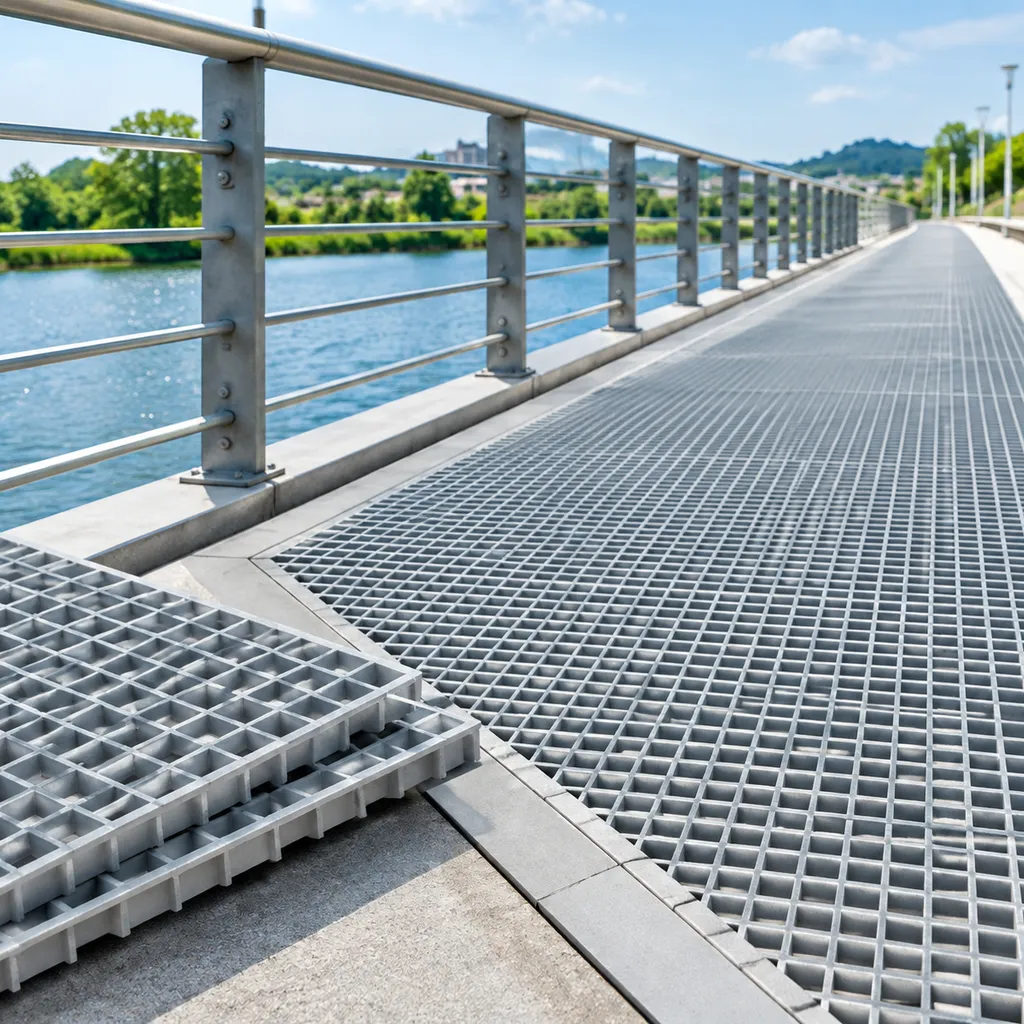
Traditional materials like reinforced concrete and structural steel add massive dead weight to bridge foundations, leading to rapid deterioration from moisture and salt exposure. Our fiberglass reinforced plastic decking systems solve these core engineering challenges by combining high strength, extreme weatherability, and minimal weight into a single structural profile.
| Performance Metric | Traditional Structural Steel | Reinforced Concrete | Leihong FRP Decking Panels |
|---|---|---|---|
| Material Weight | Heavy (~7,850 kg/m³) | Very Heavy (~2,400 kg/m³) | Ultra-Light (~1,800 kg/m³) |
| Corrosion Resistance | Prone to rust and oxidation | Cracks, spalls, and degrades | Immune to salts, water, and chemicals |
| Traction & Safety | Slippery when wet | Wears smooth over time | Permanent quartz-grit anti-slip surface |
| Lifecycle Maintenance | High (Repainting, galvanizing) | High (Sealing, patching) | Virtually Zero Maintenance |
High Strength-to-Weight Ratio
Our lightweight FRP grating for bridge decking weighs approximately one-third to one-fourth as much as traditional steel while maintaining comparable structural load capacities.
- Dead-Load Reduction: Stripping excess structural weight off existing bridge stringers allows you to maximize live-load traffic capacities without rebuilding substructures.
- Exceptional Structural Stiffness: Formulated with high-density glass fiber reinforcement to resist heavy pedestrian crowds, maintenance vehicles, and dynamic vibration.
- Simplified Handling: Lightweight panels can be positioned quickly on-site without heavy crane equipment, reducing overall job site labor costs.
Superior Corrosion, UV, and Moisture Resistance
Bridge walkways face constant exposure to standing water, chemical runoff, and de-icing salts. We formulate our composite decking with premium Isophthalic Polyester and Vinyl Ester resin matrixes that will not rust, rot, or degrade. Reviewing our comprehensive FRP grating guide provides deeper insight into matching specific resin systems with aggressive environmental demands.
- Salt and Chemical Immunity: Completely unaffected by marine atmospheres, road salts, vehicle fluid spills, and acid rain.
- UV Stability: Integrated UV inhibitors protect the composite matrix against long-term sun exposure and prevent brittleness.
- Zero Moisture Absorption: Will not swell, warp, or crack during continuous freeze-thaw cycles.
Enhanced Slip-Resistant Walking Surfaces
Safety on public walkways and access bridges is non-negotiable in wet or icy conditions. We manufacture our bridge decking panels with permanently bonded quartz silica grit and molded meniscus top textures.
- All-Weather Traction: Delivers reliable slip resistance across rain, frost, mud, and oily deck conditions.
- Integrated Safety Finish: The coarse grit is embedded directly into the resin surface during manufacturing to prevent delamination and peeling.
- Pedestrian and Wheel Safe: Designed to maintain solid foot traction while remaining comfortable for cyclists, runners, and mobility equipment.
Low Maintenance and Extended Service Life
Bridge infrastructure demands long-term reliability without constant upkeep. Our composite decking systems deliver a multi-decade operational service life with almost no recurring maintenance expenses.
- Zero Surface Treatments: Requires no sandblasting, repainting, rust-proofing, or waterproof sealing throughout its lifespan.
- Non-Conductive Properties: Electrically and thermally non-conductive, making it exceptionally safe for rail-adjacent footbridges and high-voltage utility crossings.
- Low Total Cost of Ownership: Eliminates ongoing repair cycles and deck resurfacing downtime, driving down overall lifecycle infrastructure costs.
Types of FRP Grating and Decking Options
We manufacture a versatile range of composite solutions engineered specifically for bridge infrastructure. Choosing the right profile depends on your bridge’s span dimensions, support framework, and anticipated traffic type.
| Grating Type | Primary Fiber Orientation | Best Application | Key Feature |
|---|---|---|---|
| Molded Mini-Mesh | Bi-directional | Pedestrian bridges, walkways, ADA ramps | Multi-directional load handling & small object drop prevention |
| Heavy-Duty Pultruded | Unidirectional (High stiffness) | Long-span pedestrian & light vehicular bridges | Maximum span capability with minimal load deflection |
| Solid Decking Planks | Continuous composite matrix | Catwalks, solid footbridges, overpass walkways | Complete fluid/debris containment with solid footing |
Molded FRP Grating and Mini-Mesh Panels
Our molded FRP grating provides exceptional bi-directional load distribution, making it the premier choice for complex bridge geometries, cantilevered walkways, and public footbridges.
- Even Load Distribution: We weave continuous fiberglass rovings in both directions inside the mold, allowing panels to support loads uniformly even when field cuts are required.
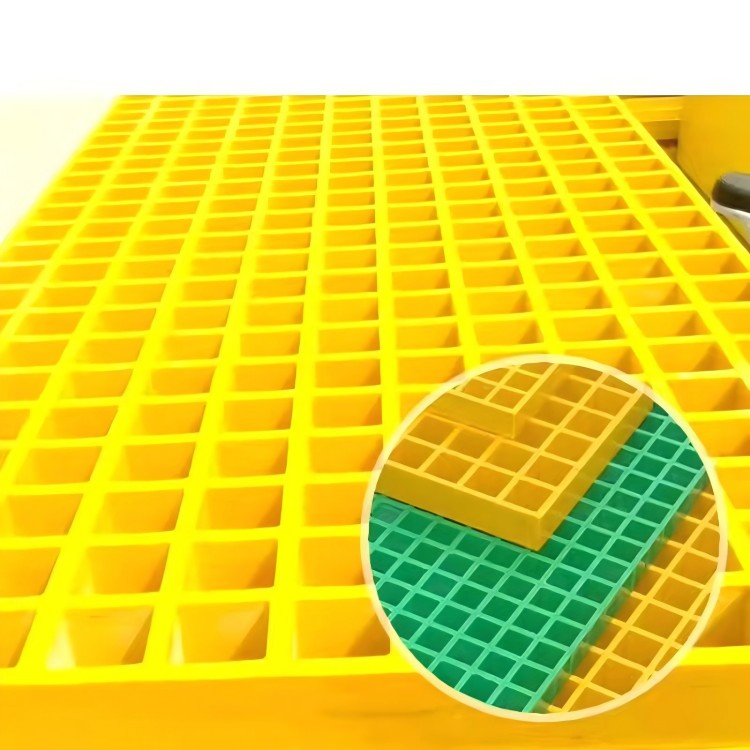
- Mini-Mesh Safety: Features a tighter 19×19 mm top mesh opening that complies with standard 15 mm ball-drop safety tests. It prevents tools, small objects, and debris from falling through to traffic or waterways below while remaining ADA-compliant and comfortable for high-heel foot traffic.
- Integrated Non-Slip Top: Molded directly with a meniscus concave surface or bonded quartz grit for permanent traction in wet and icy environments.
Heavy-Duty Pultruded FRP Grating
When projects require long spans between bridge stringers, our pultruded profiles deliver maximum structural stiffness. We pull continuous glass rovings and mat through heated steel dies to achieve high fiber-to-resin ratios.
- High Flexural Modulus: Designed specifically for high-load, unidirectional bridge spans. It handles heavier live loads with minimal deflection compared to standard molded profiles.
- Structural Efficiency: Combines I-bar or T-bar bearing bars with solid cross-rod locking systems, integrating seamlessly with existing FRP pultruded profiles and steel bridge girders.
- Substantial Weight Reduction: Delivers the load-bearing capability of traditional steel bar grating at one-third of the weight, eliminating excess dead load on aging bridge structures.
Interlocking Solid FRP Decking Planks
For bridge decks requiring a completely enclosed, continuous surface, our interlocking solid FRP decking planks offer a durable barrier against moisture, debris, and chemical runoff.
- Tongue-and-Groove Interlock: Panels snap and bolt securely together to form an unbroken surface that distributes dynamic walking and wheel loads evenly across the deck.
- Zero Drop-Through: Essential for pedestrian overpasses spanning highways, electrified railways, or protected waterways where zero debris can fall underneath.
- Textured Traction: Engineered with a gritted or diamond-checkered surface to maintain high skid resistance for maintenance carts, bicycles, and continuous foot traffic.
Common Applications for FRP Bridge Decking
Because fiber reinforced polymer systems combine structural stiffness with minimal dead load, our composite decking panels serve as a versatile, low-maintenance replacement for heavy concrete and rust-prone steel across diverse infrastructure environments.
Pedestrian Bridges and Footbridges
We supply lightweight pedestrian bridge decking engineered for urban overpasses, park crossings, and cantilevered sidewalk extensions. Key performance highlights include:
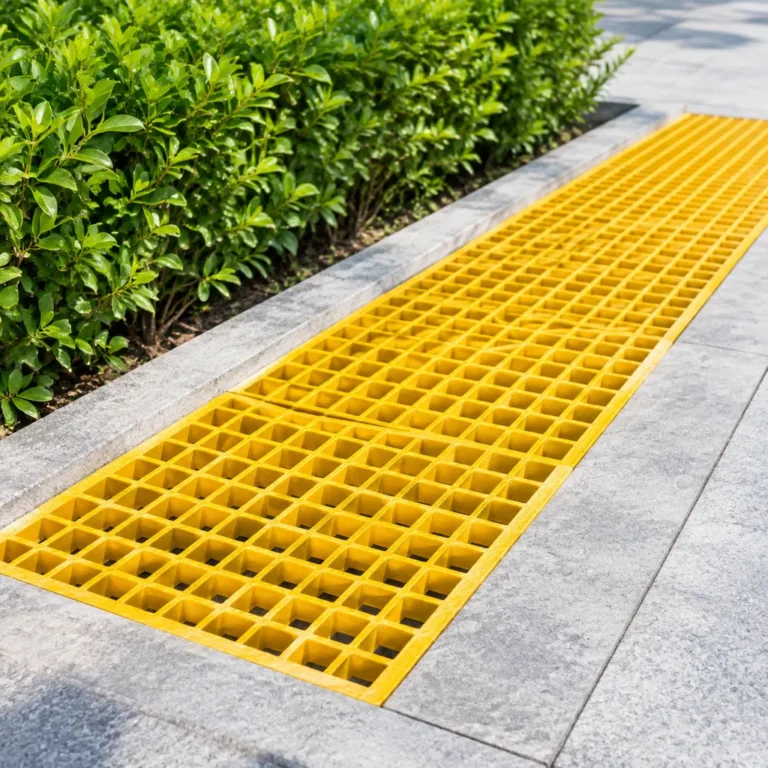
- Pedestrian-Safe Surfaces: Our mini-mesh molded grating profiles prevent small objects from falling through and accommodate high heels, wheelchairs, and walking canes smoothly.
- Integrated Anti-Slip Surface: Embedded quartz grit coatings provide exceptional traction in wet, frosty, or oily environments.
- Rapid Installation: Lightweight panels allow crews to manually position sections without shutting down major traffic arteries below.
Parks, Trails, and Wetland Boardwalks
For environmentally sensitive or remote recreational areas, hauling heavy construction equipment is often impractical or restricted. Our fiberglass reinforced plastic decking resolves these challenges effectively:
- Zero Rot or Rust: Unlike treated timber that rots or leaches chemicals, our corrosion resistant decking withstands standing water, mud, and continuous dampness without degradation.
- Manual Handling: Modular panels can be carried to remote jobsites by hand, preserving natural terrain and lowering freight expenses.
- Custom Layouts: We provide custom FRP fabrication to pre-cut panels to exact trail geometries, curves, and span widths.
Marine, Dock, and Coastal Bridge Structures
Salt spray, tidal exposure, and coastal humidity quickly destroy standard steel and reinforced concrete. We manufacture marine-grade bridge decking utilizing premium isophthalic polyester and vinyl ester resin systems:
- Saltwater Immunity: Impervious to marine atmospheres, chemical washdowns, and relentless UV exposure.
- Wave Action Relief: Open-mesh molded grating allows surge water and wind to pass directly through the deck, reducing uplift forces during storms.
- Slip Resistance: Permanent slip resistant coatings ensure firm footing on docks, gangways, and tidal crossings even when fully submerged or wet.
Light Vehicular and Utility Access Bridges
Industrial access tracks, water treatment catwalks, and maintenance bridges require dependable load ratings without exceeding substructure limits. Our heavy-duty structural FRP solutions include pultruded grating panels with a high strength-to-weight ratio:
- Load Capacity: Designed to carry utility carts, maintenance equipment, and light service vehicles over long support spans.
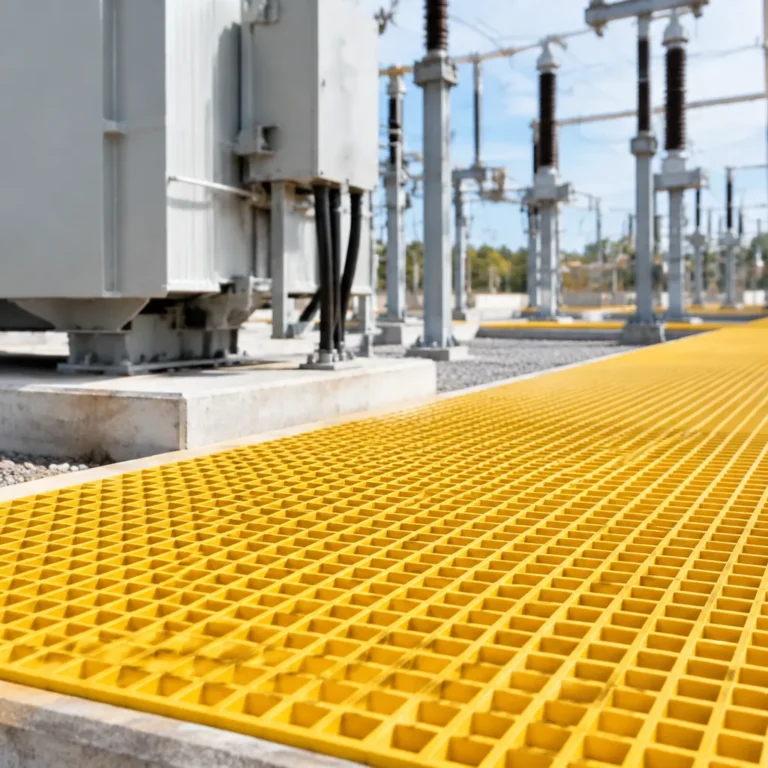
- Electrical Safety: Non-conductive resin matrices make these decks safe for electrified railway overpasses, high-voltage utility paths, and chemical plant access bridges.
- Fatigue Endurance: Resilient composite construction absorbs continuous dynamic cycling without permanent deformation or cracking.
Installation and Structural Integration
Integrating FRP grating for bridge decking into new structural plans or legacy bridge refits is clean, rapid, and predictable. Our composite panel systems are engineered to replace cumbersome poured concrete and heavy welded steel grating, dramatically cutting site downtime and equipment expenses.
Fast, Modular Installation with Minimal Equipment
Transporting and positioning bridge decking panels no longer requires heavy logistics or prolonged road closures.
- Manual Handling: Weighing roughly one-third to one-fourth the weight of structural steel, our lightweight panels are easily positioned by small two-person crews without needing costly heavy crane rentals.
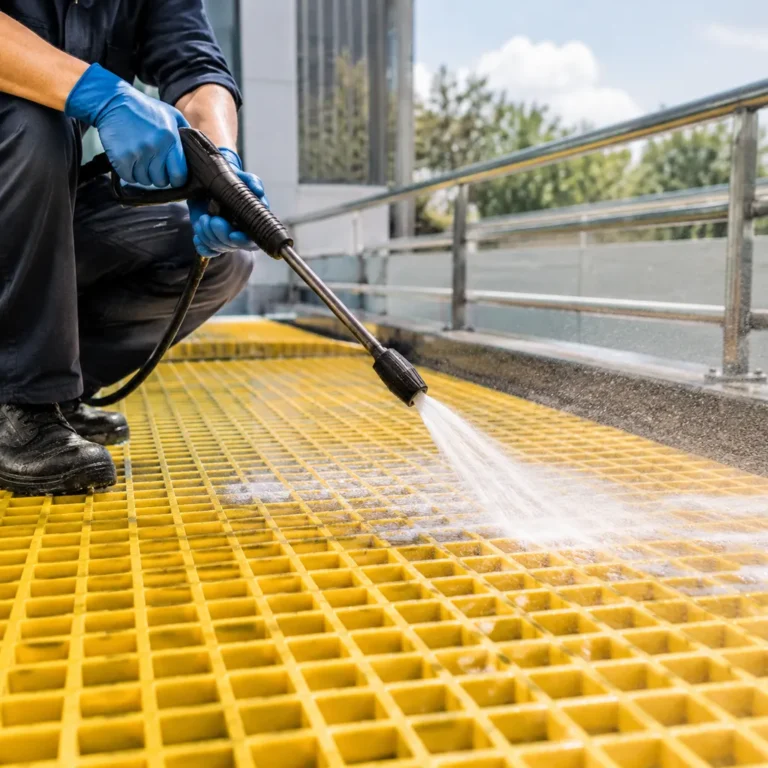
- Rapid On-Site Alterations: Panels can be factory pre-cut or altered directly on-site around bridge girders, scuppers, and utility lines using standard diamond-tipped cutting blades—eliminating the need for specialized hot-work permits.
- Modular Assembly: Standardized panel geometries lock or sit directly on steel, timber, or concrete stringers, allowing continuous pedestrian or light vehicular traffic pathways to be laid down rapidly.
Review our recent composite bridge case studies to see how modular FRP installations cut overall project timelines.
Pedestal Systems and Substructure Fasteners
A dependable bridge deck depends entirely on high-integrity anchoring systems. We supply marine-grade 316 stainless steel fastening hardware designed to handle heavy cyclic loads and resist salt-spray corrosion:
- M-Clips: Secure molded and pultruded panels directly to structural support flanges to prevent lateral and vertical movement.
- G-Clips: Clamp securely to structural steel flanges without drilling or welding, preserving the protective coatings on underlying beams.
- C-Clips & Joint Fasteners: Tie adjacent grating panels together along spans, preventing differential deflection and tripping hazards.
- Pedestal & Shim Systems: Provide precise leveling across uneven bridge caps, piers, or variable-elevation boardwalk spans.
Reducing Dead Load on Existing Bridge Frameworks
Replacing deteriorated concrete or heavy metal grating with an engineered FRP lightweight solution delivers an immediate structural upgrade:
- Maximized Live-Load Ratings: By drastically reducing the dead weight carried by aging bridge stringers, piers, and abutments, existing bridge assets gain usable live-load headroom.
- Cantilevered Sidewalk Additions: Our ultra-light panels allow structural engineers to append cantilevered pedestrian pathways directly onto existing vehicular bridges without overloading the primary substructure.
- Long-Term Foundation Protection: Lighter decks reduce total seismic mass and structural fatigue, extending the viable service life of underlying bridge infrastructure.
To calculate dead-load savings and clip configurations for your bridge project, contact our engineering team for structural data and layout assistance.
How to Choose the Right FRP Grating for Your Project
Selecting the right FRP grating for bridge decking: lightweight solution requires balancing load requirements, environmental exposure, and pedestrian safety. We engineer our composite panels to fit exact project parameters, ensuring structural integrity without adding dead weight to your substructure.
Assessing Load Capacity and Span Requirements
Bridge designs demand specific load-bearing profiles depending on traffic volume and the distance between support stringers. Determining the right profile comes down to directional load paths and maximum allowable deflection:
- Pultruded Grating: Ideal for long spans requiring superior structural stiffness. The high concentration of unidirectional glass fibers carries heavy longitudinal loads with minimal deflection.
- Molded Grating: Best for multi-directional pedestrian traffic and installations requiring cutouts for utility lines, offering uniform bi-directional load distribution.
| Bridge Application | Recommended Profile | Standard Thickness | Primary Advantage |
|---|---|---|---|
| Footbridges & Walkways | Molded Mini-Mesh | 25 mm – 38 mm | ADA-compliant, high heel safe |
| Long-Span Bridges | Heavy-Duty Pultruded | 38 mm – 50 mm | Maximum span stiffness |
| Maintenance & Utility Decks | Solid Top / Pultruded Deck | 30 mm – 60 mm | Solid barrier, high point-load capacity |
Evaluating Environmental and Weather Conditions
The operational environment determines which resin formulation will deliver the longest service life. At Leihong Fiberglass, we match our resin matrices to specific site conditions:
- Isophthalic Polyester (ISO): The standard choice for general outdoor pedestrian bridges, providing balanced UV resistance and protection against industrial weather conditions.
- Vinyl Ester (VE): Recommended for coastal, marine, and high-salinity zones. It offers maximum resistance to saltwater immersion, harsh de-icing chemicals, and acidic atmospheres.
- Phenolic Resin: Specifically formulated for high-risk zones requiring extreme fire retardance and ultra-low smoke toxicity, meeting ASTM E84 Class 1 standards.
Safety Standards and Surface Texture Selection
Deck traction is critical in wet, icy, or oily conditions. Choosing the right top finish ensures foot and vehicle safety throughout all seasons:
- Quartz Gritted Surface: Embedded silica granules provide an aggressive, long-lasting anti-slip surface suitable for wet footbridges, coastal docks, and public access ramps.
- Meniscus (Concave) Surface: A cost-effective self-draining profile that delivers reliable slip resistance for utility walkways.
- Solid Diamond/Checkered Top: Eliminates open grating gaps to prevent tools or debris from falling through, making it ideal for maintenance catwalks above active traffic lanes.
- Mini-Mesh Geometries: Featuring tight 19×19 mm openings, this configuration complies with ADA requirements and prevents small wheeled carts, canes, and footwear from catching.