LEIHONG / HEAVY INDUSTRIAL LOAD REVIEW
Heavy Industrial FRP Grating Load Capacity & Heavy-Duty Flooring Solutions
Evaluate heavy duty fiberglass grating for concentrated loads, equipment access and vehicle crossings. Match the exact construction, clear span, support arrangement, operating temperature and load case before specifying industrial load bearing grating.
Hebei Leihong FRP Technology Co., Ltd. · Factory-direct project inquiry · No universal forklift or H-20 rating inferred
Span & Deflection-Limit Helper
Calculate a specified L/n limit. This tool does not calculate the grating's actual deflection or safe load.
Use the criterion required by the project. These ratios are examples, not default industrial approvals.
01 / Engineering load parameters
Heavy-Duty Engineering Load Ratings & Criteria
Separate load cases before selecting panel depth. Distributed loads, point loads and wheel loads cannot be converted into each other without an appropriate structural model.
Uniform Distributed Load
Review loaded area, span, support direction, long-term loading and allowable deflection.
View Calculation Notes
For a truly uniform load, total applied load = pressure × loaded area. This arithmetic does not establish panel capacity.
Concentrated Point Load
Provide the equipment-foot or load-pad dimensions, position and proximity to cutouts. Check local effects and the supporting structure.
View Calculation Notes
Identify force and contact dimensions. Contact pressure alone is not a grating strength check.
Rolling Wheel Load
Provide loaded vehicle wheel reactions, tire contact area, spacing, turning, braking, impact and traffic frequency.
View Calculation Notes
Use verified vehicle or engineer-provided wheel reactions. Gross vehicle mass divided by wheel count is not a reliable design assumption.
Deflection & Serviceability
Agree the specified span ratio, absolute limit and long-term criteria, then compare with exact product data.
View Calculation Notes
A limit expressed as L/n gives permissible deflection = clear span ÷ n. Actual panel deflection needs verified stiffness and load data.
02 / Load & span documentation
Heavy Industrial FRP Grating Load & Deflection Specifications
Filter the construction and nominal depth to prepare a data request. Catalog page 6 provides deflection readings under stated loads. Select a listed molded configuration below; values are catalog references, not allowable-load ratings.
Molded heavy-duty · 38 mm
| Depth | Mesh pitch | Top / bottom bar | Catalog panel sizes | Open area | Weight |
|---|---|---|---|---|---|
| 38 mm | 38.1 × 38.1 mm | 7.0 / 5.0 mm | 1226 × 3666; 1530 × 3969 mm | 68% | 19.5 kg/m² |
| 50 mm | 50.8 × 50.8 mm | 8.0 / 5.0 mm | 1226 × 3666; 1226 × 3055 mm | 78% | 23.5 kg/m² |
| 60 mm | 38.1 × 38.1 mm | 11.5 / 9.0 mm | 1220 × 3660 mm | 54% | 50.4 kg/m² |
| 60 mm | 60 × 60 mm | 10.0 / 6.0 mm | 1510 × 2410 mm | 68% | 25.0 kg/m² |
Source: Leihong FRP gratings and pultruded parts catalogue-LH, PDF page 4. These rows reproduce that table's variants. Other catalog pages list different nominal sizes and weights; confirm the selected tooling and order drawing rather than combining values across variants.
Catalog Load–Deflection Readings
Each number below is measured deflection in millimeters at the stated applied load.
Source: supplied catalog, PDF page 6, “Gratings Plate Load Table.” “—” means no value is listed; it does not mean zero deflection or approval. Mesh designations on the load page are 38.1 × 38.1 × 38 mm and 50.8 × 50.8 × 50 mm. Verify that the ordered construction matches before using these data.
The source separates line load (kg/m), uniform load (kg/m²) and whole-plate load (kg). This page transcribes line and uniform loads only. Whole-plate load is not relabeled as a point or wheel load. SI headings use kg × 9.80665 / 1000 as force-equivalent conversion; original catalog units are retained alongside.
The catalog load page does not state the test method, resin, temperature, bearing detail, failure load or safety factor. It therefore does not establish safe working loads, a 4:1 design basis, 25°C test conditions, fatigue performance or vehicle approval. Obtain the required verification for the project.
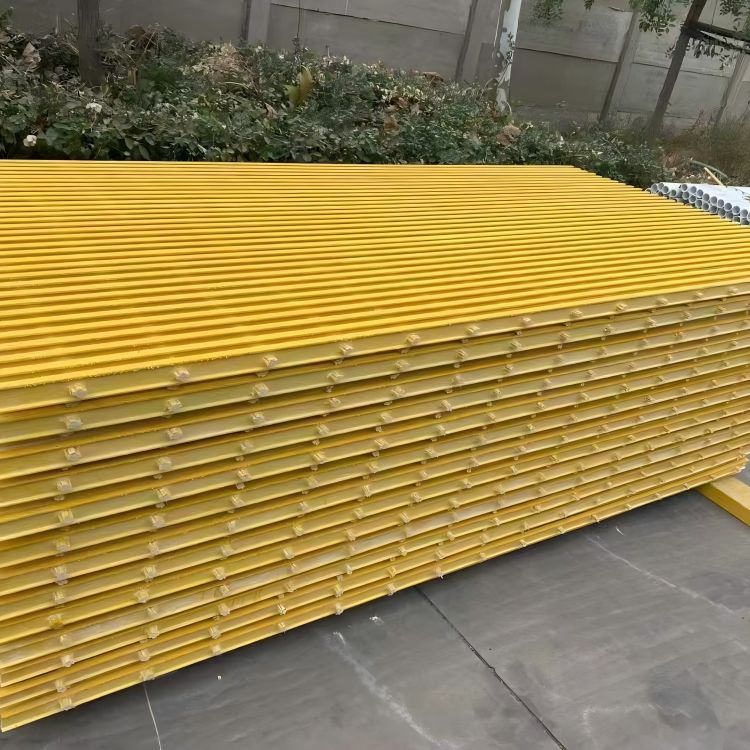
Product reference, not test evidence for a specific heavy-duty load case.
03 / Structural architecture
Review Reinforcement, Resin & Load-Bar Geometry
Molded versus pultruded load paths
Molded panels have reinforcing paths in two directions; pultruded panels have a primary bearing-bar direction. Confirm the exact geometry and support arrangement rather than selecting on the process name alone.
Resin and service conditions
Review vinyl ester or isophthalic formulations against chemical exposure and temperature. Creep, aging and fatigue can affect performance; no zero-strength-loss assumption is made.
Bar and connection design
Depth, wall thickness, bar spacing, reinforcement, cross-rods and connections influence behavior. Higher glass content or a higher resin-to-glass ratio alone does not prove greater capacity.
Send the Proposed Loading & Exposure04 / Heavy industrial applications
Engineering Review for Critical Heavy-Load Facilities
Use the application to define the loads, operating conditions and support design. Images are grating references, not verified heavy-vehicle installations.
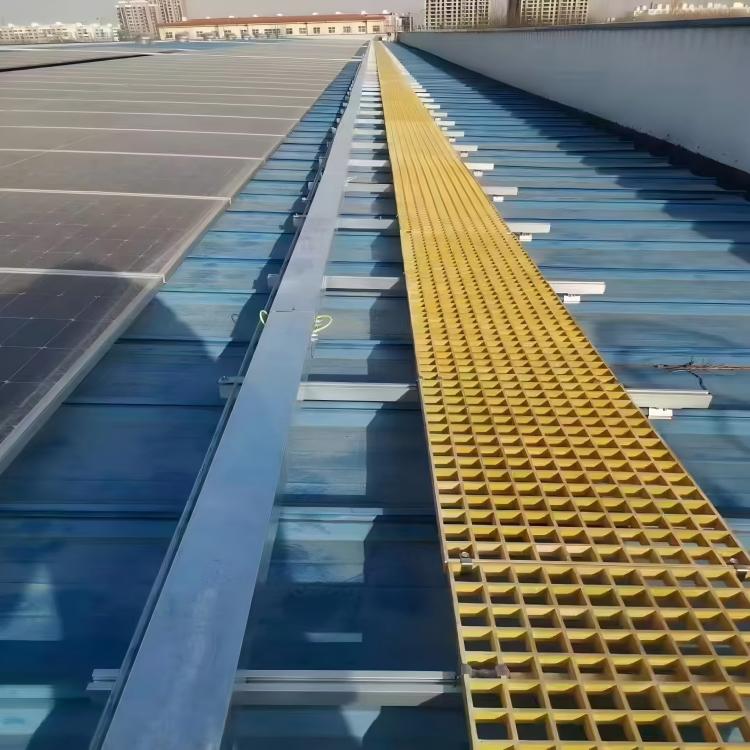
Forklift Ramps & Loading Bays
Supply loaded wheel reactions, tire type, contact areas, incline, braking and traffic frequency. Obtain explicit approval for the exact panel and framing.
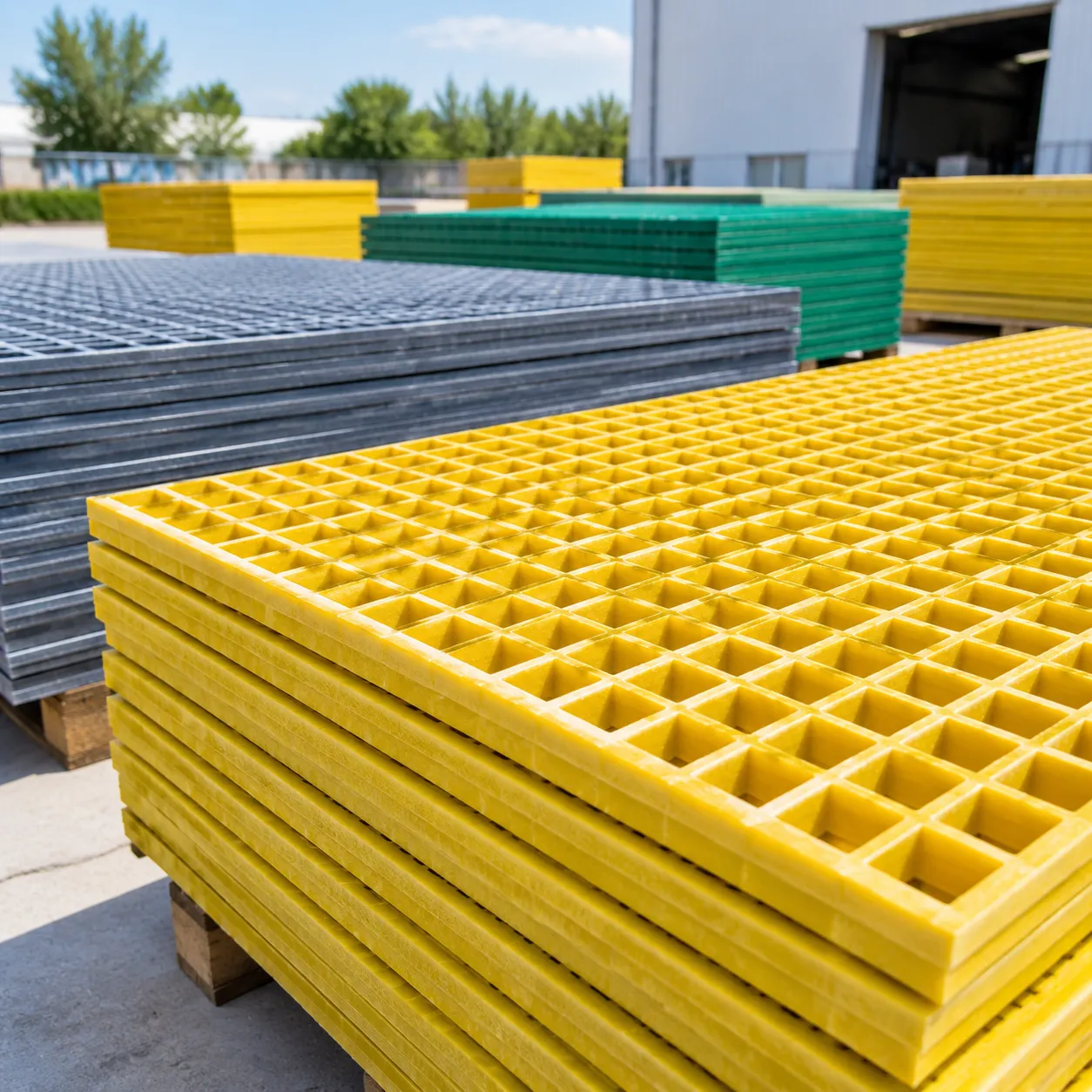
Mining & Smelting Access
Separate personnel access from equipment supports, pipe reactions and motor vibration. Include abrasion, heat and chemical exposure.
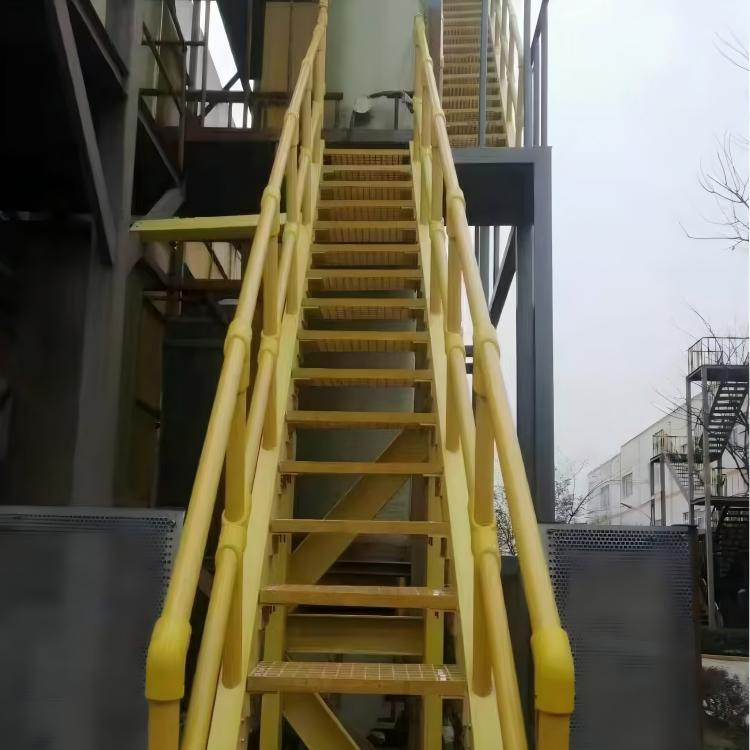
Offshore & Petrochemical Decks
Coordinate deck loads, support direction, corrosion, fire requirements, uplift and applicable marine or plant criteria.
Vehicle-Crossing Trench Covers
Verify the cover, embed angles, anchors, concrete and underlying structure together. Added intermediate supports may be part of the design.
05 / Material comparison
Heavy Industrial FRP vs. Heavy-Duty Steel Grating
Compare equal performance requirements, not equal thickness alone. Structural stiffness, fire behavior, temperature and long-term service all matter.
| Factor | Heavy-duty FRP proposal | Heavy-duty steel proposal |
|---|---|---|
| Capacity and stiffness | Verify exact geometry, reinforcement and supports | Verify steel section, connections and supports |
| Handling weight | Often lighter; compare actual selected panel | Compare actual selected panel and lifting plan |
| Chemical exposure | Resin and environment dependent | Alloy / coating and environment dependent |
| Impact and overload | May damage or fail; inspect after events | May yield or fail; inspect after events |
| Long-term loading | Review creep, fatigue and environment | Review fatigue, corrosion and connections |
| Installation | Plan cutting, dust controls, sealing and fixings | Plan cutting, coating repair and fixings |
| Maintenance | Cleaning, inspection and replacement planning | Cleaning, coating / corrosion and replacement planning |
TCO = purchase + transport + supports and installation + inspection and cleaning + repairs and replacements + downtime and disposal. Include timing and discounting where relevant; no fixed 40% saving or 20-year service life is assumed.
06 / Engineering FAQ
Frequently Asked Questions on Heavy-Duty Load Capacity
How should axle loads be converted for a vehicle crossing?
Use verified loaded wheel reactions and contact patches from the vehicle data or project engineer. Axle balance, payload location, wheel arrangement, turning and braking affect load distribution. Apply dynamic and design factors required by the project standard; do not use a universal axle-load reduction or divide gross mass equally among wheels.
How can I control stiffness over a span greater than one meter?
Review a suitable directional pultruded configuration, deeper section or closer supports using exact product data. Check deflection, creep, local loads, bearing and fixings. A span above one meter is not automatically acceptable or unacceptable based on construction name alone.
Does cutting a pipe opening reduce heavy-duty grating capacity?
It can interrupt bearing bars and reinforcement and alter load distribution. Review trimming supports, opening frames and fixing positions before cutting. Edge sealing protects exposed fibers but does not restore severed structural capacity.
Should I use molded or pultruded grating for heavy industrial loads?
Compare the exact proposed configurations against the support layout, load direction, local loads, deflection and environment. Molded panels offer two-direction reinforcement paths; pultruded panels have a primary bearing-bar direction. Neither process is universally the heavier-duty choice.
Does an H-20 statement guarantee forklift suitability?
No. The applicable assessment must match the load model, assembly, installation and design standard. Forklift wheel contact, turning and dynamic conditions can differ from a specified vehicle load model. Obtain approval for the actual vehicle and panel/frame design.
Can I request a structural calculation or finite-element analysis?
Send the load cases, support layout, geometry, exposure and acceptance criteria. Leihong can confirm available technical review, test evidence and any calculation or analysis scope, cost and deliverables. A free FEA service is not assumed.
07 / Technical RFQ
Request an Engineering Load Review & Project Quote
Send your clear span, load cases and site conditions to Hebei Leihong FRP Technology Co., Ltd. Discuss the proposed panel, supports, test evidence, custom fabrication and factory pricing.
- Clear spans, supports, bearing and panel direction
- UDL, point or wheel loads and contact dimensions
- Temperature, chemical exposure and design criteria
- Quantity, drawings and delivery destination
sales@leihongfiberglass.com
WhatsApp: +86 18831837530
Confirm technical service scope, sample terms, document availability and response timing with your inquiry. Request an NDA before providing restricted project drawings if required.
Prepare Your Engineering Requirements
Enter contact details and paste your requirements below to send the inquiry.
Email your support layout and vehicle data with the project name.
Email Drawings & Load Schedule →