LEIHONG / CHEMICAL PROCESSING FACILITIES
High-Performance FRP Grating for Chemical Plants
Specify corrosion resistant fiberglass grating for chemical plant walkways, operating platforms and trench covers. Review vinyl ester and other resin formulations against the actual chemicals, concentrations, temperatures and structural loads.
Hebei Leihong FRP Technology Co., Ltd. · Factory-direct grating · Resin selection & custom fabrication review
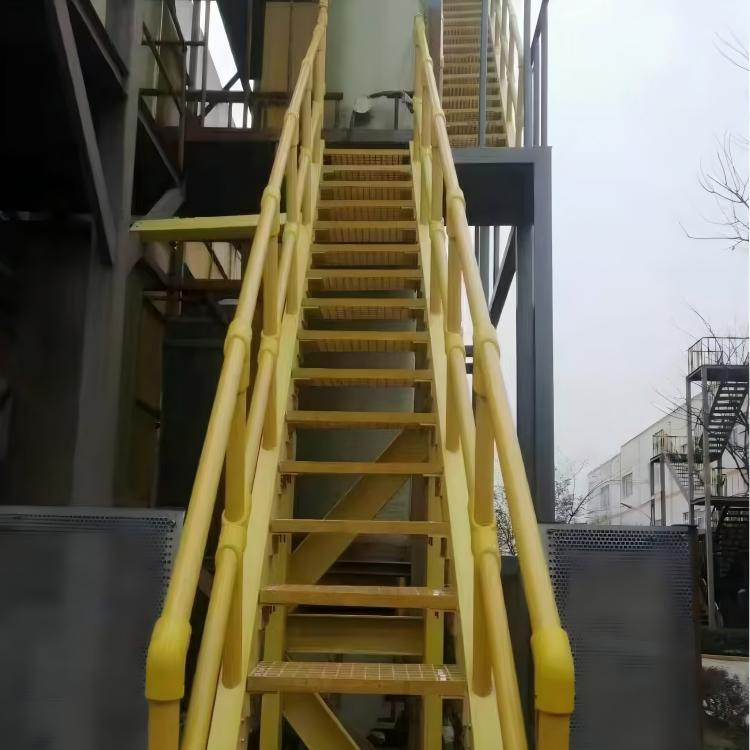
01 / Material decisions
Why Consider FRP Grating Over Steel in Harsh Chemical Environments?
Chemical plant flooring solutions must balance corrosion, loading, fire requirements, static control and maintainability.
Define the Site Problem
- Corrosion at splash zones, fixings and supporting steel
- Repeated coating repairs and difficult access
- Wet or oily walking routes
- Handling constraints on elevated platforms
- Specific hazardous-area requirements
FRP can be a useful alternative when the resin and construction match the service. It does not provide universal solvent resistance or automatic explosion protection.
| Factor | Carbon steel | Galvanized steel | 316 stainless | FRP |
|---|---|---|---|---|
| Chemical exposure | Coating / medium dependent | Coating / medium dependent | Alloy / medium dependent | Resin / medium dependent |
| Organic solvents | Check coating and seals | Check coating and seals | Check alloy and medium | Check exact formulation |
| Static / electrical | Conductive; review earthing | Conductive; review earthing | Conductive; review earthing | May accumulate static; assess separately |
| Slip performance | Surface / condition dependent | Surface / condition dependent | Surface / condition dependent | Surface / condition dependent |
| Lifecycle cost | Project comparison | Project comparison | Project comparison | Project comparison |
Include supports, handling, fixings, coating or surface upkeep, cleaning, inspection and replacement. No universal one-third cost ratio or fixed service life is assumed.
02 / Resin & chemical selection
Tailored Resin Formulations for Chemical Service
Start with the full exposure profile. The guide below prepares a technical inquiry; it does not approve a chemical or establish a maximum service temperature.
Prepare a Chemical Compatibility Request
Vinyl Ester (VE)
Evaluate specific vinyl ester formulations for demanding service. Concentrated acids, strong oxidizers and solvents require written compatibility review; no blanket approval is given.
Discuss This Formulation →Isophthalic Polyester
Consider for selected industrial corrosion environments after verifying formulation, medium, concentration and temperature.
Discuss This Formulation →Orthophthalic Polyester
Discuss for suitable lower-corrosion general service. Confirm cleaning and upset conditions as well as normal operation.
Discuss This Formulation →Phenolic — Project Inquiry
For special fire, smoke or thermal requirements, ask about availability and evidence. Do not assume low toxicity or suitability for a chemical exposure from resin family alone.
Discuss This Formulation →Obtain written suitability confirmation for the exact formulation, temperature, exposure mode and expected upset conditions. Generic “vinyl ester” data is insufficient. An alternative material or a different system may be needed.
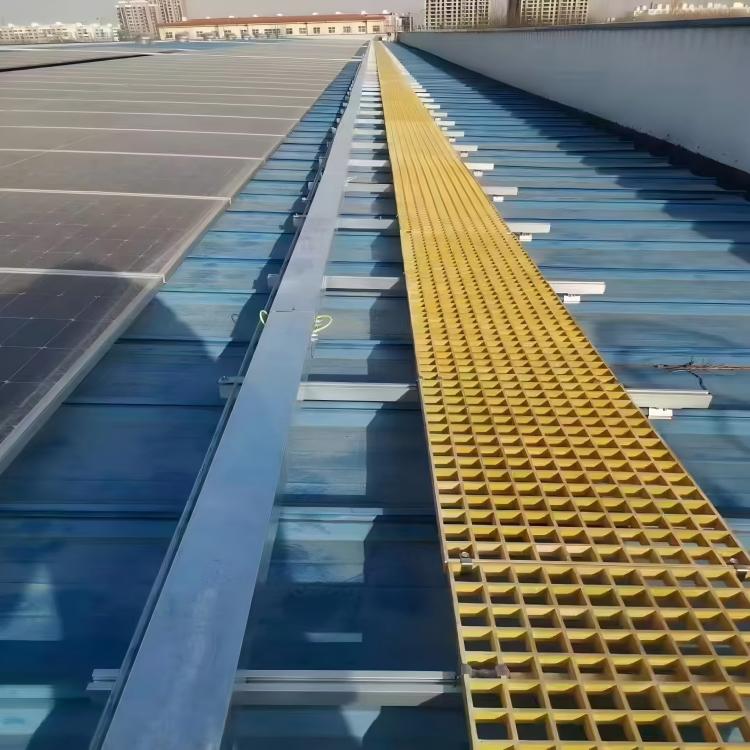
03 / Plant safety
Engineer Fire, Slip & Electrical Performance Separately
Fire and smoke criteria
State the required method and classification. ASTM E84 and UL 94 assess different aspects; request reports covering the proposed product rather than treating them as interchangeable approvals.
Walking-surface traction
Compare concave and grit surfaces under representative footwear and contamination. Inspect wear and remove oil, sludge and deposits.
Static and hazardous areas
Standard nonconductive FRP is not automatically antistatic, non-sparking or explosion-proof. Define resistance requirements, bonding or earthing arrangements and acceptance tests with the site specialist.
Structural behavior
Verify stiffness, creep, impact and load-bearing performance for the exact panel and support layout. Do not infer a heavy-duty rating from surface texture.
04 / Chemical plant applications
Applications Across Chemical Processing Facilities
Use the site location to define the selection inputs. Images are product and walkway references, not named project case studies.
Pickling & Electroplating Walkways
Specify chemical splashes, vapor exposure, wet traction and cleaning conditions.
Request a Configuration Review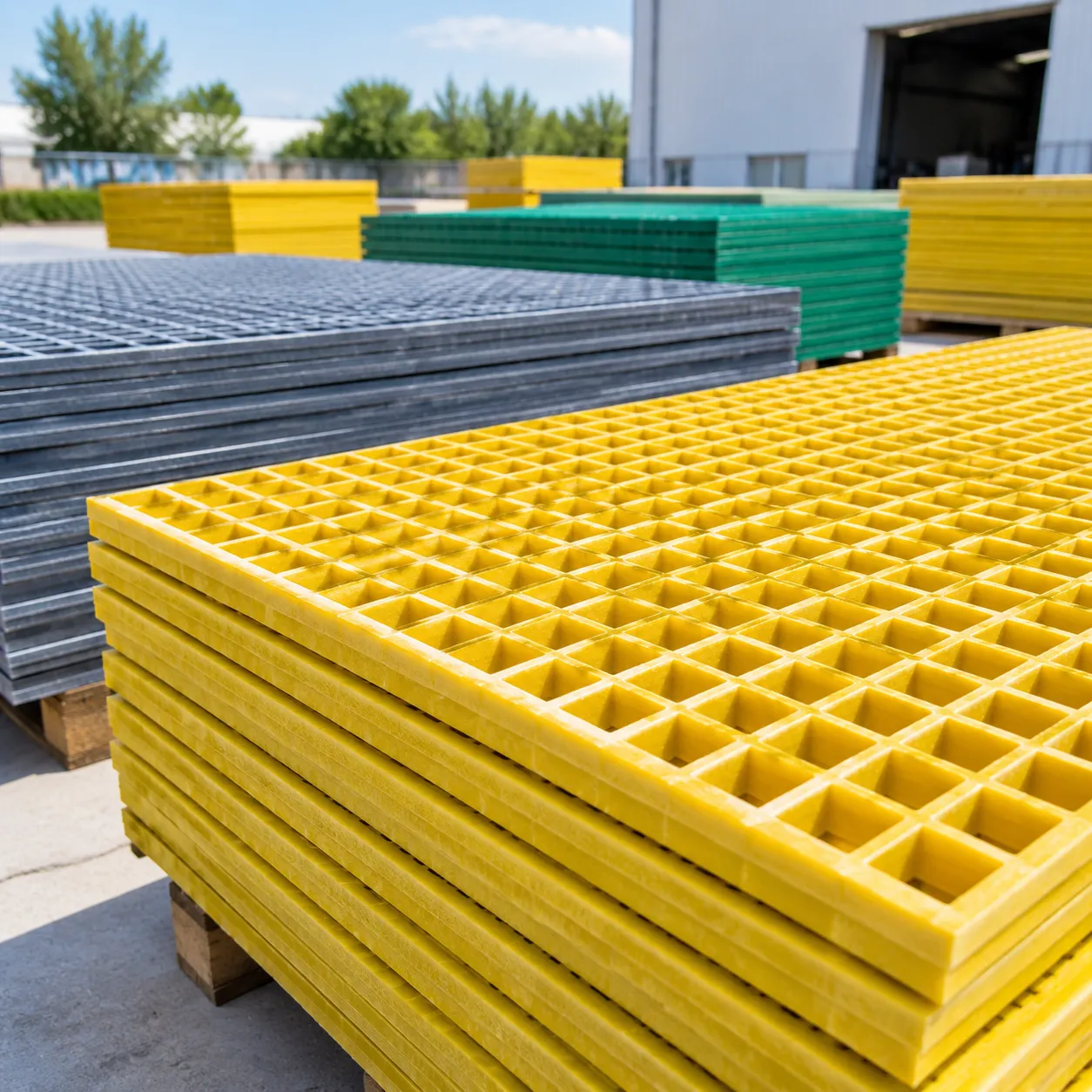
Chemical Tank Farm Catwalks
Review outdoor weathering, process vapors, supports, uplift and emergency access.
Request a Configuration ReviewEffluent Trenches & Neutralization Pits
Provide changing pH, mixed media, temperature and splash or immersion conditions.
Request a Configuration Review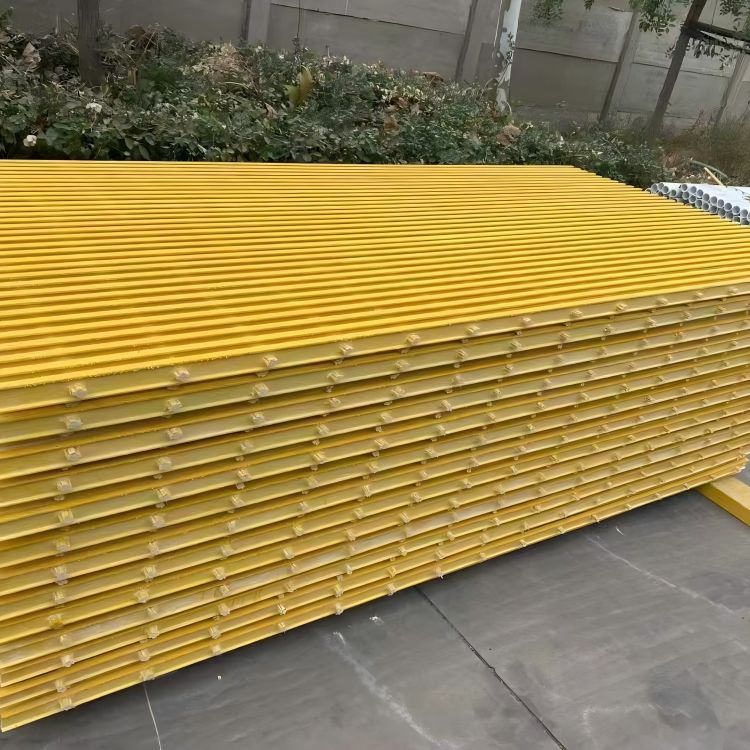
Pipe Racks & Elevated Platforms
Coordinate panel marks, cutouts, bearing, support direction and maintenance loads.
Request a Configuration ReviewBattery Rooms & Chlor-Alkali Areas
Review the exact chemical exposure and electrical or static-control requirements separately.
Request a Configuration ReviewLoading Racks & Transfer Terminals
Provide point or wheel loads, contact areas, impact factors and spill conditions.
Request a Configuration Review05 / Technical specification
Standard Specifications & Structural Load Review
These are inquiry options, subject to tooling and product availability. Obtain a load table for the exact proposed configuration.
| Nominal depth | Mesh pitch options | Clear span to assess | Loads & deflection |
|---|---|---|---|
| 25 mm | 38 × 38 / 50 × 50 mm; 19 mm small-mesh options to confirm | 450 / 600 / 900 mm or actual project span | Exact product data required; no span approval implied |
| 38 mm | 38 × 38 / 50 × 50 mm; 19 mm small-mesh options to confirm | 450 / 600 / 900 mm or actual project span | Exact product data required; no span approval implied |
| 50 mm | 38 × 38 / 50 × 50 mm; 19 mm small-mesh options to confirm | 450 / 600 / 900 mm or actual project span | Exact product data required; no span approval implied |
Mesh pitch is not the clear opening. Open area, weight and available panel sizes depend on the exact geometry. Molded and pultruded grating have different load paths.
Specify the full loading
Provide distributed, point or wheel loads, contact area, dynamic effects, support direction and allowed deflection. Check cutouts and long-term operating temperature.
Fixings and finish
Discuss 316 stainless M-, C- or L-type clip options against the actual chemicals and support material. Stainless steel is not universally corrosion-proof. Confirm colors, surface and edge treatment.
06 / Factory fabrication
Precision Fabrication for Coordinated Site Installation
Send CAD drawings, panel schedules or a dimensioned sketch. BIM deliverables and drawing-review scope can be discussed with your project.
Review added supports and fixing positions before fabrication. Edge sealing protects exposed reinforcement but does not restore strength lost through cutting.
07 / Quality & documentation
Agree the Evidence Required for Critical Chemical Operations
Ask for documents relevant to the proposed product and procurement specification. Certification names alone do not establish suitability for a process exposure.
Fire / Smoke
Method, product formulation, tested construction and classification.
Chemical Exposure
Exact formulation, concentration, temperature and exposure conditions.
Structural Performance
Panel geometry, span, loading direction, failure and deflection criteria.
Material / Curing
Agreed material identification, curing or Barcol checks and traceability.
Request the Inspection Plan
Confirm sampling frequency, acceptance criteria, third-party testing and the documents supplied with shipment.
ISO 9001, ISO 14001, CE-related declarations, test reports, quality certificates and warranty scope must be verified for their applicability. No certificate scans or ten-year corrosion warranty are represented here without supporting documents.
Request Product Reports & Inspection Scope08 / Engineer FAQ
Frequently Asked Questions About Chemical Plant FRP Grating
How should static accumulation be managed in a hazardous chemical area?
Ordinary FRP may accumulate static charge. Define the hazardous-area requirements with the site specialist, including surface or volume resistance, test method, humidity, bonding and earthing. Antistatic or conductive formulations require separate product confirmation and verification; no generic additive or resistance range guarantees ignition safety.
Which resin is suitable for 98% sulfuric acid or strong oxidizers?
Do not choose from resin family alone. Provide the exact medium, concentration, temperature, contaminants, splash or immersion mode and exposure duration. Obtain written suitability evidence from the formulation supplier and project approval. Some conditions may require a different material or system.
What should I do after a site change requires cutting a panel?
Review the opening and supports before cutting. Follow fabrication instructions, dust controls and protective measures. Clean and prepare exposed edges, apply compatible sealing resin and allow the specified cure. Confirm the treatment and repair-kit availability with Leihong.
How long does chemical-plant FRP grating last compared with stainless steel?
Service life depends on compatibility, temperature, load, UV exposure, wear, installation and inspection. Compare the exact FRP and alloy alternatives for the same site conditions. No universal 20-year service life or maintenance-free performance is assumed.
Can I request all technical questions expanded at once?
Use the Expand All button above this list. For project-specific questions, send the chemical list, operating conditions, support layout and loads to our team.
09 / Factory-direct project inquiry
Specify Corrosion-Resistant Grating for Your Chemical Plant
Send your exposure list and project drawings to Hebei Leihong FRP Technology Co., Ltd. Discuss resin compatibility, surface selection, load documentation, fabrication and factory pricing.
- Chemical names, concentrations and normal / peak temperatures
- Exposure mode, duration and cleaning conditions
- Panel quantity, clear spans and loading
- Fire, electrical or static-control requirements
sales@leihongfiberglass.com
WhatsApp: +86 18831837530
Confirm response timing, sample terms or freight, documentation and warranty scope with your inquiry.
Request a Chemical-Resistant Grating Quote
Include your name, contact details, chemical exposure and required quantity in the form.
Send your files with the project name and operating conditions.
Email Drawings & Exposure List →