FRP Pultruded Profiles: Resin Types, Shapes and Structural Selection Guide
What pultrusion is and what a profile delivers
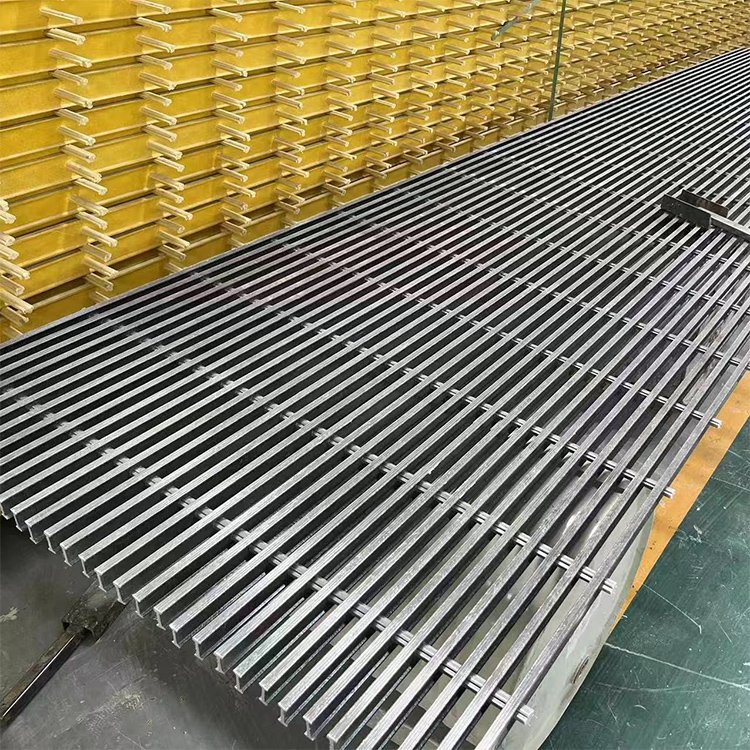
Pultrusion is a continuous manufacturing process designed to produce constant cross-section continuous composite shapes with unmatched structural integrity. Unlike extrusion, which pushes material through a die, pultrusion pulls raw materials through a heated steel forming die using specialized pulling systems.
The manufacturing process combines two essential elements:
Reinforcement: Continuous glass fiber rovings provide longitudinal tensile strength, while continuous filament mats or stitched fabrics supply multi-directional reinforcement.
Matrix: A liquid thermoset resin bath fully saturates the fibers, initiating the curing reaction as the wet reinforcement enters the precision-machined heated die.
[Fiber Creels & Mats] ➔ [Resin Impregnation Bath] ➔ [Pre-forming Guides] ➔ [Heated Curing Die] ➔ [Pulling Mechanism] ➔ [Automatic Cut-Off Saw]
Engineered Performance of FRP Pultruded Profiles
Our FRP pultruded profiles deliver an exceptional engineering balance that traditional metals cannot match:
| Performance Metric | FRP Pultruded Profile | Structural Steel (A36) | Structural Aluminum (6061-T6) |
|---|---|---|---|
| Density (g/cm³) | 1.8 – 2.0 | 7.85 | 2.70 |
| Strength-to-Weight Ratio | Extremely High | Moderate | High |
| Corrosion Resistance | Immune to rust/salts | Requires coating/galvanizing | Susceptible to galvanic corrosion |
| Electrical Conductivity | Non-conductive (Insulator) | High conductor | High conductor |
| Thermal Conductivity | Very low (Thermal break) | High | Extremely high |
Key Structural Deliverables
- High strength-to-weight ratio: Fiber volume fractions ranging between 50% and 70% yield tensile strengths that rival structural steel at roughly one-quarter of the weight.
- Built-in corrosion resistance: Total immunity to atmospheric rust, saltwater, sour gas, and aggressive industrial chemicals.
- Dimensional stability: Minimal thermal expansion and contraction ensure these fiberglass structural shapes maintain exact tolerances across wide operating temperatures.
- Radio frequency transparency: Completely non-magnetic and transparent to electromagnetic signals, making them the standard for telecommunications and electrical infrastructure.
Standard shapes and custom dies
We manufacture off-the-shelf structural elements as well as proprietary profiles built around project-specific cross-sections. Our standard fiberglass structural shapes replicate traditional steel geometries while delivering a dramatically higher strength-to-weight ratio and complete resistance to rust.
Off-the-shelf structural shapes
Standard tooling covers the structural foundations used in commercial and industrial framing:
- I-Beams and Wide-Flange (H) Beams: Primary load-bearing girders and support columns for walkways and platforms.
- Channels (C-Sections): Secondary framing, stair stringers, and equipment support rails.
- Square and Rectangular Hollow Sections (SHS/RHS): Handrails, structural framing, cage ladders, and truss networks.
- Equal and Unequal Angles: Base kick plates, bracing angles, cross-members, and corner edge protections.
- Round Tubes and Solid Rods: Handrail horizontals, electrical isolators, sucker rods, and chemical hanging bars.
- Flat Bars and Kick Plates: Floor trim, structural spacers, and perimeter containment barriers.
| Profile Geometry | Typical Size Range (mm) | Common Applications | Key Advantage |
|---|---|---|---|
| I / Wide Flange Beams | 76×38 up to 300×150 | Heavy load structural framing | Maximum bending stiffness |
| Square / Rectangular Tube | 25×25 up to 152×152 | Handrails, columns, framework | High torsional rigidity |
| Equal Angle | 25×25×3 up to 150×150×12 | Bracing, shelf frames, mounts | Clean dimensional fastening |
| Channel (C-Section) | 50×25 up to 250×70 | Equipment skids, stair stringers | Compact side mounting |
When to specify custom pultrusion dies
When standard beams and tubes require excessive machining, sub-assembly, or sealing, creating a dedicated die is often the most cost-effective solution.
We develop custom dies for:
- Integrated snap-fit systems: Enclosures, interlocking wall planks, and self-clamping cable trays.
- Multi-chamber hollow profiles: Complex structural geometries with varying wall thicknesses in a single pull.
- Specialized continuous composite shapes: Custom thermal breaks, specialized edge guards, and niche railway or automotive tracks.
Custom tooling requires an upfront steel die investment, but it cuts fabrication time, eliminates field drilling, and produces unified FRP pultruded profiles manufactured to tight dimensional tolerances straight out of the line.
Resin systems: how to match chemical and UV exposure
The resin matrix binds the glass reinforcement, transfers mechanical stress, and dictates how well your profiles survive aggressive environmental conditions. While glass fiber rovings deliver tensile capacity, the resin matrix protects against acids, alkalis, moisture, and sunlight.
Selecting the right thermoset formula ensures continuous composite shapes maintain structural integrity over decades of field service.
Primary resin types for FRP pultruded profiles
Different operational zones require different polymer backbones:
| Resin System | Corrosion Resistance | Thermal Limit | Best Suited Applications |
|---|---|---|---|
| Isophthalic Polyester | Moderate | ~65°C (150°F) | Standard industrial platforms, water treatment, cooling towers |
| Vinyl Ester Resin | Superior | ~105°C (220°F) | Chemical processing, offshore oil & gas, aggressive acid/alkali storage |
| Phenolic Resin | Moderate | ~180°C (350°F) | Tunnels, marine vessels, enclosed public transit requiring low smoke |
- Isophthalic polyester represents our standard structural workhorse. It delivers excellent mechanical strength, balanced corrosion resistance, and cost efficiency for municipal, agricultural, and light-industrial builds.
- Vinyl ester resin steps in where aggressive chemical exposure or elevated temperatures degrade basic polyesters. We recommend vinyl ester for acid splash zones, direct immersion, and harsh maritime facilities. If your facility already relies on heavy-duty floor infrastructure like pultruded FRP grating features and types, matching your structural beams with vinyl ester guarantees consistent lifespan across the entire framework.
- Phenolic resin focuses strictly on fire safety. It delivers exceptional flame retardance and emits virtually zero toxic smoke when exposed to direct flame, meeting strict commercial transit and offshore fire protocols.
Guarding against UV degradation
Outdoor sunlight triggers resin degradation, often causing “fiber blooming” if profiles are left unprotected. To prevent surface erosion and loss of structural properties under prolonged solar radiation, our fiberglass structural shapes rely on a two-tier defense:
- UV inhibitors blended into the resin: Chemical additives absorb destructive ultraviolet wavelengths throughout the core and skin.
- Synthetic surface veils: A continuous non-woven polyester veil forms a resin-rich outer layer (approx. 0.2 to 0.3 mm thick). This layer keeps fibers submerged beneath the surface, shielding the load-bearing roving pack from direct solar rays and corrosive airborne salts.
Load, deflection and span basics
When designing with continuous composite shapes, structural engineers quickly learn that deflection, rather than ultimate strength, typically governs the design. FRP pultruded profiles deliver an exceptional high strength-to-weight ratio, but their modulus of elasticity ($E$) is lower than that of mild steel. That means keeping spans within acceptable serviceability limits requires careful section selection.
Key Factors Governing FRP Beam Design
- Flexural Rigidity ($EI$): Glass fiber rovings aligned along the profile length give excellent longitudinal tensile strength. However, overall stiffness depends heavily on the geometry of the profile (moment of inertia, $I$) and the resin-matrix modulus ($E$).
- Shear Deflection: Unlike structural steel, where shear deflection is often negligible, fiberglass structural shapes experience measurable shear deformation over shorter spans. Both bending and shear deformation must be factored into total deflection calculations.
- Creep and Long-Term Loading: For permanent dead loads, design allowable stresses should include safety factors to mitigate long-term tensile creep, particularly in elevated-temperature environments.
Typical Span-to-Deflection Limits
| Application Type | Standard Deflection Limit | Primary Design Consideration |
|---|---|---|
| Pedestrian Walkways | L/240 to L/300 | Dynamic vibration, user comfort |
| Equipment Support Beams | L/360 to L/500 | Equipment alignment, precision fit |
| Architectural Framing | L/180 to L/240 | Visual aesthetics, cladding limits |
Practical Span Guidelines
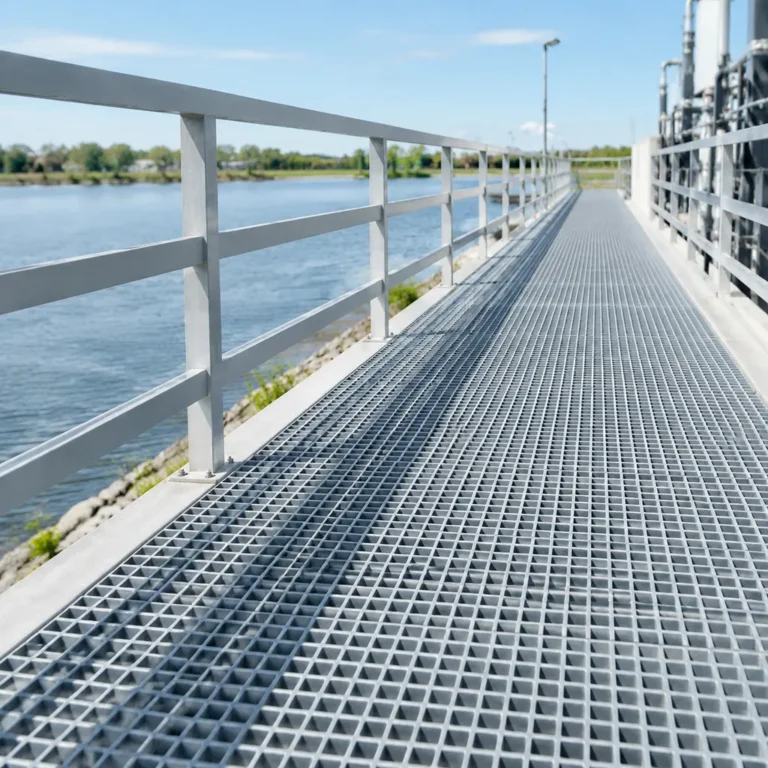
When sizing beams across platforms, conveyor supports, or walkways, selecting a deeper section (such as an I-beam or wide flange) dramatically boosts the moment of inertia without adding prohibitive weight. For complete industrial floor structures, pairing these beams with molded or pultruded FRP grating creates a rigid, corrosion-resistant platform that easily meets industrial deflection standards.
For project-specific load charts, check our engineered products to match your exact span, concentrated load, and uniform load requirements.
Fire, UV and surface-veil options
When we engineer FRP pultruded profiles for harsh environments, base resin alone is only half the equation. Extreme sunlight, open flame risks, and abrasive weather require dedicated additive packages and exterior barriers to guarantee decades of structural integrity.
Fire Retardancy Systems
We modify our composite profiles to meet strict international fire safety ratings, such as ASTM E84 Class 1 (flame spread index of 25 or less) and UL 94 V-0 standards.
- Halogenated Additives: Blended into polyester and vinyl ester systems to instantly quench flame propagation.
- Alumina Trihydrate (ATH): A non-toxic filler that releases chemically bound water when exposed to heat, actively suppressing smoke and cooling the structural core.
- Phenolic Matrix: The ultimate fire-safe choice, delivering virtually zero smoke toxicity and maximum structural retention during high-temperature exposure.
Preventing Fiber Bloom with Surface Veils
Direct outdoor weathering breaks down unshielded resin matrices over time, leading to “fiber bloom”—a condition where structural glass fiber rovings become exposed on the surface. We prevent this by pulling a continuous synthetic surface veil onto the exterior during the pultrusion cycle:
- Polyester Surface Veils: Form a resin-rich outer layer (approximately 0.2 mm to 0.3 mm thick) that seals in the reinforcement fibers and protects against chemical attack and moisture ingress.
- UV Inhibitors: Mixed directly throughout the resin matrix to absorb ultraviolet radiation before it can degrade the polymer chain.
- Topcoat Polyurethane Coatings: Applied to continuous composite shapes installed in high-elevation or high-UV tropical installations for dual-layer, zero-maintenance exterior durability.
Protection Package Selector
| Protection Tier | Formulation Components | Target Application |
|---|---|---|
| Standard Industrial | Isophthalic polyester + Standard UV inhibitors | Interior walkways, dry chemical processing plants |
| Flame Retardant (FR) | Halogenated resin + ATH smoke suppressants | Offshore rigs, enclosed tunnel infrastructure |
| Severe Weather & Marine | Vinyl ester resin + Synthetic veil + UV inhibitors | Coastal marine framing, water treatment facilities |
| Extreme Outdoor UV | Vinyl ester + Heavy veil + Aliphatic polyurethane coat | Desert solar tracking frames, equatorial platforms |
Lifecycle cost vs steel and aluminium
When comparing materials for structural projects, looking only at the initial purchase price is a common mistake. Carbon steel and standard aluminium often seem cheaper upfront, but their long-term upkeep quickly erodes those savings. Factoring in transport, heavy installation equipment, coating maintenance, and replacement downtime shows why our FRP pultruded profiles consistently deliver a significantly lower total cost of ownership (TCO).
The true cost breakdown: FRP vs. traditional metals
Fiberglass structural shapes bypass the chronic failure points of metal structures, particularly in aggressive environments:
- Freight and Installation: Thanks to a high strength-to-weight ratio, FRP weighs roughly 75% less than steel and 30% less than aluminium. Crews can handle, cut, and secure profiles on-site using standard carpentry tools, eliminating the need for heavy rental cranes, hot-work permits, and expensive certified welders.
- Maintenance and Recoating: Steel requires continuous rust removal, sandblasting, and epoxy recoating every few years to prevent structural decay. FRP profiles feature built-in corrosion resistance throughout their composite matrix, requiring zero repainting and virtually no routine maintenance.
- Asset Longevity: In chemical processing zones, marine settings, and harsh industrial facilities, steel often degrades within 5 to 10 years. FRP profiles comfortably deliver a 25- to 50-year service life without loss of structural integrity.
Direct Lifecycle Comparison
| Cost & Performance Factor | Structural Carbon Steel | Marine-Grade Aluminium | FRP Pultruded Profiles |
|---|---|---|---|
| Initial Material Cost | Low | High | Moderate |
| Handling & Erection | High (Heavy cranes, field welding) | Moderate (Specialized welding) | Low (Man-portable, standard mechanical fasteners) |
| Corrosion Maintenance | Severe (Frequent scraping and repainting) | Moderate (Pitting in coastal/acidic air) | None (Inherent chemical resistance) |
| Electrical / Thermal Insulation | Conductive (Requires grounding/insulation) | Conductive | Non-conductive (Built-in worker safety) |
| Typical Lifespan (Corrosive Zones) | 5 – 12 Years | 10 – 18 Years | 30+ Years |
Evaluating a 20-year structural lifecycle proves that choosing FRP profiles over coated steel or aluminium cuts overall capital and operational expenditure by 30% to 50%, making them the definitive choice for modern, long-term engineering solutions.
Ordering: cut-to-length and custom die enquiries
Getting the right fiberglass structural shapes onto your job site requires clear specifications upfront. Whether you need standard structural channels pre-cut to fit a specific framework or completely proprietary profiles engineered from the ground up, we streamline the supply process to reduce field labor and eliminate material waste.
Cut-to-length services and pre-fabrication
Job-site cutting of composite shapes adds unnecessary labor costs and increases the risk of rough, unsealed edges. We provide precision factory cutting for all standard shapes—including I-beams, wide flanges, angles, square tubes, and channels.
- Precision tolerances: Standard cutting tolerances held to ±1.5 mm (±1/16 inch).
- Secondary processing: Automated CNC drilling, slotting, chamfering, and miter cutting directly from your shop drawings.
- Turnkey delivery: Packaged and tagged by assembly sequence via our dedicated custom FRP fabrication team to speed up on-site erection.
- Edge sealing: Factory-applied polyurethane or resin edge sealers on cut ends to maintain long-term corrosion resistance.
Custom die development
When off-the-shelf geometries do not meet your exact structural or spatial constraints, developing a custom pultrusion die is a straightforward path. Pultrusion tooling involves precision-machined, chrome-plated heated steel dies engineered to pull glass fiber rovings and continuous strand mats with uniform resin saturation.
| Project Stage | Engineering Deliverables | Typical Lead Time |
|---|---|---|
| 1. Design Review | CAD optimization, fiber architecture selection, and wall thickness analysis | 3–5 Business Days |
| 2. Tooling Fabrication | High-grade tool steel machining, hardening, and chrome plating | 3–4 Weeks |
| 3. Sample Run & Testing | First-article profile pulling, mechanical lab testing, and dimensional inspection | 1–2 Weeks |
| 4. Mass Production | Continuous production runs with chosen resin systems | Based on order volume |
Essential RFQ checklist
To get a fast, binding quote on cut-to-length standard profiles or new custom dies, ensure your inquiry includes:
- Profile geometry: Standard shape dimensions (e.g., C-channel 150x50x6 mm) or a detailed 2D/3D CAD drawing (DWG, DXF, or STEP format).
- Resin matrix: Isophthalic polyester for general outdoor/corrosive use, vinyl ester resin for harsh chemical plant exposure, or phenolic resin for low-smoke, high-fire environments.
- Reinforcement needs: Specific longitudinal roving densities or transverse stitched mat requirements.
- Length and quantity: Exact cut lengths, overall linear footage or meters, and recurring volume estimates.
- Environmental specs: UV inhibitors, synthetic surface veil requirements, flame-retardant classifications (such as ASTM E84 Class 1), or NSF-61 potable water certifications.